
Palm olein versus soybean oil or cocoa butter,
does it really help with Whether liver fat increases versus soybean oil or cocoa butter?
research showsThe grade is D with 28 points. In a 16-week isocaloric feeding trial started by 83 healthy adults and completed by 64, the primary liver-fat outcome measured by magnetic resonance spectroscopy did not differ among palm olein, soybean oil, and cocoa butter, P=0.18. The trial did not support the claim that palm olein increases liver fat independently of excess energy under these conditions.
ads claimPalm olein's saturated-fat fraction is measurable, but composition alone cannot establish increased liver fat under isocaloric conditions. Verdict 1217 is C with 53 points for black-seed oil in patients with existing fatty liver; this verdict asks whether palm olein creates more liver fat in healthy adults.
Useful facts when choosing a product
- Measured fatty acids in the trial IV64 palm olein were 36.3% saturated, 53.8% monounsaturated, and 9.95% polyunsaturated, including 33.8% palmitic, 51.8% oleic, and 9.95% linoleic acid; alpha-linolenic acid was not detected in the table.
- An omega-6:omega-3 ratio cannot be expressed as a finite value for the trial oil because omega-3 was not detected. This is a trial-product measurement, not a universal value for every palm-oil product.
- The article did not measure smoke point for the trial product. Refined palm-olein smoke point varies with quality and free-fatty-acid content and is not a liver-fat outcome.
- Soybean oil lowered LDL by 0.37 mmol/L relative to palm olein at equal energy, but that lipid result is separate from the liver-fat claim.
Chamgap Semantic Classification Code
Candidate index · review held
D.palm-olein-diet-supplying-20-percent-of-total-energy.dietary.whether-liver-fat-increases.increase.UNKDietary patterns and eating practices > palm-olein diet supplying 20% of total energy > Dietary regimen > Whether liver fat increases > Increase claim > Unknown
An automated migration candidate, not an issued permanent code; exact claim scope remains under review. This machine-generated migration candidate helps retrieval but is not a permanent assignment. The original verdict ID and URL remain authoritative.
What the research actually shows
After a two-week run-in, Stonehouse and colleagues randomized 83 participants to palm olein, soybean oil, or cocoa butter diets, and 64 completed 16 weeks. Test fat supplied 20% of energy and total fat 33%, and proton magnetic resonance spectroscopy measured liver fat. Attrition was 23%, with food dislike and personal or health reasons among withdrawals. The Malaysian Palm Oil Board is not a manufacturer: it is a government body established under Malaysia's Palm Oil Board Act 1998, Act 582. Its statutory functions also include promotion and development of the palm-oil industry, so it is neither manufacturer-only nor fully independent and was treated as a mixed interest. It funded the study and supplied palm olein and soybean oil; investigators stated that it did not influence conduct, analysis, reporting, or interpretation.
Why this is classified as D (28)
The registered primary liver-fat outcome was null, but evidence came from one 64-completer trial supported by an industry-promoting government body, with 23% attrition and no verified precise interval, giving D with 28 points.
Counterpoint. D does not mean palm olein is unrelated to fatty liver in every setting. Excess energy and metabolically impaired populations require separate evidence.
Rejudgment record. Cross-check applied — Checked the original article for the registered primary outcome, randomized and completer counts, attrition, isocaloric comparators, measured trial-oil fatty acids, and the Act 582 government body's statutory palm-oil promotion and development role
| Endpoint | S | Surrogate marker - laboratory or imaging measures |
| Replication | R1 | Single confirmatory trial |
| Independence | I1 | Mixed funding sources |
| Effect size | E0 | Null |
| Precision | CX | No pooled confidence interval could be confirmed |
Stored derived and displayed grades match; this is not a current recalculation or validity check (D).
Sub-claim grades by effect
This ingredient is marketed for several effects. A single overall grade blends strong and weak claims together, so each effect is graded separately here. The overall grade reflects the strongest disconfirming or core claim.
| Effect (sub-claim) | Grade | Basis |
|---|---|---|
| Isocaloric palm olein increases liver fat versus soybean oil or cocoa butter | D | The 16-week primary liver-fat outcome did not differ among diets. |
Cross-check — AI research and Codex final gate
Evidence Table
| Study | Design | Sample | Funding | Endpoint | Result | Weight |
|---|---|---|---|---|---|---|
| Stonehouse et al. 2021 | Sixteen-week randomized parallel isocaloric controlled-feeding trial | 83 randomized and 64 completers analyzed | Funded by the Malaysian Palm Oil Board, a government body established under Act 582 with statutory palm-oil industry promotion and development functions, which also supplied test oils | Liver-fat concentration by proton magnetic resonance spectroscopy, prespecified primary outcome | No difference among diets, P=0.18; an adjusted between-group CI was not verified in accessible material | Direct null primary-outcome evidence |
Receipt — 1 References
All 1 cited sources were verified for existence at the original page (as of 2026-08-03).
Final verification and publication gate: Codex · Evidence date: 2026-08-03 · Corrections: none
Cite this verdict
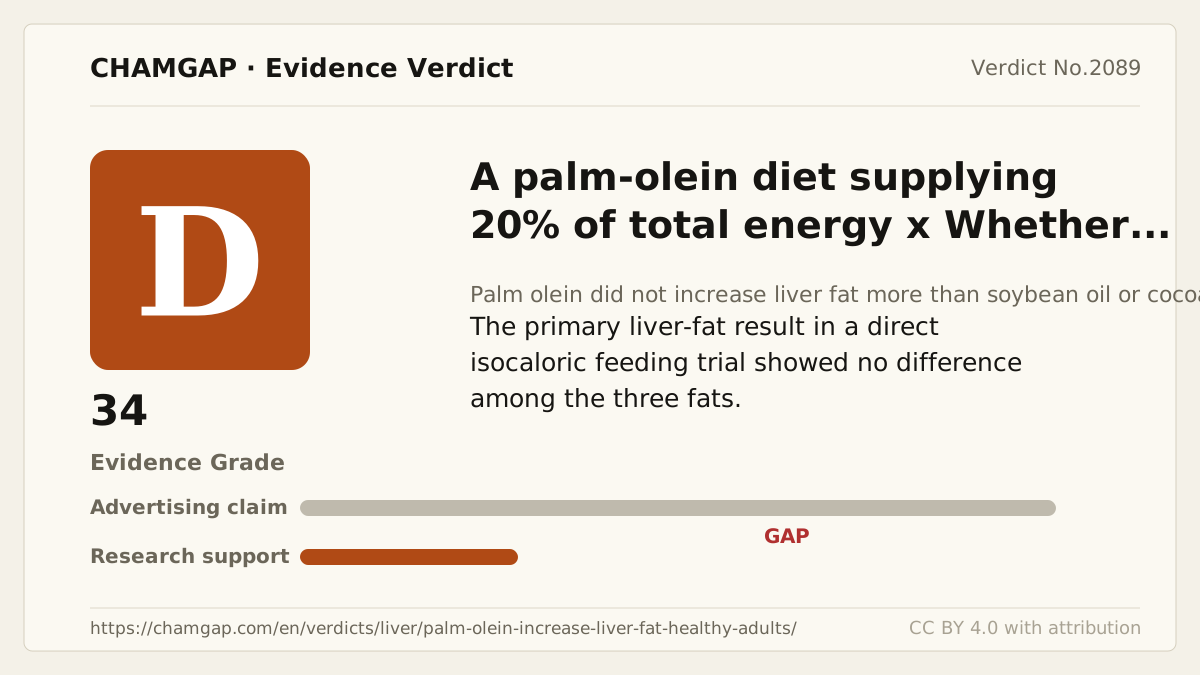
[Chamgap] Palm olein versus soybean oil or cocoa butter x whether liver fat increases — Evidence Grade D·28. 1 cited sources checked. Source: https://chamgap.com/en/verdicts/liver/palm-olein-increase-liver-fat-healthy-adults/ · CC BY 4.0CC BY 4.0 — free to use with attribution; do not distort grades, numbers, or verdict meaning.
What this document does and does not do
Chamgap is an information source. It reports what research has and has not confirmed; it does not tell readers what to take or buy. That decision belongs to readers and, when needed, medical or legal professionals. This verdict reflects literature available up to the search date and may change as new research appears. Nothing here is medical advice.