
Naltrexone,
does it really help with Relief of refractory pruritus in cholestatic liver disease?
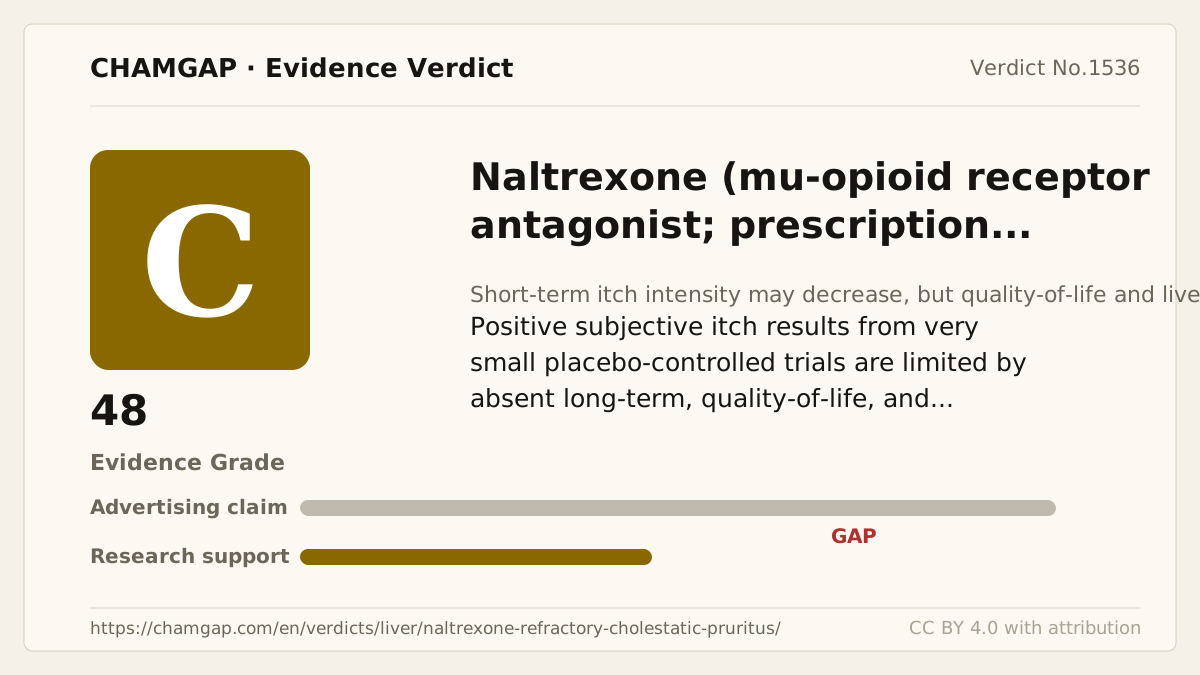
research showsNaltrexone is rated C because small placebo-controlled trials found reduced itch intensity in refractory cholestatic pruritus. Double-blind trials involving 16 patients in 1997 and 20 patients in 2002 showed lower subjective itch scores, but samples were extremely small, follow-up was short, and effects on sleep, quality of life, and liver-disease progression remain unestablished. Withdrawal-like reactions place it later in the treatment sequence with gradual dose escalation.
ads claimA signal for itch relief can be expanded into claims of correcting cholestasis, restoring liver function, or slowing liver-disease progression. Trials primarily measured short-term subjective itch intensity.
Useful facts when choosing a product
- Naltrexone antagonizes opioid receptors, including the mu receptor; its use for cholestatic pruritus is a later-line use separate from its licensed indications.
- Cholestatic-pruritus studies commonly used 50 mg daily, while guidance describes starting lower and titrating to reduce withdrawal-like reactions.
- Nausea, abdominal symptoms, headache, dizziness, withdrawal-like reactions, and liver-enzyme elevations can occur. Current opioid use or dependence creates risks of precipitated withdrawal and blocked analgesia.
Chamgap Semantic Classification Code
Candidate index · review held
M.naltrexone.UNK.refractory-pruritus-in-cholestatic-liver-disease.relieve.placeboMedicinal interventions > Naltrexone > Unknown > refractory pruritus in cholestatic liver disease > Symptom-relief claim > Placebo
An automated migration candidate, not an issued permanent code; exact claim scope remains under review. This machine-generated migration candidate helps retrieval but is not a permanent assignment. The original verdict ID and URL remain authoritative.
What the research actually shows
Wolfhagen and colleagues studied 16 patients with itching refractory to regular therapy under double-blind placebo control and reported lower daytime and nighttime itch scores. Terg and colleagues crossed 20 patients between naltrexone 50 mg and placebo for two weeks each; visual-analogue changes favored naltrexone and 45% had a reduction exceeding 50% from baseline. A 2006 sequential controlled study of 34 patients also favored naltrexone, but 47% reported adverse effects and 32% had withdrawal-like symptoms. EASL described low-dose initiation and third-line use.
Why this is classified as C (48)
Placebo-controlled trials of 16 and 20 patients found significant short-term reductions in subjective itch, but sample size and duration were extremely limited and quality-of-life and liver-progression evidence is absent, giving C with 48 points.
Counterpoint. Reduced itch intensity is distinct from improvement in cholestasis or liver-disease progression, for which clinical evidence was not identified.
Rejudgment record. New verdict — Accepted short-term subjective itch reduction in small randomized placebo-controlled trials while applying the rule ① ceiling for extremely small samples, short follow-up, and absent quality-of-life or disease-progression evidence
Sub-claim grades by effect
This ingredient is marketed for several effects. A single overall grade blends strong and weak claims together, so each effect is graded separately here. The overall grade reflects the strongest disconfirming or core claim.
| Effect (sub-claim) | Grade | Basis |
|---|---|---|
| Reduction in itch intensity | C | Very small placebo-controlled trials showed short-term reductions in subjective visual-analogue scores. |
| Improvement in sleep disruption and quality of life | D | Nighttime itch was measured, but validated quality-of-life and sleep outcomes are inadequate. |
| Improvement in cholestasis or liver-disease progression | D | No clinical endpoint establishing disease modification was identified. |
Cross-check — AI research and Codex final gate
Evidence Table
| Study | Design | Sample | Funding | Endpoint | Result | Weight |
|---|---|---|---|---|---|---|
| Wolfhagen FHJ, Sternieri E, Hop WCJ, Vitale G, Bertolotti M, and van Buuren HR. 1997 | Randomized double-blind placebo-controlled trial | 16 patients with refractory cholestatic pruritus | Inadequately reported | Subjective daytime and nighttime itch scores | Naltrexone significantly reduced itch scores versus placebo. | Direct randomized evidence with an extremely small sample |
| Terg R, Coronel E, Sordá J, Muñoz AE, and Findor J. 2002 | Randomized double-blind placebo-controlled crossover trial | 20 patients with cholestatic pruritus | Inadequately reported | Zero-to-ten itch visual-analogue scale | The VAS change exceeded placebo; 9 patients (45%) improved by more than 50% from baseline (P<0.0003). | Key direct randomized evidence |
Receipt — 3 References
All 3 cited sources were verified for existence at the original page (as of 2026-07-23).
Final verification and publication gate: Codex · Evidence date: 2026-07-23 · Corrections: none
Cite this verdict
[Chamgap] Naltrexone x relief of refractory pruritus in cholestatic liver disease — Evidence Grade C·48. 3 cited sources checked. Source: https://chamgap.com/en/verdicts/liver/naltrexone-refractory-cholestatic-pruritus/ · CC BY 4.0CC BY 4.0 — free to use with attribution; do not distort grades, numbers, or verdict meaning.
What this document does and does not do
Chamgap is an information source. It reports what research has and has not confirmed; it does not tell readers what to take or buy. That decision belongs to readers and, when needed, medical or legal professionals. This verdict reflects literature available up to the search date and may change as new research appears. Nothing here is medical advice.