
Live multistrain probiotics,
does it really help with Improved liver fat, ALT, AST, and liver stiffness in adults with MASLD or NAFLD?
research showsLive multistrain probiotics are rated C for MASLD or NAFLD. A 41-trial synthesis was favorable for ALT, AST, and some steatosis or stiffness measures, but it pooled probiotics, synbiotics, and prebiotics and is not direct evidence for multistrain live probiotics. A meta-analysis of 10 synbiotic trials involving 634 participants was also positive, whereas the direct 58-person Symbiter trial improved fatty liver index and AST or GGT but not liver stiffness. Product heterogeneity and the absence of clinical-event evidence support C rather than D, with 48 points. Bloating and rare bloodstream infection in high-risk patients remain separate safety issues.
ads claimMarketing expands gut-health language and high organism counts into liver detoxification, fatty-liver treatment, and reversal of fibrosis. The evidence instead concerns average short-term changes in enzymes and noninvasive imaging with particular combinations; equivalence across products and prevention of clinical events have not been shown.
Useful facts when choosing a product
- Probiotic effects can depend on the strains, strain combination, colony-forming-unit dose, survival during storage, and inclusion of a prebiotic, so results from one product cannot be transferred automatically to another.
- Published trials used varied live multistrain products or synbiotics for weeks to months and provide no long-term evidence that they reduce cirrhosis, liver cancer, transplantation, or death.
- Weight reduction, exercise, alcohol management, treatment of diabetes and dyslipidemia, and appropriate medical care remain central to MASLD management; probiotics do not replace them.
- Bloating and gas are the more usual concerns in otherwise healthy adults, while rare probiotic-organism bloodstream infections have been reported in people with critical illness, immunocompromise, or central venous access and warrant clinician review.
Chamgap Semantic Classification Code
Candidate index · review held
S.live-multistrain-probiotics-containing-lactobacillus-and-bifidobacterium-species.UNK.liver-fat-alt-ast-and-liver-stiffness-with-masld-or-nafld.improve.placeboSupplements and nutraceuticals > Live multistrain probiotics containing Lactobacillus and Bifidobacterium species > Unknown > liver fat, ALT, AST, and liver stiffness with MASLD or NAFLD > Improvement claim > Placebo
An automated migration candidate, not an issued permanent code; exact claim scope remains under review. This machine-generated migration candidate helps retrieval but is not a permanent assignment. The original verdict ID and URL remain authoritative.
What the research actually shows
Rong and colleagues pooled 41 randomized trials through August 2022 and reported that probiotics, prebiotics, and synbiotics improved ultrasound steatosis, noninvasive fibrosis or stiffness measures, and ALT, AST, and GGT, while explicitly identifying heterogeneity in strains, doses, and formulations as a limitation. Cai and colleagues analyzed 10 synbiotic trials involving 634 participants and found favorable changes in ALT, AST, GGT, controlled attenuation parameter, and liver stiffness, but called for confirmation. The single-center double-blind trial by Kobyliak and colleagues assigned 58 people with type 2 diabetes and NAFLD to a 14-strain live Symbiter product or placebo for eight weeks. Fatty liver index and AST or GGT improved, whereas liver stiffness did not differ significantly. These studies did not test cirrhosis, liver failure, liver cancer, transplantation, or death.
Why this is classified as C (48)
A 41-trial mixed-intervention meta-analysis and a synthesis of 10 synbiotic trials were positive for ALT, AST, and some steatosis surrogates, supporting C rather than D. They are not direct pooled evidence for multistrain live probiotics, direct liver stiffness was null in the 58-person Symbiter trial, and patient-centered clinical events were not studied. These limitations yield C with 48 points. Product viability, composition, and rare infection in high-risk patients are separate issues.
Counterpoint. When liver enzymes or noninvasive fat and stiffness measures are elevated, a product close to a studied strain and dose may be considered as an adjunct with follow-up of the same measures. Improvement in a surrogate should not justify stopping liver care or be treated as proof of better long-term outcomes.
Rejudgment record. Cross-check incorporated — Retained C because ALT, AST, and some steatosis surrogates are positive, but lowered the score because the 41-trial synthesis mixed probiotics, synbiotics, and prebiotics and therefore was not direct evidence for a multistrain live-probiotic product, liver stiffness was nonsignificant in the direct 58-person Symbiter trial, and no cirrhosis, liver cancer, transplantation, or mortality outcome was tested
Sub-claim grades by effect
This ingredient is marketed for several effects. A single overall grade blends strong and weak claims together, so each effect is graded separately here. The overall grade reflects the strongest disconfirming or core claim.
| Effect (sub-claim) | Grade | Basis |
|---|---|---|
| Reduction in ALT and AST | C | Several randomized-trial meta-analyses are positive, but strain and formulation heterogeneity and the surrogate nature of the outcome are substantial. |
| Improvement in liver fat or imaging steatosis | C | Ultrasound steatosis, controlled attenuation parameter, and fatty liver index provide positive signals, while MRI-PDFF and histology evidence is limited. |
| Improvement in liver stiffness | D | The direct 58-person multistrain probiotic trial was null, while favorable pooled estimates rely mainly on indirect data that include synbiotics, leaving the claim unconfirmed. |
Cross-check — AI research and Codex final gate
Evidence Table
| Study | Design | Sample | Funding | Endpoint | Result | Weight |
|---|---|---|---|---|---|---|
| Rong L et al. 2023 | Systematic review and meta-analysis of randomized trials | 41 randomized trials: 18 probiotic, 17 synbiotic, and six prebiotic trials | Nanyang Technological University Start-up Grant and Wang Lee Wah Memorial Fund | Ultrasound steatosis, noninvasive fibrosis or liver stiffness, ALT, AST, and GGT | Steatosis, liver stiffness, and enzymes favored intervention, but heterogeneity in strains, doses, and formulations weakened the inference. | Key positive synthesis of surrogate outcomes |
| Kobyliak N et al. 2018 | Single-center randomized double-blind placebo-controlled trial | 58 adults with type 2 diabetes and NAFLD; eight weeks | Funding source not reported in the PubMed abstract; authors reported no conflicts | Fatty liver index and shear-wave-elastography liver stiffness; AST, GGT, and other measures | The 14-strain live Symbiter product improved fatty liver index and AST or GGT, but the decrease in liver stiffness was not significant. | Direct multistrain trial with discordant stiffness result |
| Cai J et al. 2023 | Systematic review and meta-analysis of synbiotic randomized trials | 10 randomized trials involving 634 adults with NAFLD | Funding source not reported in the PubMed abstract | ALT, AST, GGT, liver stiffness, and controlled attenuation parameter | Reported favorable mean differences of -8.80 U/L for ALT, -9.48 U/L for AST, -1.09 kPa for liver stiffness, and -37.04 for controlled attenuation parameter. | Positive synthesis specific to synbiotics |
Receipt — 4 References
All 4 cited sources were verified for existence at the original page (as of 2026-07-21).
Final verification and publication gate: Codex · Evidence date: 2026-07-21 · Corrections: none
Cite this verdict
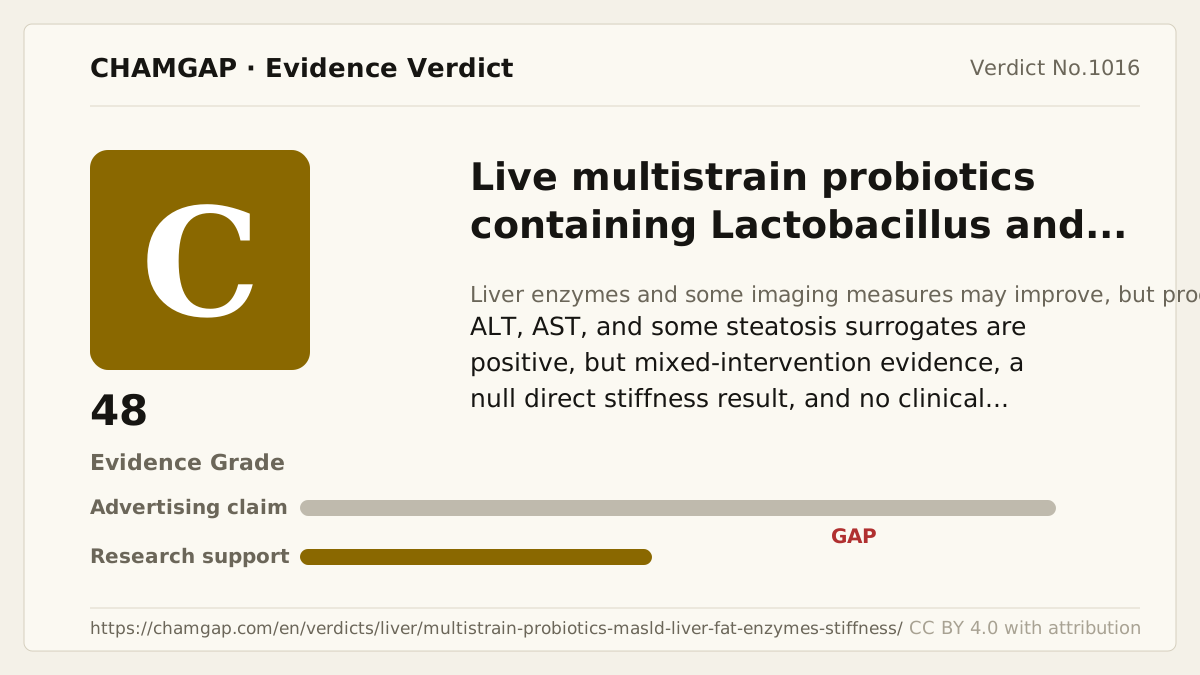
[Chamgap] Live multistrain probiotics x improved liver fat, enzymes, and stiffness in MASLD or NAFLD — Evidence Grade C·48. 4 cited sources checked. Source: https://chamgap.com/en/verdicts/liver/multistrain-probiotics-masld-liver-fat-enzymes-stiffness/ · CC BY 4.0CC BY 4.0 — free to use with attribution; do not distort grades, numbers, or verdict meaning.
What this document does and does not do
Chamgap is an information source. It reports what research has and has not confirmed; it does not tell readers what to take or buy. That decision belongs to readers and, when needed, medical or legal professionals. This verdict reflects literature available up to the search date and may change as new research appears. Nothing here is medical advice.