
Metformin,
does it really help with Prevention of hepatocellular carcinoma in people with type 2 diabetes and chronic liver disease?
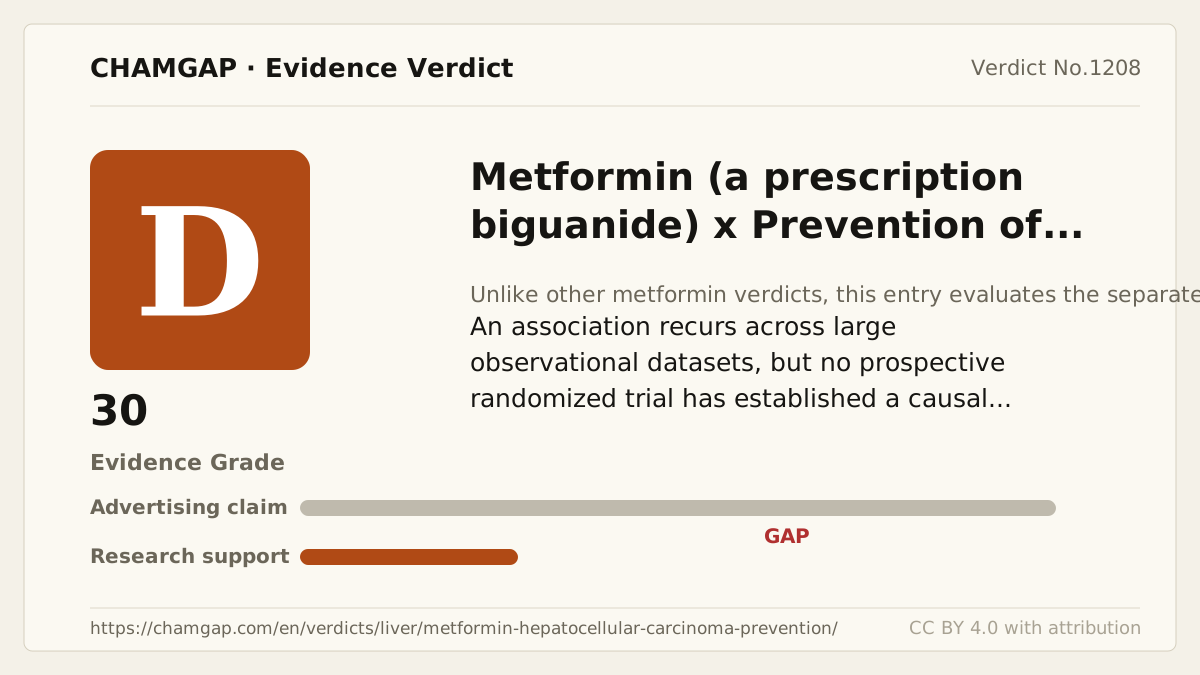
research showsIt has not been established as a preventive drug. Observational meta-analyses found less liver cancer among metformin users, but heterogeneity and confounding by prescribing and disease severity were substantial, while post hoc analyses of randomized trials found no significant reduction.
ads claimSaying that a diabetes drug cuts liver cancer in half misrepresents a relative association from observational studies as a proven drug-prevention effect.
Useful facts when choosing a product
- Metformin is a prescription glucose-lowering treatment for type 2 diabetes and is not approved to prevent hepatocellular carcinoma.
- Comparators in liver-cancer observational studies varied among users of sulfonylureas, insulin, or no metformin, leaving confounding by prescribing and disease severity.
- Liver-cancer surveillance required for chronic liver disease remains necessary and is not replaced by metformin use.
- Clinicians must assess risk factors for lactic acidosis, including impaired renal function, hypoxic states, heavy alcohol use, and selected severe liver conditions.
Chamgap Semantic Classification Code
Candidate index · review held
M.metformin.UNK.hepatocellular-carcinoma-with-type-2-diabetes-and-chronic-liver-disease.prevent.UNKMedicinal interventions > Metformin > Unknown > hepatocellular carcinoma with type 2 diabetes and chronic liver disease > Occurrence-prevention claim > Unknown
An automated migration candidate, not an issued permanent code; exact claim scope remains under review. This machine-generated migration candidate helps retrieval but is not a permanent assignment. The original verdict ID and URL remain authoritative.
What the research actually shows
A 2012 meta-analysis of five observational studies and about 105,000 people reported an odds ratio of 0.38 for liver cancer, with I² of 78%. A 2017 meta-analysis reported an observational odds ratio of 0.52 with I² of 83.7%, while pooled post hoc analyses of two randomized trials were null at OR 0.84 (95% CI 0.10 to 6.83). An association in a cohort of patients with cirrhosis and diabetes also cannot establish causation without randomization.
Why this is classified as D (30)
The reduced association in large observational datasets is useful for hypothesis generation, but there is no direct prevention RCT and the available randomized post hoc evidence is null. With no credible positive intervention trial for the core claim, the appropriate grade is D rather than C.
Counterpoint. The verdict could change if an adequately long randomized trial with prespecified hepatocellular carcinoma outcomes showed a reduction. Current evidence cannot separate any cancer effect from benefits of diabetes control or prescribing differences.
Rejudgment record. Cross-check applied — The grade is D because the large observational association has substantial heterogeneity and residual confounding, randomized post hoc analyses are null, and no dedicated hepatocellular-carcinoma prevention RCT exists.
Sub-claim grades by effect
This ingredient is marketed for several effects. A single overall grade blends strong and weak claims together, so each effect is graded separately here. The overall grade reflects the strongest disconfirming or core claim.
| Effect (sub-claim) | Grade | Basis |
|---|---|---|
| Prevention of hepatocellular carcinoma in people with type 2 diabetes and chronic liver disease | D | The reduced association remains observational, while randomized post hoc analyses were not significant. |
| Prevention of hepatocellular carcinoma in people with type 2 diabetes and cirrhosis | D | A positive association appeared in a high-risk cohort, but prescribing selection and residual confounding cannot be excluded. |
| Reduction in chronic liver-disease progression | D | No randomized intervention trial directly confirms this separate claim, and observational liver-cancer data cannot substitute for it. |
Cross-check — AI research and Codex final gate
Evidence Table
| Study | Design | Sample | Funding | Endpoint | Result | Weight |
|---|---|---|---|---|---|---|
| Zhang et al., meta-analysis of liver-cancer prevention in type 2 diabetes (2012) | Random-effects meta-analysis of five observational studies | Approximately 105,495 participants | No specific industry funding reported in the article | Incident liver cancer and hepatocellular carcinoma | Metformin use was associated with liver-cancer OR 0.38 (95% CI 0.24 to 0.59; I²=78%) and hepatocellular-carcinoma OR 0.30 (95% CI 0.17 to 0.52; I²=67%). | Large sample, but entirely observational and highly heterogeneous, so it cannot establish causality. |
| Ma et al., meta-analysis of metformin and liver-cancer risk in diabetes (2017) | Systematic review and meta-analysis including observational studies and post hoc randomized-trial analyses | Nineteen observational analyses with 550,882 participants; two post hoc randomized-trial analyses | Public support including the National Natural Science Foundation of China | Incident liver cancer in patients with diabetes | Observational evidence gave OR 0.52 (95% CI 0.40 to 0.68; I²=83.7%), but pooled post hoc randomized-trial analyses were not significant at OR 0.84 (95% CI 0.10 to 6.83; p=0.871). | Directly demonstrates the mismatch between the observational signal and randomized evidence and is central to the D grade. |
| Tangjarusritaratorn et al., type 2 diabetes and cirrhosis cohort (2021) | Retrospective cohort study | 1,061 participants (719 metformin users and 342 nonusers) | The article reported no research funding | Hepatocellular-carcinoma incidence and overall survival | Hepatocellular carcinoma occurred in 17.4% versus 37.4%, with adjusted HR 0.48 (95% CI 0.36–0.62), while the multivariable overall-survival HR of 1.07 was not significant. | Directly studies a high-risk cirrhosis population, but nonrandomized prescribing and residual confounding cannot be excluded. |
| Post hoc malignancy analysis of the ADOPT and RECORD randomized trials (2010) | Post hoc analysis of malignancy adverse events in randomized glucose-lowering trials | Participant data from ADOPT and RECORD | Trials sponsored by GlaxoSmithKline | Overall and site-specific malignancy adverse events | The trials did not prespecify liver-cancer prevention, and the subsequently pooled two randomized post hoc analyses found no significant liver-cancer difference. | Liver-cancer events were rare and post hoc, but less-confounded randomized evidence did not confirm protection. |
Receipt — 4 References
All 4 cited sources were verified for existence at the original page (as of 2026-07-23).
Final verification and publication gate: Codex · Evidence date: 2026-07-23 · Corrections: none
Cite this verdict
[Chamgap] Does metformin prevent liver cancer in people with diabetes and chronic liver disease? — Evidence Grade D·30. 4 cited sources checked. Source: https://chamgap.com/en/verdicts/liver/metformin-hepatocellular-carcinoma-prevention/ · CC BY 4.0CC BY 4.0 — free to use with attribution; do not distort grades, numbers, or verdict meaning.
What this document does and does not do
Chamgap is an information source. It reports what research has and has not confirmed; it does not tell readers what to take or buy. That decision belongs to readers and, when needed, medical or legal professionals. This verdict reflects literature available up to the search date and may change as new research appears. Nothing here is medical advice.