
A household food-provision diet targeting less than 3% of energy from free sugars,
does it really help with Reduced MRI-measured liver fat over eight weeks in adolescent boys with NAFLD?
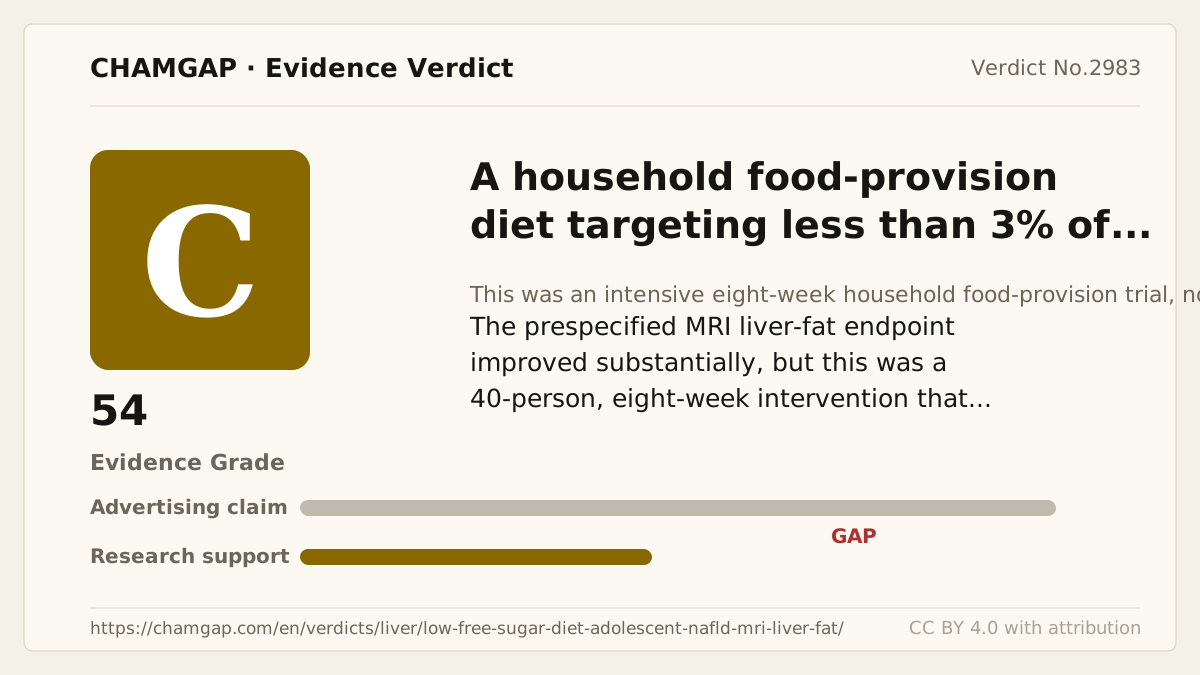
research showsGrade C. In an eight-week randomized trial of 40 boys aged 11 to 16 with biopsy-confirmed NAFLD, MRI-PDFF liver fat was 6.23 percentage points lower with the low-free-sugar diet than usual diet after adjustment, 95% CI -9.45 to -3.02, P<.001. This was an intensive household food-provision intervention and a small, short surrogate-endpoint trial, not proof of long-term liver outcomes.
ads claimTurning this into 'just stop sugar and fatty liver is cured' erases the intensity of menu design, household food provision, and twice-weekly contact.
Useful facts when choosing a product
- This was a household food-provision diet, not a supplement.
- The target was less than 3% of energy from free sugars.
- Participants were adolescent boys with biopsy-confirmed NAFLD.
Chamgap Semantic Classification Code
Permanent code issued
D.low-free-sugar-diet.dietary.liver-fat-mri.reduce.usual-dietDietary patterns and eating practices > A household food-provision diet targeting less than 3% of energy from free sugars > Dietary delivery > Reduced MRI-measured liver fat over eight weeks in adolescent boys with NAFLD > Reduction claim > Usual diet
Codex retrospectively verified the principal intervention, delivery, population, endpoint, and comparator from the existing reviewed verdict and issued a permanent semantic code. Secondary outcomes on the page are not transferred as separate claims. The code identifies the intervention and claim; it never contains the evidence grade, score, or safety result.
Exact Claim Classification
These independent facets prevent evidence from different forms, routes, populations, effects, and comparators from being mixed.
| Intervention class | D · Dietary pattern or eating method |
|---|---|
| Canonical ingredient or intervention | A household food-provision diet targeting less than 3% of energy from free sugars |
| Source or part used | Food-provided dietary pattern specified in the verdict; components as reported |
| Formulation or processing | A household food-provision diet targeting less than 3% of energy from free sugars |
| Route | Dietary delivery |
| Dose | A household food-provision diet targeting less than 3% of energy from free sugars |
| Duration | Eight weeks |
| Population | 40 boys aged 11-16, 20/20, all completed eight weeks |
| Effect or condition | Reduced MRI-measured liver fat over eight weeks in adolescent boys with NAFLD |
| Primary endpoint | Change in MRI-PDFF liver fat from baseline to week eight |
| Comparator | Usual diet |
| Duplicate-detection key | low-free-sugar-diet|dietary|40 boys aged 11-16, 20/20, all completed eight weeks|liver-fat-mri|Eight weeks |
What the research actually shows
Forty boys aged 11 to 16 with biopsy-confirmed NAFLD and MRI-PDFF above 10% were randomized 1:1. The intervention provided household food targeting less than 3% of energy from free sugars for eight weeks. Liver fat changed from 25% to 17% versus 21% to 20%, with an adjusted difference of -6.23 percentage points.
Why this is classified as C (54)
A large prespecified MRI-PDFF difference and independent funding are offset by a surrogate endpoint, n=40, and eight-week duration, giving C with 54 points.
Counterpoint. All 40 participants completed follow-up and no study-related adverse events were reported.
Rejudgment record. Codex full-text and registry cross-check — Accepted the large prespecified MRI-PDFF effect and independent funding while accounting for the surrogate endpoint, n=40, and eight-week duration
| Endpoint | S | Surrogate marker - laboratory or imaging measures |
| Replication | R1 | Single confirmatory trial |
| Independence | I2 | Decisive evidence is publicly or non-profit funded |
| Effect size | E+ | Meets the clinically important threshold |
| Precision | C0 | The confidence interval leaves room for benefit |
Stored derived and displayed grades match; this is not a current recalculation or validity check (C).
Sub-claim grades by effect
This ingredient is marketed for several effects. A single overall grade blends strong and weak claims together, so each effect is graded separately here. The overall grade reflects the strongest disconfirming or core claim.
| Effect (sub-claim) | Grade | Basis |
|---|---|---|
| Eight-week reduction in MRI-PDFF liver fat | C | Positive adjusted difference of -6.23 percentage points. |
| Reduced long-term liver-disease events | ? | The eight-week surrogate trial did not measure this. |
Cross-check — AI research and Codex final gate
Evidence Table
| Study | Design | Sample | Funding | Endpoint | Result | Weight |
|---|---|---|---|---|---|---|
| Schwimmer JB et al. 2019 | Open-label two-center randomized food-provision trial with masked MRI assessment | 40 boys aged 11-16, 20/20, all completed eight weeks | Nutrition Science Initiative plus foundation, academic, and NIH support | Change in MRI-PDFF liver fat from baseline to week eight | Adjusted between-group difference -6.23 percentage points (95% CI -9.45 to -3.02), P<.001 | Positive prespecified MRI endpoint |
Receipt — 1 References
All 1 cited sources were verified for existence at the original page (as of 2026-09-07).
Final verification and publication gate: Codex · Evidence date: 2026-09-07 · Corrections: none
Cite this verdict
[Chamgap] Low-Free-Sugar Diet for Eight-Week MRI Liver-Fat Reduction in Adolescent Boys With NAFLD — Evidence Grade C·54. 1 cited sources checked. Source: https://chamgap.com/en/verdicts/liver/low-free-sugar-diet-adolescent-nafld-mri-liver-fat/ · CC BY 4.0CC BY 4.0 — free to use with attribution; do not distort grades, numbers, or verdict meaning.
What this document does and does not do
Chamgap is an information source. It reports what research has and has not confirmed; it does not tell readers what to take or buy. That decision belongs to readers and, when needed, medical or legal professionals. This verdict reflects literature available up to the search date and may change as new research appears. Nothing here is medical advice.