
Lenvatinib,
does it really help with Overall survival noninferior to sorafenib in previously untreated unresectable hepatocellular carcinoma?
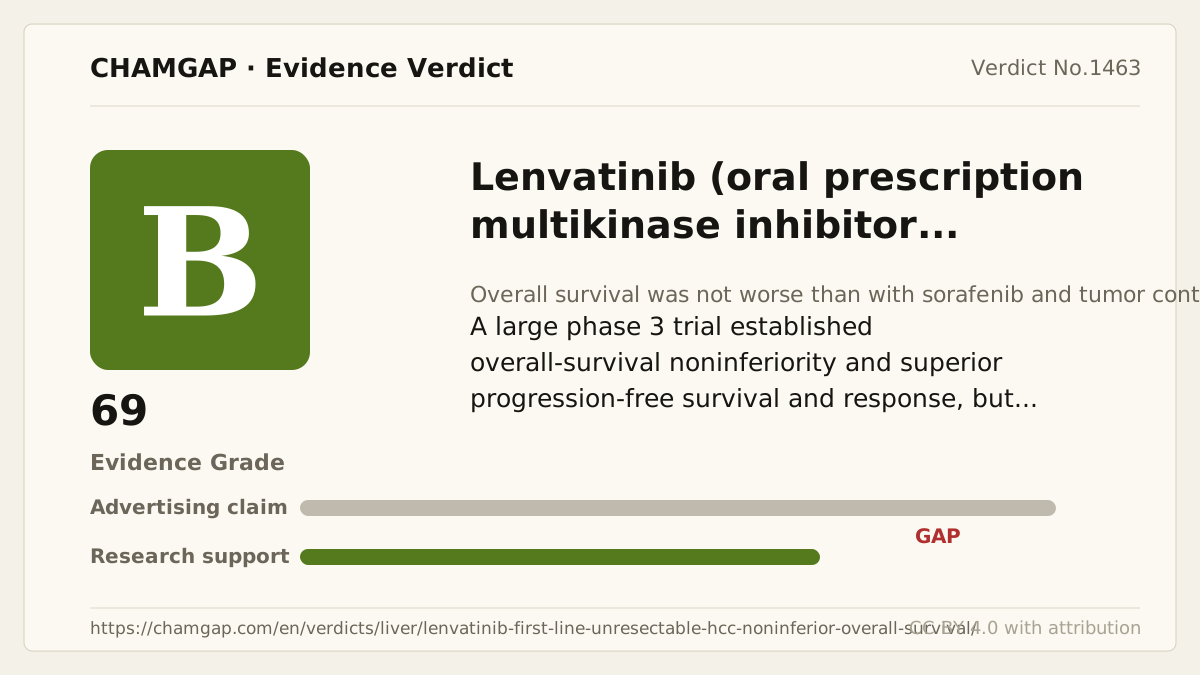
research showsLenvatinib is rated B because it produced overall survival noninferior to sorafenib and better progression-free survival and response rates in previously untreated unresectable hepatocellular carcinoma. REFLECT randomized 954 patients and reported median overall survival of 13.6 versus 12.3 months, with HR 0.92, meeting its prespecified noninferiority criterion. This does not mean superior survival to sorafenib and is not direct proof of lenvatinib mortality superiority over placebo. First-line options now include immune-based combinations, so liver function, bleeding risk, contraindications, and subsequent-treatment options must be considered.
ads claimCalling lenvatinib a drug that extends survival more than sorafenib converts a noninferiority result into superiority. The accurate statement is that overall survival was not worse and radiographic disease control was better.
Useful facts when choosing a product
- Lenvatinib is an oral multikinase inhibitor for unresectable hepatocellular carcinoma; once-daily dosing is selected by body weight and labeling and managed by an oncology team.
- Hypertension, proteinuria, diarrhea, reduced appetite, weight loss, and fatigue are common, requiring regular monitoring of blood pressure, urine protein, kidney and liver function, and weight.
- Arterial thrombosis, hemorrhage, heart failure, reversible posterior leukoencephalopathy, fistula or perforation, and impaired wound healing can require interruption, dose reduction, or discontinuation.
- REFLECT mainly enrolled Child-Pugh A patients with ECOG performance status 0 to 1 and excluded some high-risk patterns such as complete main portal-vein invasion or at least 50% liver occupation, limiting generalization.
Chamgap Semantic Classification Code
Candidate index · review held
M.lenvatinib.oral.overall-survival-noninferior-to-sorafenib-in-previously-untreated-unresectable-hepatocellular-carcinoma.noninferior.MULTIMedicinal interventions > Lenvatinib > Oral > Overall survival noninferior to sorafenib in previously untreated unresectable hepatocellular carcinoma > Noninferiority claim > Multiple: primary unresolved
An automated migration candidate, not an issued permanent code; exact claim scope remains under review. This machine-generated migration candidate helps retrieval but is not a permanent assignment. The original verdict ID and URL remain authoritative.
What the research actually shows
Kudo and colleagues' open-label REFLECT trial randomized 954 patients with previously untreated unresectable hepatocellular carcinoma to lenvatinib, 478 patients, or sorafenib, 476 patients. The primary endpoint of median overall survival was 13.6 versus 12.3 months, with HR 0.92, meeting the prespecified noninferiority margin of 1.08 but not demonstrating superiority. Independent imaging review favored lenvatinib for progression-free survival and objective response. Later systematic reviews support comparative-effectiveness signals but cannot remove observational heterogeneity or reliance on REFLECT as the single pivotal randomized trial.
Why this is classified as B (69)
A 954-patient randomized phase 3 trial established prespecified overall-survival noninferiority and superior progression-free survival and response. The comparator was active sorafenib rather than placebo, however, and overall-survival superiority was not shown, so the active-control noninferiority ceiling gives B with 69 points.
Counterpoint. Modern first-line priority depends on eligibility for immune combinations, liver function, bleeding risk, and autoimmune risk; the B rating from REFLECT does not establish superiority over every current first-line regimen.
Rejudgment record. Cross-check applied — Accepted overall-survival noninferiority and superior progression-free survival and response in the large phase 3 REFLECT trial, while applying the B ceiling and not converting active-control noninferiority into survival superiority or placebo-controlled efficacy. At cross-check the score was lowered to 69 because REFLECT's overall-survival HR of 0.92 established only noninferiority, not superiority (grade B retained).
Sub-claim grades by effect
This ingredient is marketed for several effects. A single overall grade blends strong and weak claims together, so each effect is graded separately here. The overall grade reflects the strongest disconfirming or core claim.
| Effect (sub-claim) | Grade | Basis |
|---|---|---|
| Overall survival noninferior to sorafenib | B | Overall survival was 13.6 versus 12.3 months with HR 0.92, meeting prespecified noninferiority but not superiority. |
| Improved progression-free survival versus sorafenib | B | Imaging-based progression-free survival was significantly longer, but it is a lower-level endpoint than overall survival. |
| Improved objective response rate versus sorafenib | B | Tumor response was higher, but it is a radiographic surrogate in an open-label trial. |
Cross-check — AI research and Codex final gate
Evidence Table
| Study | Design | Sample | Funding | Endpoint | Result | Weight |
|---|---|---|---|---|---|---|
| Kudo M et al. 2018 REFLECT | Multinational randomized open-label phase 3 active-control noninferiority trial | 954 patients; 478 assigned to lenvatinib and 476 to sorafenib | Eisai | Primary overall survival; secondary progression-free survival, time to progression, and objective response | Overall survival was 13.6 versus 12.3 months with HR 0.92, establishing noninferiority; progression-free survival and objective response favored lenvatinib. | Pivotal large randomized noninferiority evidence |
| Facciorusso A et al. 2021 | Systematic review and meta-analysis of lenvatinib versus sorafenib | 10 comparative studies | No specific external funding reported | Overall survival, progression-free survival, response, and severe adverse events | Comparative real-world evidence supported disease-control advantages for lenvatinib but included observational studies and heterogeneity. | Supportive external-validity evidence |
Receipt — 2 References
All 2 cited sources were verified for existence at the original page (as of 2026-07-23).
Final verification and publication gate: Codex · Evidence date: 2026-07-23 · Corrections: none
Cite this verdict
[Chamgap] Lenvatinib x overall survival noninferior to sorafenib in first-line unresectable hepatocellular carcinoma — Evidence Grade B·69. 2 cited sources checked. Source: https://chamgap.com/en/verdicts/liver/lenvatinib-first-line-unresectable-hcc-noninferior-overall-survival/ · CC BY 4.0CC BY 4.0 — free to use with attribution; do not distort grades, numbers, or verdict meaning.
What this document does and does not do
Chamgap is an information source. It reports what research has and has not confirmed; it does not tell readers what to take or buy. That decision belongs to readers and, when needed, medical or legal professionals. This verdict reflects literature available up to the search date and may change as new research appears. Nothing here is medical advice.