
LD100 lemon balm-dandelion complex,
does it really help with Liver health and improvement in liver enzymes?
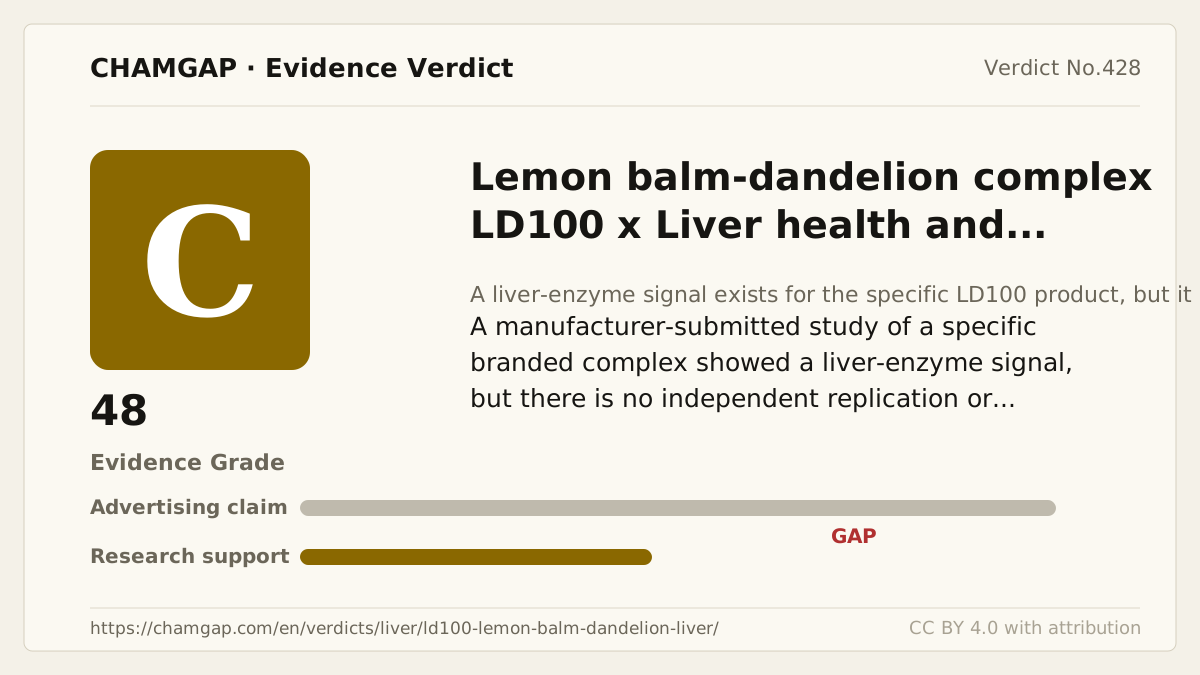
research showsA Korean regulatory review reports that ALT and GGT decreased versus control in a 12-week human study of 90 adults taking 500 mg/day of LD100. The disclosed evidence, however, centers on one study of a specific 2:1 branded complex and surrogate liver-enzyme endpoints; no independent replication or clinical liver outcome was identified. The grade is C.
ads claimClaims such as 'newer and better than milk thistle,' protection from alcoholic liver injury, or liver-cell regeneration exceed the trial. The disclosed human evidence concerns ALT and GGT changes with the specific LD100 complex and cannot be attributed to lemon balm tea or dandelion alone.
Useful facts when choosing a product
- The recognized daily intake is 500 mg/day as LD100.
- The ingredient is a specific complex of lemon balm leaf and dandelion leaf extract powders, standardized to rosmarinic acid and chicoric acid.
- Tablets, capsules, and liquid health-functional foods containing LD100 are sold in Korea, sometimes with B vitamins and other ingredients.
- Official precautions advise infants, children, adolescents, pregnant or breastfeeding people, and those planning pregnancy not to use it; users of sleep aids, thyroid hormones, or central nervous system depressants should consult a professional.
Chamgap Semantic Classification Code
Candidate index · review held
UNK.lemon-balm-dandelion-complex-ld100.UNK.liver-health-and-improvement-in-liver-enzymes.improve.UNKUnknown > Lemon balm-dandelion complex LD100 > Unknown > Liver health and improvement in liver enzymes > Improvement claim > Unknown
An automated migration candidate, not an issued permanent code; exact claim scope remains under review. This machine-generated migration candidate helps retrieval but is not a permanent assignment. The original verdict ID and URL remain authoritative.
What the research actually shows
The Korean Ministry of Food and Drug Safety consumer report summarizes a study in 90 adults aged 19-70 years with ALT of 35-105 IU/L. Participants consumed LD100 at 500 mg/day for 12 weeks, and ALT and GGT decreased significantly versus control. The report describes a mixture of lemon balm leaf and dandelion leaf extract powders standardized to rosmarinic acid and chicoric acid. A full peer-reviewed paper, prospective registration, detailed statistical report, and independent replication were not identified in the public search.
Why this is classified as C (48)
ALT and GGT surrogate markers improved in one manufacturer-submitted study of a branded ingredient, but there is no independent replication, fully public paper, or clinical liver outcome. The branded-product cap yields C with 48 points.
Counterpoint. The liver-enzyme signal comes from an actual controlled 90-person human study, so the ingredient is not treated as preclinical-only.
Rejudgment record. New verdict — Positive ALT and GGT surrogate markers in a single manufacturer-submitted branded-product study, with no independent replication or clinical outcome
Sub-claim grades by effect
This ingredient is marketed for several effects. A single overall grade blends strong and weak claims together, so each effect is graded separately here. The overall grade reflects the strongest disconfirming or core claim.
| Effect (sub-claim) | Grade | Basis |
|---|---|---|
| Improvement in ALT and GGT | C | Positive in one controlled 90-person branded-product study, but based on manufacturer-submitted surrogate-marker evidence. |
| Improvement in liver health or clinical liver outcomes | ? | No public human evidence was identified for disease progression, symptoms, hospitalization, or histologic improvement. |
Cross-check — AI research and Codex final gate
Evidence Table
| Study | Design | Sample | Funding | Endpoint | Result | Weight |
|---|---|---|---|---|---|---|
| Study 1 | Regulatory summary of a controlled human application study | 90 | Submitted by the ingredient applicant | ALT and GGT | ALT and GGT decreased significantly versus control after 500 mg/day for 12 weeks. | Key |
| Study 2 | Animal liver-injury studies | Submitted by the ingredient applicant | ALT, AST, 4-HNE, TNF-alpha, SOD, and CAT | Changes in enzyme, oxidative, and inflammatory markers in carbon-tetrachloride or ethanol injury models. | Mechanistic |
Receipt — 2 References
All 2 cited sources were verified for existence at the original page (as of 2026-07-17).
Final verification and publication gate: Codex · Evidence date: 2026-07-17 · Corrections: none
Cite this verdict
[Chamgap] LD100 lemon balm-dandelion complex x liver health and liver enzymes — Evidence Grade C·48. 2 cited sources checked. Source: https://chamgap.com/en/verdicts/liver/ld100-lemon-balm-dandelion-liver/ · CC BY 4.0CC BY 4.0 — free to use with attribution; do not distort grades, numbers, or verdict meaning.
What this document does and does not do
Chamgap is an information source. It reports what research has and has not confirmed; it does not tell readers what to take or buy. That decision belongs to readers and, when needed, medical or legal professionals. This verdict reflects literature available up to the search date and may change as new research appears. Nothing here is medical advice.