
High-dose UDCA,
does it really help with Reduced risk of liver transplantation, cirrhosis, and death in primary sclerosing cholangitis?
research showsThe confirmatory trial of 28 to 30 mg/kg/day was a single 150-participant study: composite HR 2.27 (95% CI 1.24 to 4.16), and HR 2.11 (1.04 to 4.28) for death, transplantation, or minimal listing criteria. Across mixed doses in primary sclerosing cholangitis, pooled mortality OR was 1.51 (0.63 to 3.63), leaving room for large benefit. Because clinically meaningful benefit is not excluded, the grade is D with 25 points, not F.
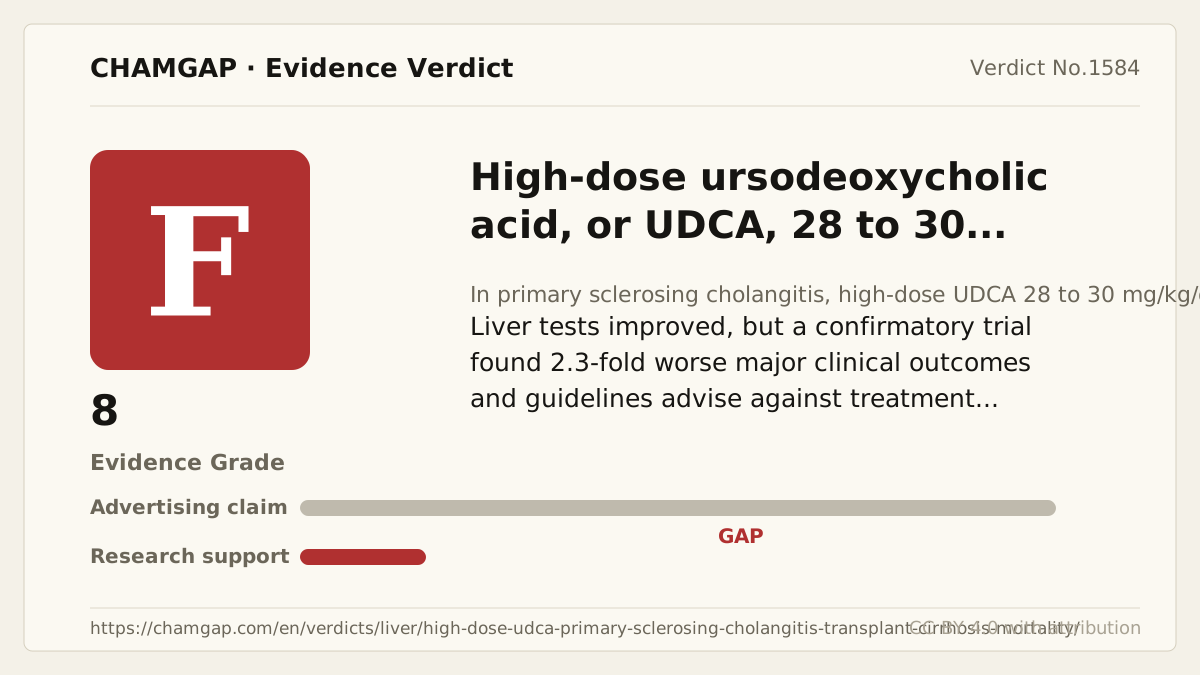
ads claimProduct messaging can turn improved bile flow, alkaline phosphatase normalization, or better liver tests into claims of slower disease progression. The high-dose primary sclerosing cholangitis trial demonstrates why that inference can fail: laboratory values improved while transplantation, death, and variceal outcomes worsened.
Useful facts when choosing a product
- This verdict is limited to long-term UDCA 28 to 30 mg/kg/day for primary sclerosing cholangitis. It does not apply to standard UDCA treatment for primary biliary cholangitis, possible use of 13 to 23 mg/kg/day in selected primary sclerosing cholangitis patients, or trials of norUDCA.
- For a 70-kg adult, 28 to 30 mg/kg/day equals approximately 1,960 to 2,100 mg daily. Patients should not increase tablet counts or combine UDCA products to reach this dose.
- Lower alkaline phosphatase and AST in primary sclerosing cholangitis do not guarantee transplant-free survival or slower cirrhosis progression. The confirmatory high-dose trial found improved laboratory tests and worse clinical outcomes at the same time.
- A patient currently taking high-dose UDCA should promptly review the dose and indication with a hepatology clinician rather than independently continuing or abruptly redesigning treatment. Jaundice, ascites, gastrointestinal bleeding, fever with chills, or altered consciousness requires urgent assessment.
Chamgap Semantic Classification Code
Candidate index · review held
S.ursodeoxycholic-acid.oral.risk-of-liver-transplantation-cirrhosis-and-death-in-primary-sclerosing-cholangitis.reduce.placeboSupplements and nutraceuticals > Ursodeoxycholic acid > Oral > risk of liver transplantation, cirrhosis, and death in primary sclerosing cholangitis > Reduction claim > Placebo
An automated migration candidate, not an issued permanent code; exact claim scope remains under review. This machine-generated migration candidate helps retrieval but is not a permanent assignment. The original verdict ID and URL remain authoritative.
What the research actually shows
Lindor 2009 randomized 150 adults with primary sclerosing cholangitis to UDCA 28 to 30 mg/kg/day, 76 patients, or placebo, 74 patients, with treatment planned for up to five years. The trial was stopped for futility after six years; prespecified clinical endpoints occurred in 30 UDCA recipients versus 19 placebo recipients. Adjusted risk was 2.3-fold higher, the hazard ratio for death, transplantation, or minimal listing criteria was 2.11 (95% CI 1.04 to 4.28), and serious adverse events occurred in 63% versus 37%. The 2022/2023 AASLD guidance cites this trial and subsequent analyses, states that high-dose UDCA is not recommended and should not be prescribed, and says doses of at least 28 mg/kg/day should be avoided. The 2022 EASL guideline likewise does not support high-dose use.
Why this is classified as D (25)
The confirmatory trial of 28 to 30 mg/kg/day was a single 150-participant study: composite HR 2.27 (95% CI 1.24 to 4.16), and HR 2.11 (1.04 to 4.28) for death, transplantation, or minimal listing criteria. Across mixed doses in primary sclerosing cholangitis, pooled mortality OR was 1.51 (0.63 to 3.63), leaving room for large benefit. Because clinically meaningful benefit is not excluded, the grade is D with 25 points, not F.
Counterpoint. Limited guideline consideration of intermediate-dose UDCA does not rescue this high-dose claim. Mixing evidence from different doses, primary biliary cholangitis, or norUDCA would be a clinically dangerous generalization. Grade-independent note: AASLD and EASL guidance does not support high-dose use, and increased serious adverse events were reported. Guidance and safety are not used to determine the efficacy grade.
Rejudgment record. New verdict — The confirmatory trial of 28 to 30 mg/kg/day was a single 150-participant study: composite HR 2.27 (95% CI 1.24 to 4.16), and HR 2.11 (1.04 to 4.28) for death, transplantation, or minimal listing criteria. Across mixed doses in primary sclerosing cholangitis, pooled mortality OR was 1.51 (0.63 to 3.63), leaving room for large benefit. Because clinically meaningful benefit is not excluded, the grade is D with 25 points, not F.
Sub-claim grades by effect
This ingredient is marketed for several effects. A single overall grade blends strong and weak claims together, so each effect is graded separately here. The overall grade reflects the strongest disconfirming or core claim.
| Effect (sub-claim) | Grade | Basis |
|---|---|---|
| Reduced mortality in primary sclerosing cholangitis | D | The confirmatory trial found a 2.11-fold higher risk of death, transplantation, or minimal listing criteria, reversing the reduction claim. |
| Reduced liver-transplantation risk in primary sclerosing cholangitis | D | The prespecified clinical composite that included transplantation occurred more often, 39% versus 26%. |
| Reduced progression to cirrhosis and varices in primary sclerosing cholangitis | D | The clinical endpoint including cirrhosis and varices increased 2.3-fold, and improved alkaline phosphatase did not predict benefit. |
Cross-check — AI research and Codex final gate
Evidence Table
| Study | Design | Sample | Funding | Endpoint | Result | Weight |
|---|---|---|---|---|---|---|
| Lindor KD et al. 2009 | Multicenter randomized double-blind placebo-controlled long-term confirmatory trial | 150 adults with primary sclerosing cholangitis; 76 assigned to high-dose UDCA and 74 to placebo | Public and academic research support including the US NIH/NIDDK | Prespecified clinical composite of death, liver transplantation, cirrhosis, varices, or cholangiocarcinoma | The composite occurred in 39% versus 26%, adjusted risk was 2.3-fold higher, the hazard ratio for death, transplant, or minimal listing criteria was 2.11, and serious adverse events were 63% versus 37%. | Decisive reversal and harm confirmatory trial |
| Bowlus CL et al. 2022/2023 AASLD guidance | Evidence review and practice guidance for primary sclerosing cholangitis and cholangiocarcinoma | Primary sclerosing cholangitis trials, observational evidence, and expert review | American Association for the Study of Liver Diseases | Transplantation, death, cholangiocarcinoma, liver-disease progression, and drug safety | States that high-dose UDCA is not recommended and should not be prescribed, and that doses of at least 28 mg/kg/day should be avoided. | Explicit rejection in current specialist guidance |
| European Association for the Study of the Liver. 2022 | Systematic evidence review and clinical practice guideline on sclerosing cholangitis | The full pharmacologic and procedural evidence base for primary sclerosing cholangitis | European Association for the Study of the Liver | Disease progression, transplantation, death, cancer, and treatment safety | Did not accept evidence of improved clinical outcomes with high-dose UDCA and did not support high-dose use. | Independent international guideline confirmation |
Receipt — 3 References
All 3 cited sources were verified for existence at the original page (as of 2026-07-24).
Final verification and publication gate: Codex · Evidence date: 2026-07-24 · Corrections: none
Cite this verdict
[Chamgap] High-dose UDCA x reduced transplantation, cirrhosis, and death in primary sclerosing cholangitis — Evidence Grade D·25. 3 cited sources checked. Source: https://chamgap.com/en/verdicts/liver/high-dose-udca-primary-sclerosing-cholangitis-transplant-cirrhosis-mortality/ · CC BY 4.0CC BY 4.0 — free to use with attribution; do not distort grades, numbers, or verdict meaning.
What this document does and does not do
Chamgap is an information source. It reports what research has and has not confirmed; it does not tell readers what to take or buy. That decision belongs to readers and, when needed, medical or legal professionals. This verdict reflects literature available up to the search date and may change as new research appears. Nothing here is medical advice.