
Green tea extract or EGCG,
does it really help with Improved liver enzymes including ALT and AST in MASLD or NAFLD?
research showsGreen tea catechins may still lower ALT and AST in MASLD or NAFLD, but the evidence sits at the bottom of C. A 2020 meta-analysis of 15 randomized trials found no significant overall effect on ALT, AST, or alkaline phosphatase, with a favorable signal only in the NAFLD subgroup. In the 80-participant, 90-day Pezeshki trial, adjusted between-group differences in ALT and AST were not significant versus placebo (P=0.251 and 0.291). The remaining positive evidence is therefore limited to the NAFLD subgroup of an overall null meta-analysis and a 17-participant, 12-week high-dose trial. Doses and formulations varied, enzymes and CT liver fat are surrogates, and no trial showed less fibrosis, cirrhosis, liver failure, or mortality. Favorable point estimates and a weak subgroup signal keep the verdict at C rather than D, with 40 points; rare liver injury from high-dose EGCG extract remains separate.
ads claimMarketing expands antioxidant activity and lower ALT into treatment of fatty liver, liver detoxification, and reversal of fibrosis. The evidence concerns short-term enzyme and imaging surrogates for selected formulations, not proven slower clinical liver-disease progression.
Useful facts when choosing a product
- Trials used different formulations and doses, including 500 mg per day of green tea extract or tea providing more than one gram of catechins daily, so total extract weight on a label does not define EGCG exposure.
- Concentrated extract differs from brewed green tea in EGCG dose and absorption, and high-dose extract taken while fasting can increase exposure and concern for liver injury.
- Nausea, abdominal discomfort, insomnia, or palpitations from caffeine can occur, and jaundice, dark urine, severe fatigue, or right-upper-quadrant pain warrants immediate discontinuation and assessment.
- People with existing liver disease or hepatotoxic medicines should not start high-dose EGCG as self-treatment, and supplements must not replace weight management and standard metabolic-risk care for MASLD.
Chamgap Semantic Classification Code
Candidate index · review held
S.green-tea-extract-or-egcg.UNK.liver-enzymes-including-alt-and-ast-in-masld-or-nafld.improve.placeboSupplements and nutraceuticals > Green tea extract or EGCG > Unknown > liver enzymes including ALT and AST in MASLD or NAFLD > Improvement claim > Placebo
An automated migration candidate, not an issued permanent code; exact claim scope remains under review. This machine-generated migration candidate helps retrieval but is not a permanent assignment. The original verdict ID and URL remain authoritative.
What the research actually shows
Mahmoodi and colleagues synthesized 15 green-tea or catechin trials through February 2019 and found a null overall enzyme result but a reduction in the NAFLD subgroup. Pezeshki and colleagues randomized 80 people with ultrasound-diagnosed NAFLD to 500 mg per day of extract or placebo; ALT and AST fell within the extract group after 90 days, but adjusted between-group differences were nonsignificant (P=0.251 and 0.291). Sakata and colleagues randomized only 17 people to high-catechin, low-catechin, or placebo tea for 12 weeks and found improvements in ALT and the liver-to-spleen CT attenuation ratio with high catechins. Newer network analyses of natural products or polyphenols rank catechins favorably, but depend on indirect comparisons and few original trials. A USP safety review supports a causal link between concentrated green tea extract and rare idiosyncratic liver injury, creating a particular concern when people with liver disease self-treat with high-dose products.
Why this is classified as C (40)
The overall 15-trial analysis was null, and adjusted between-group ALT and AST differences in the 80-person Pezeshki trial were also nonsignificant. The remaining positive evidence is limited to the NAFLD subgroup and a 17-person high-dose trial; every outcome is a surrogate and formulations are heterogeneous. Favorable point estimates and a weak subgroup signal support C rather than D, but the absence of hard liver outcomes yields the bottom of C with 40 points. High-dose EGCG hepatotoxicity remains a separate safety concern.
Counterpoint. This is a different efficacy axis from the D rating for green-tea catechins and body fat; it resembles the conflicting surrogate evidence behind curcumin for NAFLD, rated C with 40 points, but is one point lower because the overall enzyme analysis was null.
Rejudgment record. Cross-check revision — Balanced null overall ALT and AST results across 15 randomized trials and null adjusted between-group results in the 80-person Pezeshki trial against a favorable NAFLD subgroup and a weak signal from a 17-person high-dose trial, then applied a ceiling for enzyme and imaging surrogates, formulation and dose heterogeneity, and absence of hard liver outcomes
Sub-claim grades by effect
This ingredient is marketed for several effects. A single overall grade blends strong and weak claims together, so each effect is graded separately here. The overall grade reflects the strongest disconfirming or core claim.
| Effect (sub-claim) | Grade | Basis |
|---|---|---|
| Improvement of ALT and AST in MASLD or NAFLD | C | The overall 15-trial analysis and adjusted between-group results in the 80-person Pezeshki trial were null; only the NAFLD subgroup and a 17-person trial retain weak positive signals, and liver enzymes are surrogates. |
| Reduction of liver fat in MASLD or NAFLD | C | A 17-person CT trial and selected small studies provide a signal, but repeated quantitative MRI or histologic validation is lacking. |
| Reduction of cirrhosis, liver failure, or liver-related death in MASLD or NAFLD | ? | No human efficacy trial of green tea extract or EGCG was identified that directly followed these hard clinical outcomes. |
Cross-check — AI research and Codex final gate
Evidence Table
| Study | Design | Sample | Funding | Endpoint | Result | Weight |
|---|---|---|---|---|---|---|
| Mahmoodi M et al. 2020 | Systematic review and meta-analysis of randomized clinical trials | Fifteen randomized trials | Funding was not reported in the PubMed abstract; included-trial funding was mixed | ALT, AST, alkaline phosphatase, and bilirubin | Overall ALT, AST, and alkaline phosphatase effects were nonsignificant, while liver enzymes decreased in the NAFLD subgroup. | Pivotal conflicting synthesis with a positive subgroup |
| Pezeshki A et al. 2016 | Ninety-day randomized double-blind placebo-controlled trial | 80 adults with ultrasound-diagnosed NAFLD | Funding was not reported in the PubMed abstract | ALT, AST, alkaline phosphatase, and body weight | After 90 days of 500 mg per day of green tea extract, adjusted between-group differences in ALT and AST were not significant versus placebo (P=0.251 and 0.291). | Direct small short-term trial with null adjusted between-group results |
| Sakata R et al. 2013 | Twelve-week randomized double-blind placebo-controlled trial | 17 participants with NAFLD | Funding was not reported in the PubMed abstract | ALT, liver-to-spleen CT attenuation ratio, body fat, and urinary 8-isoprostane | More than one gram of catechins daily improved ALT and the CT liver-fat measure versus placebo and low-dose tea. | Very small positive imaging and enzyme signal |
| Oketch-Rabah HA et al. 2020 USP review | Comprehensive systematic review of green-tea-extract hepatotoxicity | 204 clinical and 127 nonclinical research articles | Safety review by the United States Pharmacopeial Convention | Liver-injury cases, rechallenge, dose, fasting, and product characteristics | Supported causality for rare idiosyncratic liver injury from concentrated green tea extract and recommended a caution statement. | Key safety and product-variability evidence |
Receipt — 4 References
All 4 cited sources were verified for existence at the original page (as of 2026-07-21).
Final verification and publication gate: Codex · Evidence date: 2026-07-21 · Corrections: none
Cite this verdict
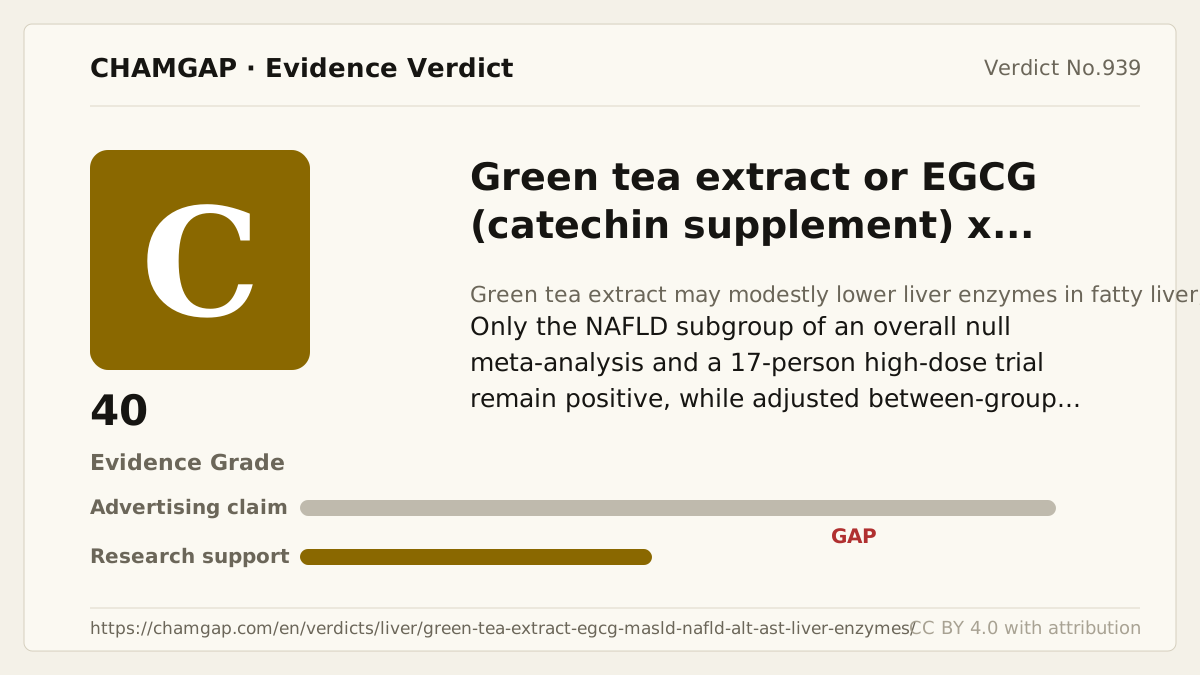
[Chamgap] Green tea extract or EGCG x improved liver enzymes in MASLD or NAFLD — Evidence Grade C·40. 4 cited sources checked. Source: https://chamgap.com/en/verdicts/liver/green-tea-extract-egcg-masld-nafld-alt-ast-liver-enzymes/ · CC BY 4.0CC BY 4.0 — free to use with attribution; do not distort grades, numbers, or verdict meaning.
What this document does and does not do
Chamgap is an information source. It reports what research has and has not confirmed; it does not tell readers what to take or buy. That decision belongs to readers and, when needed, medical or legal professionals. This verdict reflects literature available up to the search date and may change as new research appears. Nothing here is medical advice.