
Glecaprevir/pibrentasvir,
does it really help with Virologic cure at SVR12 after eight weeks of treatment for chronic hepatitis C?
research showsMavyret is rated B because an eight-week course achieves SVR12 in about 98% of eligible patients with chronic hepatitis C. ENDURANCE-1 reported 348 of 351, or 99%, and EXPEDITION-8 reported 335 of 343, or 98%, reaching SVR12. The effect is very large and consistent across genotypes and real-world cohorts, but SVR12 is a validated surrogate endpoint recognized by AASLD and every pivotal trial was sponsored by AbbVie. That falls short of the independent direct hard-outcome standard for an A-rated prescription drug, giving an upper-band B with 79 points. SVR12 does not prevent reinfection, and this regimen must not be used in decompensated cirrhosis.
ads claimThe phrase everyone is cured in eight weeks omits eligibility, adherence, prior treatment, compensated liver status, and interactions. Cure means removal of the treated infection; it does not confer immunity, prevent reinfection, or erase established cirrhosis.
Useful facts when choosing a product
- Mavyret combines 100 mg of glecaprevir and 40 mg of pibrentasvir per tablet and is taken as three tablets once daily with food under prescription.
- The eight-week regimen mainly applies to treatment-naive patients with genotypes 1 to 6 who have no cirrhosis or compensated cirrhosis, while prior treatment can change duration.
- It is contraindicated in decompensated cirrhosis or a history of hepatic decompensation, and major interactions such as rifampin or atazanavir must be screened.
- Headache, fatigue, nausea, and pruritus can occur; hepatitis B markers should be checked before treatment and signs of serious liver injury monitored.
Chamgap Semantic Classification Code
Candidate index · review held
M.glecaprevir-pibrentasvir.UNK.virologic-cure-at-svr12-after-of-treatment-for-chronic-hepatitis-c.treat.UNKMedicinal interventions > Glecaprevir/pibrentasvir > Unknown > Virologic cure at SVR12 after of treatment for chronic hepatitis C > Treatment or remission claim > Unknown
An automated migration candidate, not an issued permanent code; exact claim scope remains under review. This machine-generated migration candidate helps retrieval but is not a permanent assignment. The original verdict ID and URL remain authoritative.
What the research actually shows
ENDURANCE-1 and -3 evaluated 1,208 noncirrhotic patients with genotype 1 or 3; ENDURANCE-1 reported SVR12 in 348 of 351 participants, or 99%, while the genotype 3 eight-week rate was 95%. Three phase 3 studies in noncirrhotic genotype 2, 4, 5, or 6 infection reported eight-week rates of 98% and 93%, with no virologic failures in the latter group. EXPEDITION-8 found 335 of 343, or 98%, by ITT and 334 of 335, or 99.7%, per protocol in treatment-naive compensated cirrhosis. The German registry confirmed 99.4% by modified ITT in routine care. SVR12 is a validated surrogate recognized by AASLD, and the pivotal clinical trials were all sponsored by AbbVie.
Why this is classified as B (79)
ENDURANCE-1 at 348 of 351 and EXPEDITION-8 at 335 of 343 show a consistent eight-week SVR12 effect of about 98% with rare virologic failure. SVR12 is a validated surrogate endpoint recognized by AASLD, however, and every pivotal trial was sponsored by AbbVie, so the evidence does not meet the independent direct hard-outcome standard for an A-rated prescription drug. The magnitude supports an upper-band B with 79 points. Safety is assessed separately.
Counterpoint. Before treatment, compensated liver status, prior DAA exposure, renal and hepatic status, concomitant medicines, and likely adherence must be reviewed together.
Rejudgment record. Reassessment (cross-check reflected) — Accepted the very large SVR12 effect in ENDURANCE-1, 348 of 351, and EXPEDITION-8, 335 of 343, but assigned upper-band B because SVR12 is a validated surrogate recognized by AASLD and every pivotal trial was AbbVie-sponsored, falling short of the independent direct hard-outcome standard for an A-rated prescription drug
Sub-claim grades by effect
This ingredient is marketed for several effects. A single overall grade blends strong and weak claims together, so each effect is graded separately here. The overall grade reflects the strongest disconfirming or core claim.
| Effect (sub-claim) | Grade | Basis |
|---|---|---|
| Eight-week SVR12 cure in eligible chronic hepatitis C | B | The effect is very large at about 98%, but SVR12 is a validated surrogate and pivotal trials were AbbVie-sponsored. |
| Eight-week treatment in treatment-naive compensated cirrhosis | B | EXPEDITION-8 reported 335 of 343 by ITT and 334 of 335 per protocol in a conditional eligible population in a sponsor-funded trial. |
| Universal eight-week use after prior DAA failure or in retreatment | D | Prior treatment and resistance can require a different regimen or duration. |
| Prevention of reinfection or elimination of established cirrhosis | D | SVR12 does not create immunity or end follow-up for cirrhosis. |
Cross-check — AI research and Codex final gate
Evidence Table
| Study | Design | Sample | Funding | Endpoint | Result | Weight |
|---|---|---|---|---|---|---|
| Zeuzem S et al. 2018 ENDURANCE-1/3 | Multicenter phase 3 randomized open-label noninferiority trials | 1,208 noncirrhotic patients with genotype 1 or 3 | AbbVie | SVR12 after treatment | Eight-week SVR12 was 99.1% in genotype 1 and 95% in genotype 3. | Key large phase 3 evidence |
| Brown RS Jr et al. 2020 EXPEDITION-8 | Multicenter single-arm phase 3b study with historical thresholds | 343 treatment-naive patients with compensated cirrhosis | AbbVie | Eight-week SVR12 | SVR12 was 334/335 (99.7%) per protocol and 335/343 (97.7%) by ITT. | Compensated-cirrhosis evidence |
| Berg T et al. 2019 German registry | Prospective multicenter real-world registry cohort | 586 patients with outcome data | Registry study with AbbVie employee coauthors | Real-world SVR12 | SVR12 was 96.7% by ITT and 99.4% by modified ITT, with one virologic failure. | Real-world replication |
Receipt — 4 References
All 4 cited sources were verified for existence at the original page (as of 2026-07-20).
Final verification and publication gate: Codex · Evidence date: 2026-07-20 · Corrections: none
Cite this verdict
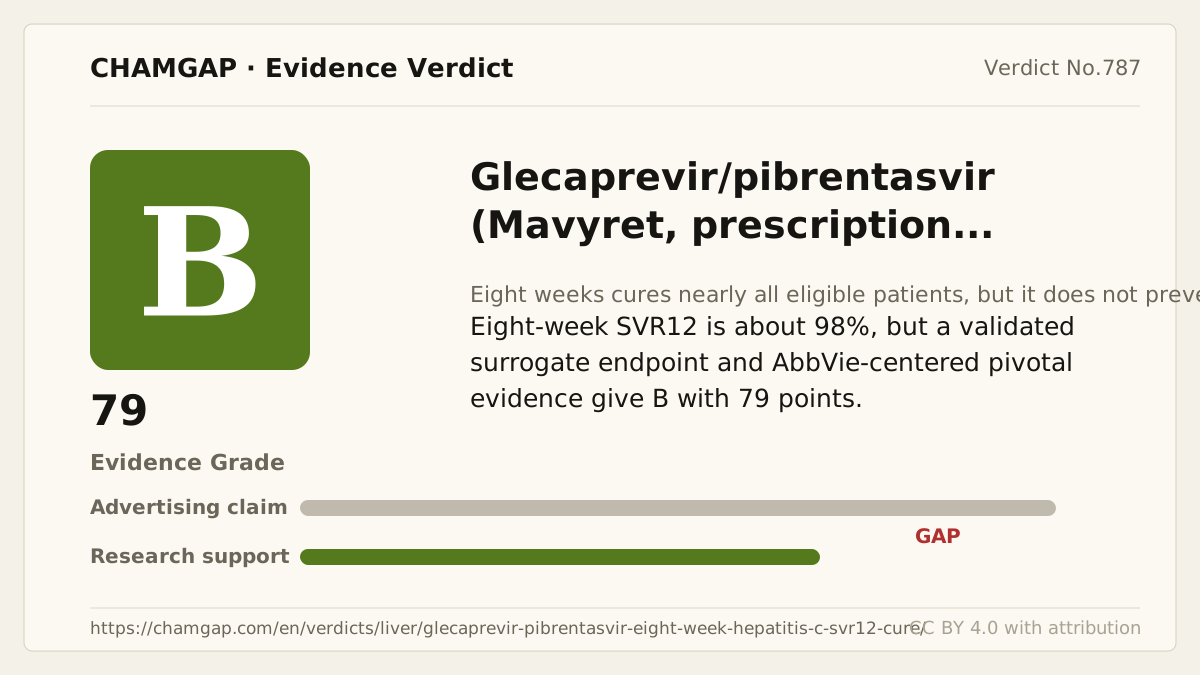
[Chamgap] Glecaprevir/pibrentasvir x eight-week SVR12 cure of chronic hepatitis C — Evidence Grade B·79. 4 cited sources checked. Source: https://chamgap.com/en/verdicts/liver/glecaprevir-pibrentasvir-eight-week-hepatitis-c-svr12-cure/ · CC BY 4.0CC BY 4.0 — free to use with attribution; do not distort grades, numbers, or verdict meaning.
What this document does and does not do
Chamgap is an information source. It reports what research has and has not confirmed; it does not tell readers what to take or buy. That decision belongs to readers and, when needed, medical or legal professionals. This verdict reflects literature available up to the search date and may change as new research appears. Nothing here is medical advice.