
Empagliflozin,
does it really help with Reduction in MRI-measured liver fat in MASLD with type 2 diabetes?
research showsEmpagliflozin is rated C because imaging-measured liver fat repeatedly declined in MASLD with type 2 diabetes, but evidence remains limited to surrogate outcomes rather than clinical events.
ads claimA lower liver-fat image should not be expanded into cure of fatty liver, reversal of fibrosis, or prevention of cirrhosis and liver cancer.
Useful facts when choosing a product
- E-LIFT added empagliflozin 10 mg to standard diabetes treatment for 20 weeks.
- The distinction is 50 randomized versus 42 who completed and entered MRI-PDFF analysis.
Chamgap Semantic Classification Code
Candidate index · review held
M.empagliflozin.UNK.mri-measured-liver-fat-in-masld-with-type-2-diabetes.reduce.usual-careMedicinal interventions > Empagliflozin > Unknown > MRI-measured liver fat in MASLD with type 2 diabetes > Reduction claim > Usual care
An automated migration candidate, not an issued permanent code; exact claim scope remains under review. This machine-generated migration candidate helps retrieval but is not a permanent assignment. The original verdict ID and URL remain authoritative.
What the research actually shows
E-LIFT randomized 50 people with type 2 diabetes and what was then called NAFLD; 42 completed 20-week MRI-PDFF and entered the imaging analysis. The between-group difference was -4.0 percentage points, P<0.0001. A meta-analysis of 11 randomized trials reported a liver-fat mean difference of -3.11 percentage points (95% CI -4.12 to -2.11). Independence was assessed from funding of the pooled source trials, not from funding of the meta-analysis itself. At least one included source trial was funded outside industry, including NIH R01 support, so some independent trial evidence exists.
Why this is classified as C (54)
MRI liver-fat reduction was repeated and some source trials had nonmanufacturer support such as NIH R01 funding, but the 50-person trial, 42-completer imaging analysis, and surrogate-only outcome yield C with 54 points.
Counterpoint. Liver fat declines on imaging, but patient-important liver outcomes remain unproven.
Rejudgment record. Cross-check applied — Accepted repeated MRI liver-fat reduction while accounting for an imaging-only outcome and a small completer analysis
| Endpoint | S | Surrogate marker - laboratory or imaging measures |
| Replication | R2 | Independently replicated across trials |
| Independence | I1 | Mixed funding sources |
| Effect size | E+ | Meets the clinically important threshold |
Stored derived and displayed grades match; this is not a current recalculation or validity check (C).
Sub-claim grades by effect
This ingredient is marketed for several effects. A single overall grade blends strong and weak claims together, so each effect is graded separately here. The overall grade reflects the strongest disconfirming or core claim.
| Effect (sub-claim) | Grade | Basis |
|---|---|---|
| Reduction in MRI-PDFF liver fat | C | The E-LIFT primary endpoint found a -4.0 percentage-point difference. |
| Replicated imaging-based liver-fat reduction | C | The 11-trial synthesis found -3.11 percentage points. |
| Reduction in liver stiffness | C | The meta-analysis found -0.43 kPa, but this remains a surrogate for clinical events. |
Cross-check — AI research and Codex final gate
Evidence Table
| Study | Design | Sample | Funding | Endpoint | Result | Weight |
|---|---|---|---|---|---|---|
| Kuchay MS et al. 2018 E-LIFT | Single-center randomized open-label standard-care-controlled trial | 50 randomized; 42 with complete MRI data in the primary analysis | Investigator-initiated trial supported by a Boehringer Ingelheim investigator-initiated study grant | Primary endpoint of 20-week change in MRI-PDFF liver fat | Between-group difference -4.0 percentage points, P<0.0001; primary endpoint succeeded | Key imaging-surrogate trial |
| Hamzah KA et al. 2026 | Systematic review and meta-analysis of randomized trials | 11 randomized trials and 3,077 participants | No funding for the meta-analysis itself; source-trial funding mixed across public, academic, and manufacturer sources | Liver fat, liver stiffness, liver enzymes, and fibrosis scores | Liver-fat mean difference -3.11 percentage points (95% CI -4.12 to -2.11), P<0.00001; FIB-4 and NFS null | Repeated imaging effect with limits on clinical scope |
Receipt — 2 References
All 2 cited sources were verified for existence at the original page (as of 2026-07-24).
Final verification and publication gate: Codex · Evidence date: 2026-07-24 · Corrections: none
Cite this verdict
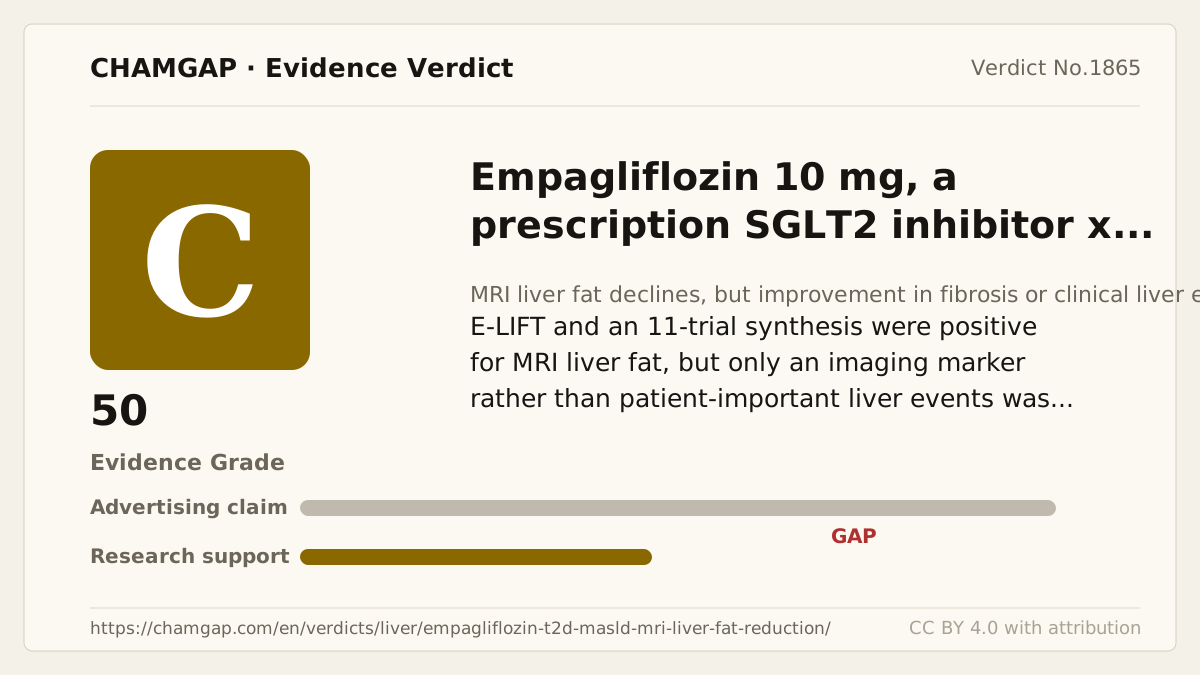
[Chamgap] Empagliflozin x lower liver fat in MASLD with type 2 diabetes — Evidence Grade C·54. 2 cited sources checked. Source: https://chamgap.com/en/verdicts/liver/empagliflozin-t2d-masld-mri-liver-fat-reduction/ · CC BY 4.0CC BY 4.0 — free to use with attribution; do not distort grades, numbers, or verdict meaning.
What this document does and does not do
Chamgap is an information source. It reports what research has and has not confirmed; it does not tell readers what to take or buy. That decision belongs to readers and, when needed, medical or legal professionals. This verdict reflects literature available up to the search date and may change as new research appears. Nothing here is medical advice.