
Early TIPS,
does it really help with Reduction in rebleeding and one-year mortality after high-risk acute variceal bleeding in cirrhosis?
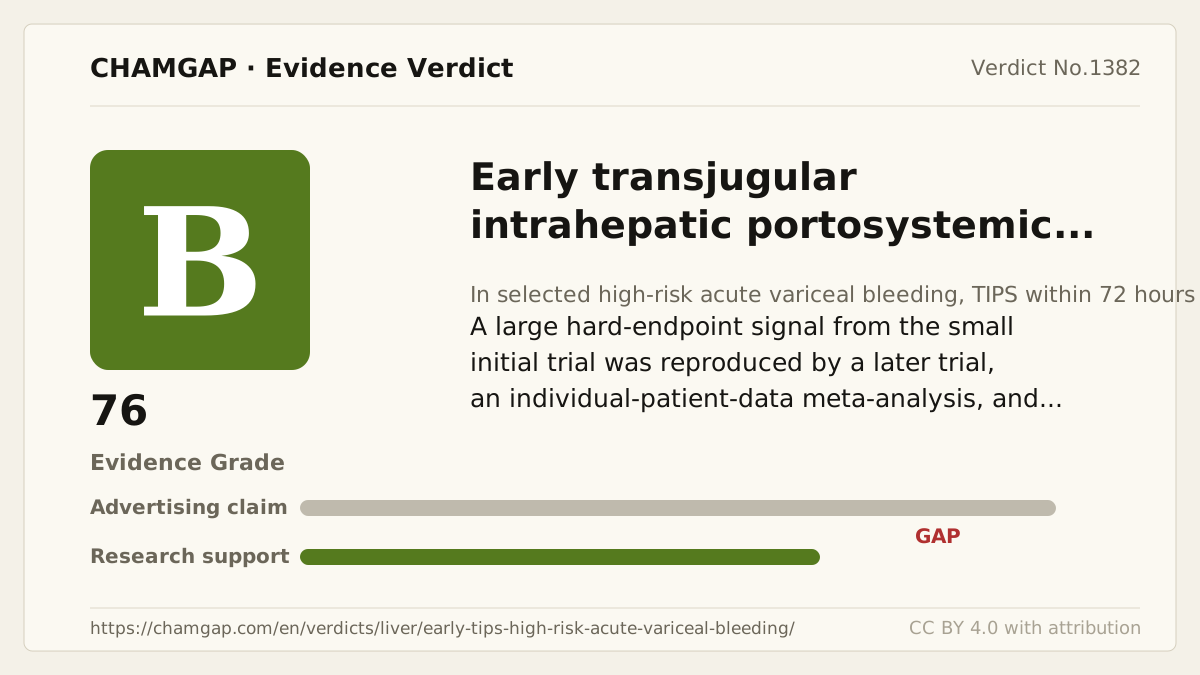
research showsEarly TIPS is rated B because it reduces rebleeding and one-year mortality in selected high-risk patients with cirrhosis and acute variceal bleeding. In the 63-person 2010 trial, one-year survival was 86% versus 61% and freedom from failure to control bleeding or rebleeding was 97% versus 50%. That small trial alone would support C, but a subsequent 129-person randomized trial, an individual-patient-data meta-analysis, and Baveno VII guidance reproduced the benefit and support B.
ads claimPresenting early TIPS as a universal survival procedure for all cirrhotic bleeding is an overstatement. Evidence applies to selected patients at high risk of failure after initial vasoactive and endoscopic control.
Useful facts when choosing a product
- TIPS creates a covered-stent channel between the portal and hepatic venous systems to reduce portal pressure.
- Pre-emptive TIPS is performed in a high-risk patient after initial control, generally within 72 hours of endoscopy, rather than only after rescue becomes necessary.
- Representative high-risk criteria are Child-Pugh C scores 10 to 13 or Child-Pugh B with active bleeding at initial endoscopy.
- Hepatic encephalopathy, worsening liver failure, bleeding, infection, stent dysfunction, and cardiac stress can occur, requiring assessment of liver and cardiac status and contraindications.
Chamgap Semantic Classification Code
Candidate index · review held
UNK.early-transjugular-intrahepatic-portosystemic-shunt.intravenous.rebleeding-and-mortality-after-high-risk-acute-variceal-bleeding-in-cirrhosis.reduce.UNKUnknown > Early transjugular intrahepatic portosystemic shunt > Intravenous > rebleeding and mortality after high-risk acute variceal bleeding in cirrhosis > Reduction claim > Unknown
An automated migration candidate, not an issued permanent code; exact claim scope remains under review. This machine-generated migration candidate helps retrieval but is not a permanent assignment. The original verdict ID and URL remain authoritative.
What the research actually shows
The 2010 multicenter trial compared covered-stent TIPS within 72 hours after vasoactive and endoscopic therapy with continued drugs and band ligation. A 2019 single-center randomized trial also improved transplant-free survival. A 2021 individual-patient-data meta-analysis synthesized better one-year survival, and Baveno VII recommends the procedure within 72 hours, ideally within 24 hours, for defined high-risk patients.
Why this is classified as B (76)
The rebleeding and survival benefit from the 63-person trial was reproduced by a 129-person trial, an individual-patient-data meta-analysis, and Baveno VII, but limited sample size and narrow eligibility yield B with 76 points.
Counterpoint. In properly selected high-risk patients, the initial small sample should not obscure the replicated survival benefit. The evidence must not be automatically extended beyond the selection criteria.
Rejudgment record. New verdict — Although the initial 63-person randomized trial alone would merit C, a subsequent 129-person randomized survival result, individual-patient-data meta-analysis, and Baveno VII recommendation constitute strong replication under the boundary rule and support B
Sub-claim grades by effect
This ingredient is marketed for several effects. A single overall grade blends strong and weak claims together, so each effect is graded separately here. The overall grade reflects the strongest disconfirming or core claim.
| Effect (sub-claim) | Grade | Basis |
|---|---|---|
| Reduction in one-year mortality | B | Survival benefit in selected high-risk patients was reproduced in the initial and subsequent trials and the individual-patient-data meta-analysis. |
| Reduction in failure to control bleeding and rebleeding | B | The initial trial showed a large direct benefit, with 97% versus 50% free of failure or rebleeding at one year. |
| Improved survival in all patients with acute variceal bleeding | D | Evidence is restricted to defined high-risk groups and does not establish universal benefit. |
Cross-check — AI research and Codex final gate
Evidence Table
| Study | Design | Sample | Funding | Endpoint | Result | Weight |
|---|---|---|---|---|---|---|
| García-Pagán JC et al.; Early TIPS Cooperative Study Group. 2010 | Multicenter randomized controlled trial | 63 high-risk patients with cirrhosis and acute variceal bleeding | Spanish, French, and Belgian public and academic grants | Failure to control bleeding, rebleeding, and survival | One-year freedom from failure or rebleeding was 97% versus 50%, and one-year survival was 86% versus 61%. | Pivotal small hard-endpoint randomized trial |
| Lv Y et al. 2019 | Investigator-initiated open-label randomized controlled trial | 132 randomized; 129 analyzed | Chinese public and hospital research funding | Transplant-free survival | Death occurred in 18% versus 33%, and transplant-free survival favored early TIPS, HR 0.50 (95% CI 0.25 to 0.98). | Independent randomized replication |
| Nicoară-Farcău O et al. 2021 | Individual-patient-data meta-analysis | Individual data from comparative studies of high-risk acute variceal bleeding | Academic international collaboration | One-year survival, rebleeding, and hepatic encephalopathy | Confirmed improved one-year survival with TIPS within 72 hours in high-risk patients. | Key synthesis supporting replication |
Receipt — 4 References
All 4 cited sources were verified for existence at the original page (as of 2026-07-23).
Final verification and publication gate: Codex · Evidence date: 2026-07-23 · Corrections: none
Cite this verdict
[Chamgap] Early TIPS x less rebleeding and mortality after high-risk acute variceal bleeding — Evidence Grade B·76. 4 cited sources checked. Source: https://chamgap.com/en/verdicts/liver/early-tips-high-risk-acute-variceal-bleeding/ · CC BY 4.0CC BY 4.0 — free to use with attribution; do not distort grades, numbers, or verdict meaning.
What this document does and does not do
Chamgap is an information source. It reports what research has and has not confirmed; it does not tell readers what to take or buy. That decision belongs to readers and, when needed, medical or legal professionals. This verdict reflects literature available up to the search date and may change as new research appears. Nothing here is medical advice.