
Carvedilol,
does it really help with Prevent a first decompensating event in compensated cirrhosis with clinically significant portal hypertension?
research showsCarvedilol is rated B because it probably reduces first decompensation in compensated cirrhosis with clinically significant portal hypertension. PREDESCI reported a hard endpoint of first decompensation or death in 16% versus 27%, HR 0.51, but the active group contained only 100 participants, most received propranolol, and only 33 received carvedilol. A carvedilol-specific individual-participant-data meta-analysis of small trials strengthened the evidence, but the drug-specific base remains thin. Off-label use, selection by HVPG response, and extrapolation from a mostly propranolol nonselective beta-blocker strategy yield B with 76 points.
ads claimOff-label therapy should not be interpreted as a blood-pressure medicine that anyone with cirrhosis can self-start to stop progression. The intended population has confirmed or reliably inferred CSPH and compensated cirrhosis, and specialist prescribing with monitoring of blood pressure, pulse, renal function, and ascites status is necessary.
Useful facts when choosing a product
- Carvedilol lowers portal pressure through nonselective beta blockade and alpha-1 blockade, but prevention of portal-hypertension decompensation is generally off-label and requires hepatology oversight.
- The direct PREDESCI population had compensated cirrhosis, HVPG of at least 10 mmHg, and no high-risk varices.
- Hypotension, bradycardia, and dizziness can occur, and contraindications such as bronchospastic asthma or relevant conduction disease must be assessed.
- Recurrent or refractory ascites, low systolic blood pressure, acute kidney injury, or hepatorenal syndrome can require reassessment including dose reduction or discontinuation.
Chamgap Semantic Classification Code
Candidate index · review held
M.carvedilol.UNK.prevent-a-first-decompensating-event-in-compensated-cirrhosis-with-clinically-significant-portal-hypertension.prevent.placeboMedicinal interventions > Carvedilol > Unknown > Prevent a first decompensating event in compensated cirrhosis with clinically significant portal hypertension > Occurrence-prevention claim > Placebo
An automated migration candidate, not an issued permanent code; exact claim scope remains under review. This machine-generated migration candidate helps retrieval but is not a permanent assignment. The original verdict ID and URL remain authoritative.
What the research actually shows
PREDESCI enrolled 201 people with compensated cirrhosis and HVPG of at least 10 mmHg. Acute responders to intravenous propranolol were assigned to propranolol or placebo, while nonresponders were assigned to carvedilol or placebo; active treatment comprised 67 propranolol and 33 carvedilol recipients. The 2022 individual-participant meta-analysis pooled four randomized trials with 181 carvedilol recipients and 171 controls and reported reductions in first decompensation and death. Carvedilol-specific evidence therefore extends beyond simple extrapolation from propranolol, but it still falls short of a large standalone confirmatory trial.
Why this is classified as B (76)
PREDESCI's first-decompensation-or-death result of 16% versus 27%, HR 0.51, is a strong direct hard endpoint. The active group contained only 100 participants, however, most received propranolol, and only 33 received carvedilol. Carvedilol-specific evidence still relies on an individual-participant meta-analysis of four small trials and 352 participants; off-label use and selection by HVPG response further limit applicability. The rating is therefore B with 76 points.
Counterpoint. Acute HVPG response determined drug allocation in PREDESCI, but repeated HVPG measurement is impractical for many patients in routine care. Current noninvasive CSPH criteria and guidance can aid selection, yet prescribing and tolerability monitoring remain specialist tasks.
Rejudgment record. Cross-check revision — Accepted PREDESCI's direct hard endpoint of first decompensation or death at 16% versus 27%, HR 0.51, while noting that the active group had only 100 participants, most received propranolol, and carvedilol-specific evidence was thin. A small four-trial individual-participant meta-analysis supports the extrapolation, but reliance on a mostly propranolol nonselective beta-blocker strategy, off-label use, and selection by HVPG response support B.
Sub-claim grades by effect
This ingredient is marketed for several effects. A single overall grade blends strong and weak claims together, so each effect is graded separately here. The overall grade reflects the strongest disconfirming or core claim.
| Effect (sub-claim) | Grade | Basis |
|---|---|---|
| Prevention of first decompensation in compensated cirrhosis with CSPH | B | The direct hard endpoint is positive, but no large independent confirmatory carvedilol trial exists. |
| Prevention of first ascites | B | This was the main component driving reduced decompensation in PREDESCI and the carvedilol individual-participant meta-analysis. |
| Improved survival in compensated cirrhosis | B | Death SHR was 0.417 in the four-trial, 352-participant individual-participant meta-analysis, but this remains a small pooled evidence base. |
Cross-check — AI research and Codex final gate
Evidence Table
| Study | Design | Sample | Funding | Endpoint | Result | Weight |
|---|---|---|---|---|---|---|
| Villanueva C et al. PREDESCI. 2019 | Investigator-initiated multicentre randomized double-blind placebo-controlled trial | 201 participants with compensated cirrhosis and CSPH; 67 propranolol and 33 carvedilol among 100 actively treated participants | Public funding from the Spanish Ministries of Health and Economy | First cirrhosis decompensation, defined as ascites, bleeding, or overt encephalopathy, or death | 16% versus 27%; HR 0.51 (95% CI 0.26 to 0.97; P=0.041), driven mainly by fewer cases of ascites. | Key direct hard endpoint but a mixed nonselective beta-blocker strategy |
| Villanueva C et al.; Carvedilol-IPD-MA-group. 2022 | Competing-risk individual-participant-data meta-analysis of four randomized trials | 352 participants with compensated cirrhosis and portal hypertension; 181 carvedilol and 171 control | Public research grants including Instituto de Salud Carlos III, Spain | First decompensation, ascites, portal-hypertensive bleeding, encephalopathy, and death | Decompensation SHR 0.506 (95% CI 0.289 to 0.887) and death SHR 0.417 (95% CI 0.194 to 0.896). | Carvedilol-specific supporting evidence with small trials and heterogeneous controls |
| de Franchis R et al.; Baveno VII Faculty. 2022 | International portal-hypertension consensus and evidence review | Expert consensus rather than a pooled trial sample | Baveno VII academic consensus process | CSPH diagnosis and strategies to prevent first decompensation | Provided a clinical framework supporting nonselective beta-blockers and favoring carvedilol in compensated CSPH. | Clinical application context, not trial evidence for the grade itself |
Receipt — 3 References
All 3 cited sources were verified for existence at the original page (as of 2026-07-21).
Final verification and publication gate: Codex · Evidence date: 2026-07-21 · Corrections: none
Cite this verdict
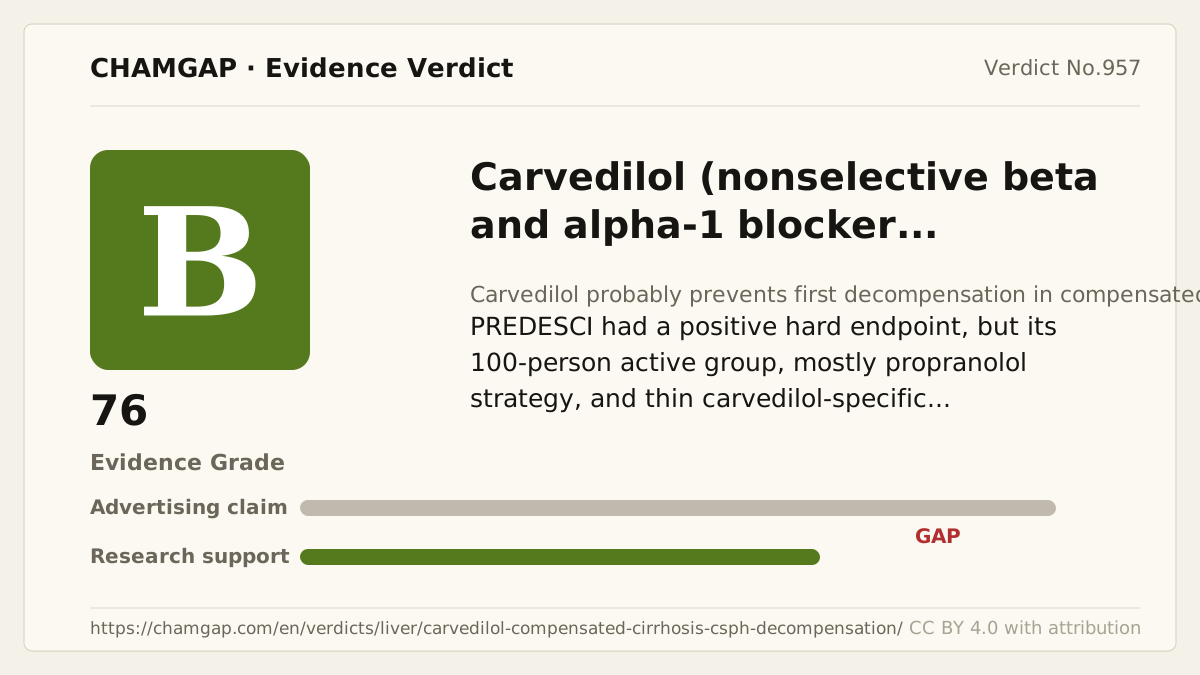
[Chamgap] Carvedilol x prevention of first decompensation in compensated cirrhosis with CSPH — Evidence Grade B·76. 3 cited sources checked. Source: https://chamgap.com/en/verdicts/liver/carvedilol-compensated-cirrhosis-csph-decompensation/ · CC BY 4.0CC BY 4.0 — free to use with attribution; do not distort grades, numbers, or verdict meaning.
What this document does and does not do
Chamgap is an information source. It reports what research has and has not confirmed; it does not tell readers what to take or buy. That decision belongs to readers and, when needed, medical or legal professionals. This verdict reflects literature available up to the search date and may change as new research appears. Nothing here is medical advice.