
Camu-camu fruit extract, 1.5 g/day,
does it really help with Reduced liver fat after 12 weeks in overweight adults with elevated triglycerides?
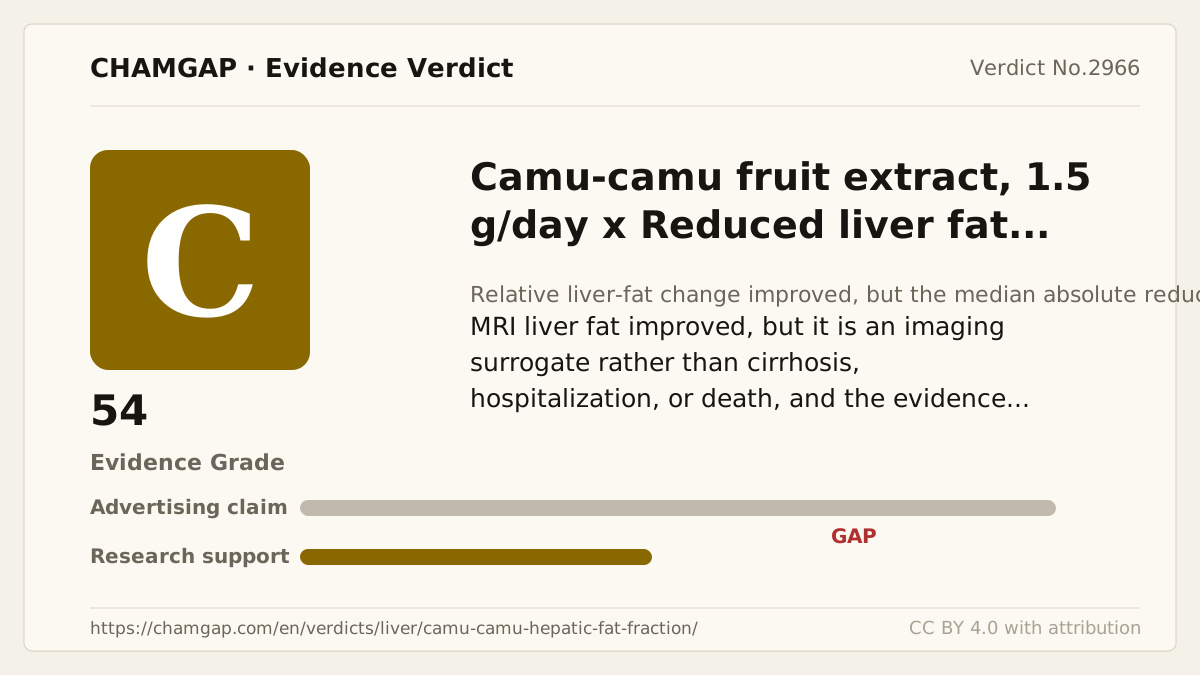
research showsGrade C. In a 35-participant crossover trial, the 30 completers had relative MRI liver-fat changes of -7.43% with camu-camu versus +8.42% with placebo, a between-treatment relative difference of -15.85% (P=.003). The median absolute HFF reduction was about 1.6 percentage points, and no confidence interval for this effect was reported.
ads claimThe -15.85% value is a relative-change contrast, not a 15.85-point absolute reduction. It should be paired with the approximately 1.6-point median absolute HFF reduction.
Useful facts when choosing a product
- Camu-camu is an extract of Myrciaria dubia fruit.
- The trial used 1.5 g/day for 12 weeks.
- The endpoint was MRI liver fat, not a clinical liver event.
Chamgap Semantic Classification Code
Candidate index · review held
S.camu-camu-fruit-extract.UNK.liver-fat-after-with-elevated-triglycerides.reduce.placeboSupplements and nutraceuticals > Camu-camu fruit extract > Unknown > liver fat after with elevated triglycerides > Reduction claim > Placebo
An automated migration candidate, not an issued permanent code; exact claim scope remains under review. This machine-generated migration candidate helps retrieval but is not a permanent assignment. The original verdict ID and URL remain authoritative.
What the research actually shows
NCT04130321 randomized 35 overweight adults with elevated fasting triglycerides to the order of camu-camu and placebo in a double-blind crossover trial. Each period lasted 12 weeks with a washout. Thirty participants completed both intervention periods, but the primary MRI liver-fat analysis included 20 participants in the camu-camu period and 25 in the placebo period. This is a key limitation of the positive result. The prespecified hepatic-steatosis outcome used the mean MRI HFF from five regions per participant. Funding came from the W. Garfield Weston Foundation's Weston Family Microbiome Initiative and CIHR. The paper did not report manufacturer funding, free product, commercial analysis, medical writing, or publication support. A. Marette disclosed a Pfizer-CIHR research chair and Y. Desjardins an NSERC-Diana Food industrial research chair.
Why this is classified as C (54)
The positive publicly funded result is limited by a surrogate endpoint and one 35-person study. Thirty participants completed both intervention periods, but the primary MRI liver-fat analysis included 20 in the camu-camu period and 25 in the placebo period. This is a key limitation of the positive result, giving C with 54 points.
Counterpoint. The verdict is limited to this extract, dose, duration, and MRI endpoint. Verdict 2962 is D with 34 points (/en/verdicts/liver/high-dose-green-tea-extract-liver-safety/) for high-dose green-tea-extract liver safety, showing why different plant extracts cannot be treated as one intervention.
Rejudgment record. Cross-check applied — Positive MRI liver-fat result and public funding, limited by a surrogate endpoint, completer analysis, and small sample
| Endpoint | S | Surrogate marker - laboratory or imaging measures |
| Replication | R1 | Single confirmatory trial |
| Independence | I2 | Decisive evidence is publicly or non-profit funded |
| Effect size | E+ | Meets the clinically important threshold |
Stored derived and displayed grades match; this is not a current recalculation or validity check (C).
Sub-claim grades by effect
This ingredient is marketed for several effects. A single overall grade blends strong and weak claims together, so each effect is graded separately here. The overall grade reflects the strongest disconfirming or core claim.
| Effect (sub-claim) | Grade | Basis |
|---|---|---|
| Reduced MRI liver fat at 12 weeks | C | The relative difference was -15.85%, P=.003, but the endpoint was an imaging surrogate. |
Cross-check — AI research and Codex final gate
Evidence Table
| Study | Design | Sample | Funding | Endpoint | Result | Weight |
|---|---|---|---|---|---|---|
| Marette A et al. 2024 camu-camu crossover trial | Double-blind randomized placebo-controlled crossover trial | 35 randomized; 30 completing both periods analyzed | Public/nonprofit funding from the Weston Family Microbiome Initiative and CIHR | Change from baseline in MRI hepatic fat fraction | -7.43% vs +8.42%; relative difference -15.85%, P=.003; median absolute HFF reduction about 1.6 points; CI not reported | Single small imaging-endpoint trial |
Receipt — 1 References
All 1 cited sources were verified for existence at the original page (as of 2026-08-26).
Final verification and publication gate: Codex · Evidence date: 2026-08-26 · Corrections: none
Cite this verdict
[Chamgap] Benefit of Camu-Camu Extract for 12-Week MRI Liver Fat — Evidence Grade C·54. 1 cited sources checked. Source: https://chamgap.com/en/verdicts/liver/camu-camu-hepatic-fat-fraction/ · CC BY 4.0CC BY 4.0 — free to use with attribution; do not distort grades, numbers, or verdict meaning.
What this document does and does not do
Chamgap is an information source. It reports what research has and has not confirmed; it does not tell readers what to take or buy. That decision belongs to readers and, when needed, medical or legal professionals. This verdict reflects literature available up to the search date and may change as new research appears. Nothing here is medical advice.