
Bezafibrate,
does it really help with Improved complete biochemical response and pruritus in primary biliary cholangitis with inadequate UDCA response?
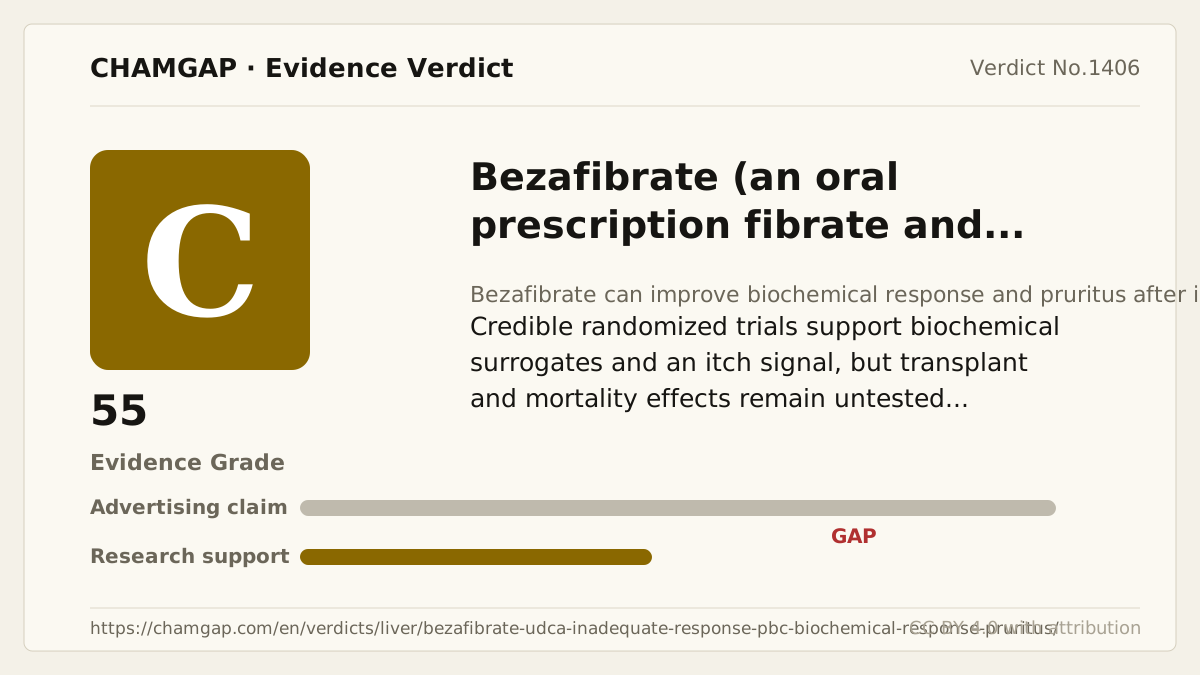
research showsBezafibrate is rated C because adding it to UDCA can improve complete biochemical response and pruritus in patients with PBC whose response to UDCA is inadequate. In the 100-participant BEZURSO trial, complete biochemical response at 24 months was 31% versus 0%, and the separate FITCH trial found improvement in moderate-to-severe cholestatic pruritus. The pivotal PBC trial, however, tested laboratory surrogates rather than transplantation or death and did not establish a hard-outcome benefit.
ads claimTurning laboratory normalization into claims of halted cirrhosis, prevented transplantation, or longer survival is an overstatement. Bezafibrate is an off-label specialist add-on for PBC, not a supplement or an unsupervised substitute for UDCA.
Useful facts when choosing a product
- Bezafibrate is an oral prescription fibrate acting through PPAR pathways. Its principal approved use is dyslipidemia, while use in PBC is off-label.
- The BEZURSO regimen added bezafibrate 400 mg to continued UDCA in patients whose biochemical response to UDCA was inadequate.
- Myalgia, muscle-enzyme elevation, increased serum creatinine, and liver-enzyme abnormalities require monitoring, particularly with impaired renal function or other myotoxic drugs.
- Fibrates should be avoided in decompensated cirrhosis, and any PBC treatment change requires specialist follow-up of laboratory values and symptoms.
Chamgap Semantic Classification Code
Candidate index · review held
M.bezafibrate.oral.complete-biochemical-response-and-pruritus-in-primary-biliary-cholangitis-with-inadequate-udca-response.improve.MULTIMedicinal interventions > Bezafibrate > Oral > complete biochemical response and pruritus in primary biliary cholangitis with inadequate UDCA response > Improvement claim > Multiple: primary unresolved
An automated migration candidate, not an issued permanent code; exact claim scope remains under review. This machine-generated migration candidate helps retrieval but is not a permanent assignment. The original verdict ID and URL remain authoritative.
What the research actually shows
Corpechot and colleagues randomized 100 patients with PBC and an inadequate response to properly dosed UDCA to add bezafibrate 400 mg or placebo for 24 months. Complete biochemical response occurred in 31% versus 0%, and alkaline phosphatase normalization in 67% versus 2%. Myalgia was reported in 20% and 10%, respectively, and creatinine increased with bezafibrate. The 74-participant FITCH trial by de Vries and colleagues found a 50% or greater pruritus reduction in 45% versus 11% after 21 days. This differs from verdict 531 on first-line UDCA: the present verdict concerns second-line add-on therapy after inadequate UDCA response.
Why this is classified as C (55)
A 24-month double-blind trial showing 31% versus 0% complete biochemical response and a separate positive pruritus trial provide credible signals. Because the main evidence is a biochemical surrogate, hard outcomes such as transplantation and death were not directly tested, and the itch trial was short, boundary rule ③ yields C with 55 points.
Counterpoint. For a patient with inadequate UDCA response and no decompensated cirrhosis, specialist-supervised add-on therapy is a reasonable evidence-based consideration.
Rejudgment record. New verdict — Applied the C ceiling for a credible randomized surrogate endpoint because BEZURSO established complete biochemical response and FITCH supported pruritus relief, while transplantation and mortality were not directly tested
Sub-claim grades by effect
This ingredient is marketed for several effects. A single overall grade blends strong and weak claims together, so each effect is graded separately here. The overall grade reflects the strongest disconfirming or core claim.
| Effect (sub-claim) | Grade | Basis |
|---|---|---|
| Improved complete biochemical response in PBC with inadequate UDCA response | C | BEZURSO found 31% versus 0% in 100 patients over 24 months, but the outcome was a biochemical surrogate. |
| Improved PBC-associated pruritus | C | Symptom findings from BEZURSO and the direct FITCH itch trial are supportive, with short-duration and mixed-disease limitations. |
| Reduced transplantation or mortality | C | This may be implied by disease-modifying claims but was not directly tested; the grade cannot exceed the surrogate evidence. |
Cross-check — AI research and Codex final gate
Evidence Table
| Study | Design | Sample | Funding | Endpoint | Result | Weight |
|---|---|---|---|---|---|---|
| Corpechot C et al. 2018 (BEZURSO) | Multicenter randomized double-blind placebo-controlled trial | 100 patients with PBC and inadequate UDCA response | French public research funding and Arrow Génériques | Complete biochemical response composite at 24 months | Bezafibrate plus UDCA achieved 31% versus 0% with placebo plus UDCA; alkaline phosphatase normalization was 67% versus 2%. | Key credible randomized trial using a surrogate |
| de Vries E et al. 2021 (FITCH) | Randomized double-blind placebo-controlled trial | 74 patients with cholestatic pruritus; 24 with PBC | Investigator-initiated through a Dutch liver research collaboration | At least a 50% reduction in pruritus VAS after 21 days | Response was 45% versus 11% overall; 55% of the PBC subgroup receiving bezafibrate responded. | Short but direct symptom trial |
Receipt — 2 References
All 2 cited sources were verified for existence at the original page (as of 2026-07-23).
Final verification and publication gate: Codex · Evidence date: 2026-07-23 · Corrections: none
Cite this verdict
[Chamgap] Bezafibrate x improved complete biochemical response and pruritus in UDCA-inadequate-response PBC — Evidence Grade C·55. 2 cited sources checked. Source: https://chamgap.com/en/verdicts/liver/bezafibrate-udca-inadequate-response-pbc-biochemical-response-pruritus/ · CC BY 4.0CC BY 4.0 — free to use with attribution; do not distort grades, numbers, or verdict meaning.
What this document does and does not do
Chamgap is an information source. It reports what research has and has not confirmed; it does not tell readers what to take or buy. That decision belongs to readers and, when needed, medical or legal professionals. This verdict reflects literature available up to the search date and may change as new research appears. Nothing here is medical advice.