
Betaine or TMG,
does it really help with Improvement of fatty liver, liver fat, and liver enzymes?
research showsBetaine has been tested in RCTs in NASH and in obesity with prediabetes, but major liver-enzyme, liver-fat, and histology outcomes were generally null. Positive evidence is limited to a small uncontrolled pilot and selected steatosis signals, supporting C.
ads claimTMG products can combine methylation, homocysteine, exercise performance, liver detoxification, and fatty liver in one message. Lower homocysteine or less liver fat in animals is not a treatment outcome for human NAFLD.
Useful facts when choosing a product
- TMG capsules and tablets providing 500-1000 mg are common on Korean cross-border marketplaces, and some products recommend 1-3 g/day.
- Liver trials used about 9.9-20 g/day, far above common exercise or methylation supplement intakes.
- Anhydrous betaine or TMG differs in salt form and purpose from betaine HCl products marketed for digestion or stomach acid.
- Gastrointestinal discomfort, body odor, and possible LDL increases have been reported at high doses, and prescription Cystadane dosing for homocystinuria must not be applied to common fatty liver.
Chamgap Semantic Classification Code
Candidate index · review held
S.betaine.UNK.fatty-liver-liver-fat-and-liver-enzymes.improve.placeboSupplements and nutraceuticals > Betaine > Unknown > fatty liver, liver fat, and liver enzymes > Improvement claim > Placebo
An automated migration candidate, not an issued permanent code; exact claim scope remains under review. This machine-generated migration candidate helps retrieval but is not a permanent assignment. The original verdict ID and URL remain authoritative.
What the research actually shows
The Abdelmalek 2001 pilot gave betaine 20 g/day for up to one year to ten patients with NASH and reported improvements in ALT, AST, and selected histology among seven participants, but there was no control group. The confirmatory Abdelmalek 2009 RCT randomized 55 patients with biopsy-confirmed NASH to 20 g/day or placebo for 12 months, with only 35 completing. Major liver tests, NAFLD activity score, and fibrosis did not differ between groups; only selected signals for improvement or prevention of worsening steatosis remained. Grizales 2018 gave 27 adults with obesity and prediabetes 6.6 g/day for ten days followed by 9.9 g/day for 12 weeks and found no effect on liver fat. Lower-dose exercise and homocysteine studies were not transferred to liver efficacy.
Why this is classified as C (41)
Direct RCTs exist, but the two key placebo-controlled trials were largely null for liver fat, enzymes, and histology, while positive evidence comes from an uncontrolled pilot and selected steatosis signals. This supports C with 41 points, while clinical prognosis is separately graded ?.
Counterpoint. A possibility of preventing worsening steatosis remains, so the evidence is not repeatedly disproven to an F level, but support for treating fatty liver at supplement doses is weak.
Rejudgment record. New verdict — A positive small pilot conflicts with largely null liver-fat, liver-enzyme, and histology outcomes in two key RCTs, supporting limited C evidence
Sub-claim grades by effect
This ingredient is marketed for several effects. A single overall grade blends strong and weak claims together, so each effect is graded separately here. The overall grade reflects the strongest disconfirming or core claim.
| Effect (sub-claim) | Grade | Basis |
|---|---|---|
| Improvement of imaging or histologic liver fat and steatosis | C | An uncontrolled pilot and selected RCT signals were positive, but two key RCTs were largely null. |
| Improvement of liver enzymes such as ALT and AST | D | The uncontrolled pilot was positive, but the 12-month placebo-controlled NASH trial found no between-group difference in major liver tests. |
| Improved clinical prognosis including cirrhosis, liver cancer, or transplantation | ? | No betaine trial assessing these clinical outcomes was identified. |
Cross-check — AI research and Codex final gate
Evidence Table
| Study | Design | Sample | Funding | Endpoint | Result | Weight |
|---|---|---|---|---|---|---|
| Abdelmalek et al. 2001 | Uncontrolled pilot clinical trial | 10 | Unknown | ALT, AST, and liver biopsy | Enzyme and histology improvements were reported among seven completers, but there was no control group. | Supportive |
| Abdelmalek et al. 2009 | Randomized placebo-controlled trial | 35 | NIH research support | Liver tests, NAFLD activity score, fibrosis, and steatosis | There was no between-group difference in major liver tests, NAS, or fibrosis; only selected steatosis signals remained. | Key |
| Grizales et al. 2018 | Randomized double-blind placebo-controlled trial | 26 | American Diabetes Association and academic institutions | Liver fat, insulin sensitivity, and glycemia | Approximately 9.9 g/day for 12 weeks had no significant effect on liver fat. | Key |
Receipt — 4 References
All 4 cited sources were verified for existence at the original page (as of 2026-07-17).
Final verification and publication gate: Codex · Evidence date: 2026-07-17 · Corrections: none
Cite this verdict
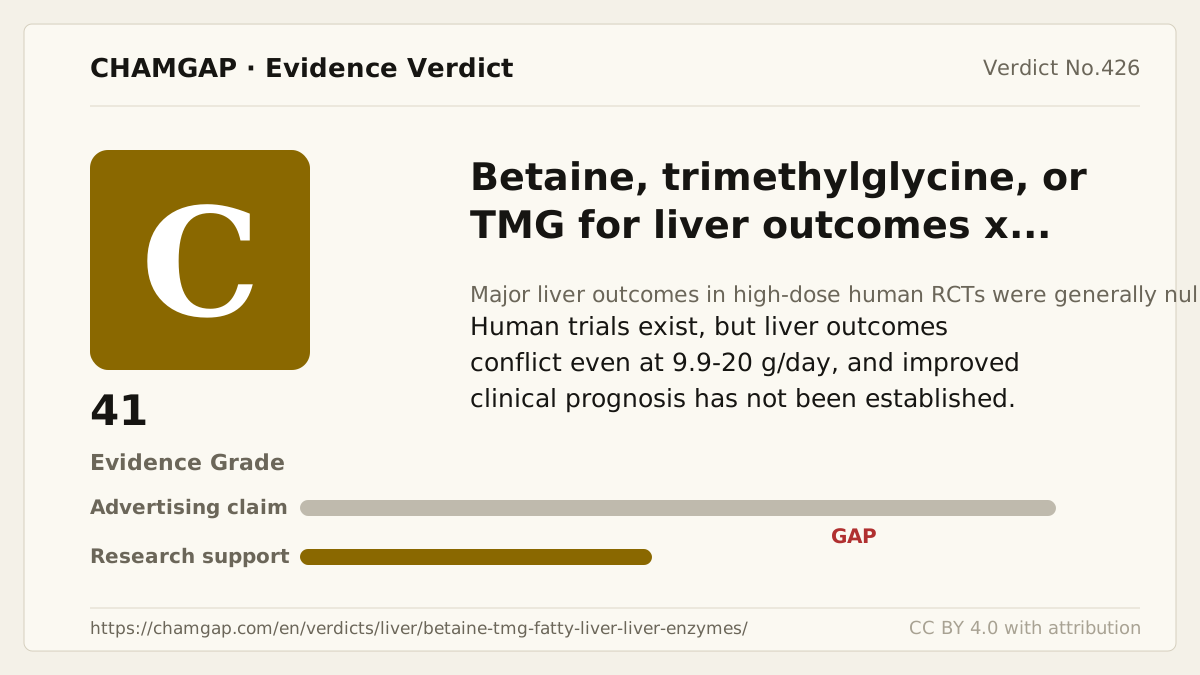
[Chamgap] Betaine or TMG x fatty liver, liver fat, and liver enzymes — Evidence Grade C·41. 4 cited sources checked. Source: https://chamgap.com/en/verdicts/liver/betaine-tmg-fatty-liver-liver-enzymes/ · CC BY 4.0CC BY 4.0 — free to use with attribution; do not distort grades, numbers, or verdict meaning.
What this document does and does not do
Chamgap is an information source. It reports what research has and has not confirmed; it does not tell readers what to take or buy. That decision belongs to readers and, when needed, medical or legal professionals. This verdict reflects literature available up to the search date and may change as new research appears. Nothing here is medical advice.