
Branched-chain amino acids,
does it really help with Improvement of consciousness and neuropsychiatric symptoms in cirrhosis-related hepatic encephalopathy?
research showsBCAAs are rated C because they may improve clinical manifestations of cirrhosis-related hepatic encephalopathy. The 2026 Cochrane update estimated less hepatic encephalopathy across 18 randomized trials and 934 participants, but the RR of 0.79 (95% CI 0.64 to 0.96) was supported by low-certainty evidence. Mortality was not reduced across 17 trials and 867 participants, with an RR of 0.89 (95% CI 0.71 to 1.12) and very low certainty. The evidence mixes old and small trials of oral and intravenous administration, overt and covert encephalopathy, and controls ranging from diets to lactulose and neomycin, creating substantial treatment heterogeneity and risk of bias. This is a hepatic-encephalopathy medical-nutrition axis, distinct from the muscle and exercise axis in verdict 079. Nausea, diarrhea, and caution about protein and nitrogen load in impaired kidney function are separated under safety.
ads claimMarketing can bundle BCAAs into claims of liver detoxification, ammonia removal, restored consciousness, and longer survival. The evidence is confined to a possible improvement in manifestations of hepatic encephalopathy accompanying cirrhosis and is separate from general liver-health or sports-BCAA claims.
Useful facts when choosing a product
- BCAAs are medical-nutrition amino acid mixtures containing leucine, isoleucine, and valine. Hepatic-encephalopathy trials used both oral supplements and intravenous nutrition, which cannot automatically be equated with retail sports supplements.
- Management of hepatic encephalopathy prioritizes correction of triggers such as infection, gastrointestinal bleeding, constipation, dehydration, and sedatives together with standard therapy; BCAAs do not replace urgent assessment or prescription treatment.
- Products differ in the ratio of the three amino acids, serving size, energy content, and accompanying amino acids or nutrients, so results from a studied medical formulation cannot be transferred to any exercise powder.
- Tolerability is generally acceptable, but nausea and diarrhea can occur. People with impaired kidney function should have amino acid and nitrogen loads individualized by their clinical team.
Chamgap Semantic Classification Code
Candidate index · review held
S.branched-chain-amino-acids.UNK.consciousness-and-neuropsychiatric-symptoms-in-cirrhosis-related-hepatic-encephalopathy.improve.usual-careSupplements and nutraceuticals > Branched-chain amino acids > Unknown > consciousness and neuropsychiatric symptoms in cirrhosis-related hepatic encephalopathy > Improvement claim > Usual care
An automated migration candidate, not an issued permanent code; exact claim scope remains under review. This machine-generated migration candidate helps retrieval but is not a permanent assignment. The original verdict ID and URL remain authoritative.
What the research actually shows
The 2026 Cochrane review by Aamann and colleagues synthesized 18 randomized trials, including 13 in overt and five in covert hepatic encephalopathy. BCAAs improved the hepatic-encephalopathy outcome with low certainty, while effects on all-cause mortality, nausea and diarrhea, albumin, and nitrogen balance could not be determined because certainty was very low. Marchesini and colleagues randomized 64 people with chronic hepatic encephalopathy to BCAAs at 0.24 g/kg or isonitrogenous casein; after three months, the portosystemic encephalopathy index improved significantly with BCAAs. A 1990 acute trial by Vilstrup and colleagues in 65 participants did not improve the prognosis for awakening, although it reported changes in some cerebral-state measures and nitrogen homeostasis. The possibility of symptom improvement therefore cannot be extended to replacement of modern standard therapy or reduced mortality.
Why this is classified as C (54)
The 2026 Cochrane review found a direct neuropsychiatric clinical signal for less non-improvement or worsening of hepatic encephalopathy, RR 0.79, rather than merely an ammonia surrogate. Mortality was not reduced, RR 0.89, but the claim concerns symptom improvement. Old small trials and heterogeneity in route, controls, and disease stage preclude B, while the direct symptom signal makes D too harsh, yielding C with 54 points.
Counterpoint. For a patient with cirrhosis who cannot consume enough ordinary protein or has protein intolerance, a liver specialist and nutrition team may consider BCAA medical nutrition as an adjunct. New altered consciousness requires immediate evaluation for hepatic encephalopathy and triggers rather than a supplement trial.
Rejudgment record. New verdict — Accepted the low-certainty hepatic-encephalopathy signal in the 2026 Cochrane review, but applied C for limited and heterogeneous evidence because mortality was null, trials varied in bias, route, disease stage, and comparator, and modern head-to-head standard-therapy evidence was inadequate
Sub-claim grades by effect
This ingredient is marketed for several effects. A single overall grade blends strong and weak claims together, so each effect is graded separately here. The overall grade reflects the strongest disconfirming or core claim.
| Effect (sub-claim) | Grade | Basis |
|---|---|---|
| Improvement of neuropsychiatric manifestations of cirrhosis-related hepatic encephalopathy | C | The latest Cochrane review found a direct clinical signal at RR 0.79, but trial bias and heterogeneity were substantial; mortality was not reduced across 17 trials and 867 participants, RR 0.89 (0.71 to 1.12). |
| Recovery of consciousness in overt hepatic encephalopathy | C | Improved mental status in a chronic trial coexists with a null prognosis for awakening in an acute trial, making results inconsistent. |
Cross-check — AI research and Codex final gate
Evidence Table
| Study | Design | Sample | Funding | Endpoint | Result | Weight |
|---|---|---|---|---|---|---|
| Aamann L et al. 2026 Cochrane review | Systematic review and meta-analysis of randomized clinical trials | 18 trials with 934 participants for hepatic encephalopathy; 17 trials with 867 participants for mortality | No external funding for the Cochrane review; for-profit organizations supplied interventions in three included trials | Non-improvement or worsening of hepatic encephalopathy, all-cause mortality, nausea, and diarrhea | Hepatic encephalopathy was reduced with RR 0.79 (95% CI 0.64 to 0.96) at low certainty; mortality did not differ with RR 0.89 (95% CI 0.71 to 1.12) at very low certainty. | Key current synthesis |
| Marchesini G et al. 1990 | Multicenter randomized double-blind isonitrogenous casein-controlled trial | 64 patients with chronic hepatic encephalopathy | Inadequately reported; older formulation-evaluation study | Three-month portosystemic encephalopathy index and neuropsychological function | The encephalopathy index improved from 40% to 21% with BCAAs, and 80% improved on at least two measures versus 35% with casein. | Direct positive but small and old trial |
| Vilstrup H et al. 1990 | Randomized double-blind glucose-controlled trial in acute hepatic encephalopathy | 65 patients with cirrhosis | Inadequately reported | Prognosis for awakening, cerebral state, and nitrogen homeostasis over up to 16 days | Intravenous BCAA-enriched amino acids did not improve the prognosis for awakening but changed some cerebral-state and nitrogen-homeostasis measures. | Null and mixed signal for acute recovery of consciousness |
Receipt — 3 References
All 3 cited sources were verified for existence at the original page (as of 2026-07-20).
Final verification and publication gate: Codex · Evidence date: 2026-07-20 · Corrections: none
Cite this verdict
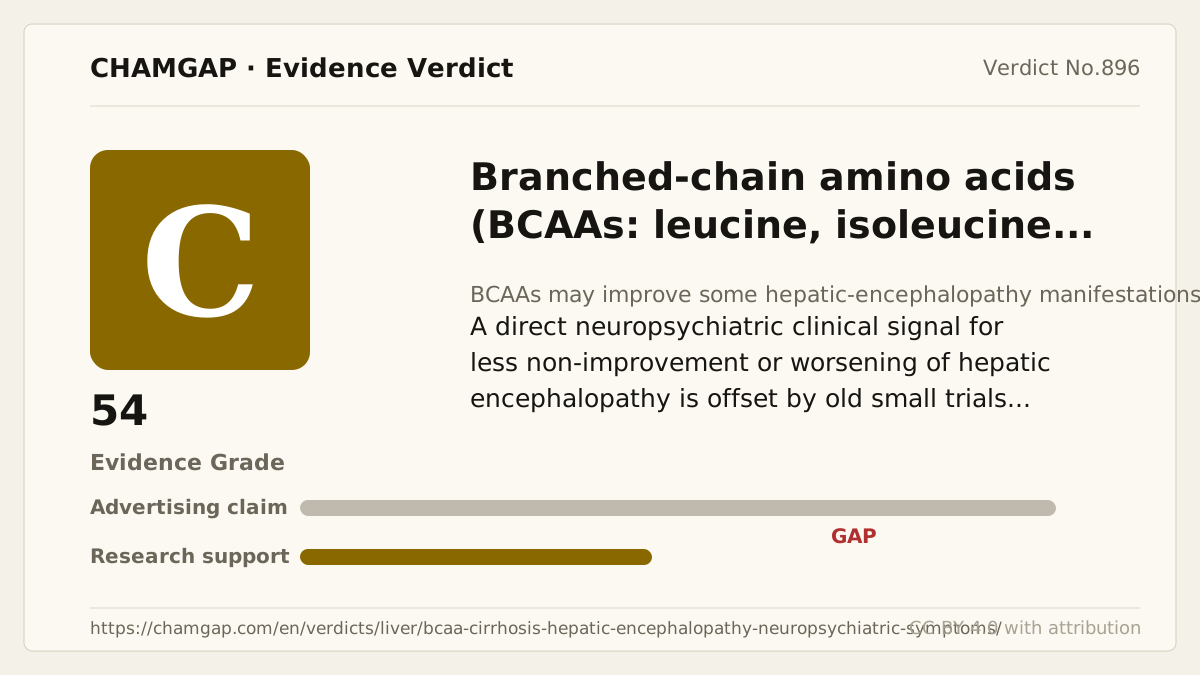
[Chamgap] Branched-chain amino acids x improvement of consciousness and neuropsychiatric symptoms in cirrhosis-related hepatic encephalopathy — Evidence Grade C·54. 3 cited sources checked. Source: https://chamgap.com/en/verdicts/liver/bcaa-cirrhosis-hepatic-encephalopathy-neuropsychiatric-symptoms/ · CC BY 4.0CC BY 4.0 — free to use with attribution; do not distort grades, numbers, or verdict meaning.
What this document does and does not do
Chamgap is an information source. It reports what research has and has not confirmed; it does not tell readers what to take or buy. That decision belongs to readers and, when needed, medical or legal professionals. This verdict reflects literature available up to the search date and may change as new research appears. Nothing here is medical advice.