
Acer tegmentosum extract,
does it really help with Relief of hangover and improvement of alcohol-related liver injury, fatty liver, and liver enzymes?
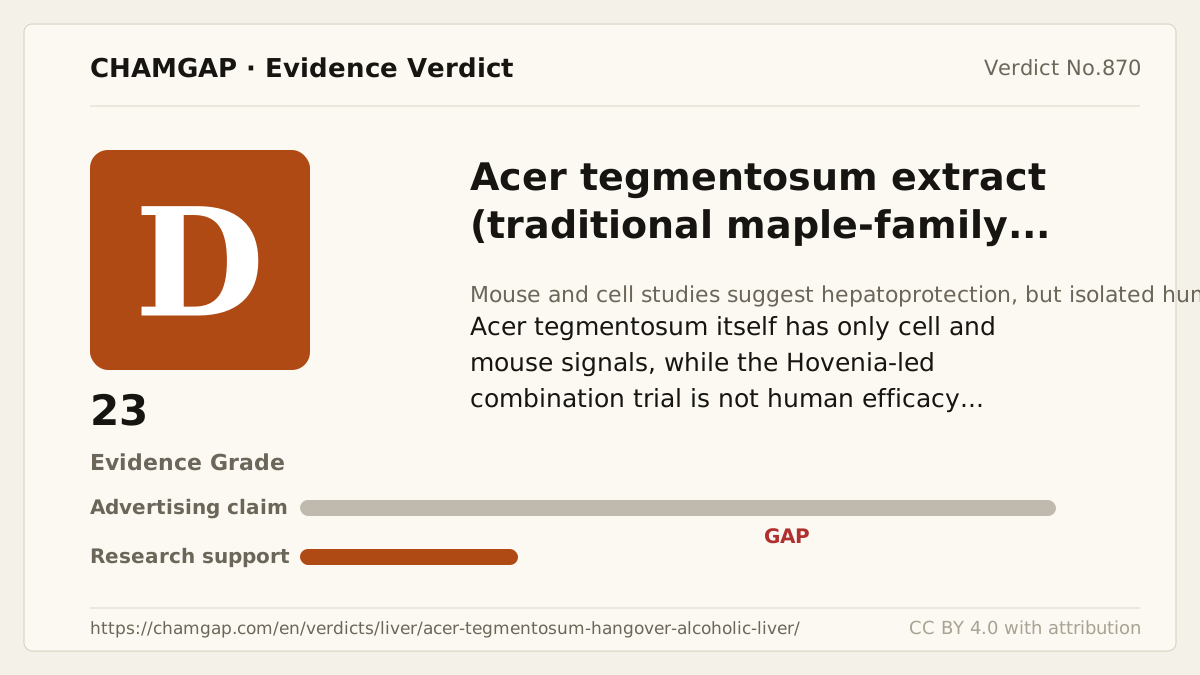
research showsAcer tegmentosum extract is rated D for relieving hangover and improving alcohol-related liver injury, fatty liver, or liver enzymes. Direct positive evidence is mainly preclinical, measuring transaminases, fat accumulation, oxidative pathways, and autophagy in alcohol- or carbon-tetrachloride-injured mice and HepG2 cells. A 25-person randomized crossover hangover study included Acer tegmentosum at 0.1% as a minor ingredient, but the beverages also contained Hovenia dulcis, Pueraria lobata or glutathione yeast, Alnus japonica, fermented rice embryo, albumin, and other ingredients, so the isolated effect cannot be determined. No controlled single-ingredient human trial was identified for alcohol-related fatty liver or sustained liver-enzyme improvement, supporting D for preclinical-only evidence.
ads claimMarketing translates lower transaminases in mice and antioxidant signals in cells into liver detoxification and fatty-liver treatment in humans, then attributes a combination beverage result to Acer tegmentosum alone. Hangover symptom relief and treatment of steatosis, hepatitis, or fibrosis are distinct clinical claims.
Useful facts when choosing a product
- Acer tegmentosum is a maple-family tree whose stems, twigs, and bark have traditional East Asian uses; extraction solvent, plant part, and marker compounds differ across studies.
- Recognition as a food or functional ingredient indicates evidence and specifications for defined manufacturing conditions, not proven clinical efficacy for every commercial product.
- Hangover beverages commonly combine Hovenia, kudzu, yeast, alder, vitamins, and other ingredients, so even a product effect cannot identify the contribution of Acer tegmentosum.
- Preclinical repeated-dose studies provide some reassurance, but human long-term use, use in liver disease, medicine interactions, and product-specific purity and standardization remain inadequately characterized.
Chamgap Semantic Classification Code
Candidate index · review held
S.acer-tegmentosum-extract.UNK.hangover-and-improvement-of-alcohol-related-liver-injury-fatty-liver-and-liver-enzymes.relieve.placeboSupplements and nutraceuticals > Acer tegmentosum extract > Unknown > hangover and improvement of alcohol-related liver injury, fatty liver, and liver enzymes > Symptom-relief claim > Placebo
An automated migration candidate, not an issued permanent code; exact claim scope remains under review. This machine-generated migration candidate helps retrieval but is not a permanent assignment. The original verdict ID and URL remain authoritative.
What the research actually shows
Lee and colleagues administered HIMH0021, a flavonoid from Acer tegmentosum extract, in a chronic-plus-binge mouse model and assessed ALT, AST, hepatic fat, CYP2E1, inflammation, and AMPK-related markers. Park and colleagues applied an Acer tegmentosum water extract to mice injured by alcohol or carbon tetrachloride and to HepG2 cells exposed to hydrogen peroxide or alcohol, measuring transaminases, triglycerides, malondialdehyde, Nrf2 and HO-1, and autophagy. In the human study by Lee and colleagues, 25 adults with prior hangover experience crossed over between placebo and two combination beverages. Acer tegmentosum was a 0.1% minor ingredient in both test beverages, which also shared Hovenia dulcis, Alnus japonica, fermented rice embryo, albumin, vitamin C, and other ingredients and differed in Pueraria lobata or glutathione yeast. No isolated effect can be estimated.
Why this is classified as D (23)
Positive signals for enzymes, fat accumulation, and oxidative pathways come from alcohol-injured mice and HepG2 cells. There is no human efficacy evidence for Acer tegmentosum itself: the 25-person publication tested a Hovenia dulcis-led multi-ingredient beverage in which Acer tegmentosum was only a shared 0.1% minor ingredient. With no single-ingredient human trial for hangover, alcoholic fatty liver, or sustained enzymes, preclinical-only evidence gives D with 23 points.
Counterpoint. Persistent elevation of AST or ALT or fatty liver calls for alcohol reduction or abstinence, weight and metabolic-risk management, and diagnosis of the cause. A hangover product does not prevent alcohol harm or create a safer drinking allowance.
Rejudgment record. New verdict — Accepted positive Acer tegmentosum liver-enzyme, steatosis, and oxidative-marker signals in alcohol-injured mice and HepG2 cells, but treated the 25-person Hovenia-led combination beverage as no human efficacy evidence for Acer tegmentosum because it was only a shared 0.1% minor ingredient; no single-ingredient human outcome exists for hangover, alcoholic fatty liver, or sustained liver enzymes
Sub-claim grades by effect
This ingredient is marketed for several effects. A single overall grade blends strong and weak claims together, so each effect is graded separately here. The overall grade reflects the strongest disconfirming or core claim.
| Effect (sub-claim) | Grade | Basis |
|---|---|---|
| Relief of hangover symptoms | D | Acer tegmentosum itself has only preclinical evidence. The 25-person study tested a Hovenia-led multi-ingredient beverage in which it was only a shared 0.1% minor ingredient, so no human effect can be attributed to it. |
| Improvement of alcohol-related liver injury and fatty liver | D | Positive findings are confined to mice and HepG2 cells, with no clinical outcomes in patients. |
| Improvement of liver enzymes such as AST and ALT | D | Mouse surrogate markers improved, but no single-ingredient trial verified sustained liver-enzyme improvement in humans. |
Cross-check — AI research and Codex final gate
Evidence Table
| Study | Design | Sample | Funding | Endpoint | Result | Weight |
|---|---|---|---|---|---|---|
| Lee Y et al. 2017 | Chronic-plus-binge mouse study and hepatocyte mechanism experiments using a constituent isolated from Acer tegmentosum | Seven mice per group; zero humans | Korea Forest Service forest-science research support | ALT, AST, hepatic fat, inflammation, CYP2E1, and AMPK signaling | HIMH0021 reduced transaminases, fat accumulation, and inflammation in alcohol-exposed mice. | Direct-ingredient preclinical signal |
| Park HS et al. 2019 | Alcohol- and carbon-tetrachloride-injured mouse and HepG2 cell experiments | Mice and cultured cells; zero humans | Academic and functional-ingredient development context | Transaminases, triglycerides, malondialdehyde, Nrf2 and HO-1, and autophagy | The water extract improved markers of mouse liver injury and cellular oxidative injury. | Corroborating preclinical evidence |
| Lee KW et al. 2024 | Randomized double-blind placebo-controlled crossover hangover trial | 25 adults aged 19 to 40 years | Korean Ministry of Food and Drug Safety support; multiple Kwangdong Pharmaceutical employee authors | Blood alcohol, acetaldehyde, and Acute Hangover Scale | Combination beverages improved selected early alcohol and hangover measures, but Acer tegmentosum was a 0.1% minor ingredient among many, preventing isolation of its effect. | Human evidence for a Hovenia-led combination, not human efficacy evidence for Acer tegmentosum |
Receipt — 3 References
All 3 cited sources were verified for existence at the original page (as of 2026-07-20).
Final verification and publication gate: Codex · Evidence date: 2026-07-20 · Corrections: none
Cite this verdict
[Chamgap] Acer tegmentosum extract x hangover relief and alcohol-related liver improvement — Evidence Grade D·23. 3 cited sources checked. Source: https://chamgap.com/en/verdicts/liver/acer-tegmentosum-hangover-alcoholic-liver/ · CC BY 4.0CC BY 4.0 — free to use with attribution; do not distort grades, numbers, or verdict meaning.
What this document does and does not do
Chamgap is an information source. It reports what research has and has not confirmed; it does not tell readers what to take or buy. That decision belongs to readers and, when needed, medical or legal professionals. This verdict reflects literature available up to the search date and may change as new research appears. Nothing here is medical advice.