
Vitamin D3,
does it really help with Prevention of falls in community-dwelling older adults without vitamin D deficiency?
research showsVitamin D3 is rated F because it does not prevent falls in community-dwelling older adults without documented deficiency. In the D-Health trial of 21,315 participants, 60,000 IU monthly did not reduce fall risk over as long as five years, and Cochrane found no benefit for most older people living in the community. High bolus doses such as 500,000 IU annually and 60,000 IU monthly increased falls or fractures in some trials and should not be used for fall prevention.
ads claimMarketing extends the roles of vitamin D in muscle and bone directly into a promise to prevent falling. Raising serum 25-hydroxyvitamin D and reducing actual falls are different outcomes, and the assumption that more is better can reverse into harm.
Useful facts when choosing a product
- Vitamin D3 is widely sold in Korea alone or with calcium and vitamin K in products ranging from about 1,000 to 5,000 IU and other strengths.
- One microgram of vitamin D3 equals 40 IU, and combining products can unintentionally duplicate the total dose.
- Self-directed monthly or annual high-dose boluses for fall prevention lack benefit and increased harm in some trials.
- Excess can cause hypercalcemia, hypercalciuria, and kidney stones; treatment doses for deficiency should follow laboratory testing and clinical guidance.
Chamgap Semantic Classification Code
Candidate index · review held
S.vitamin-d3.UNK.falls-without-vitamin-d-deficiency.prevent.placeboSupplements and nutraceuticals > Vitamin D3 (cholecalciferol) > Unknown > falls without vitamin D deficiency > Occurrence-prevention claim > Placebo
An automated migration candidate, not an issued permanent code; exact claim scope remains under review. This machine-generated migration candidate helps retrieval but is not a permanent assignment. The original verdict ID and URL remain authoritative.
What the research actually shows
The 2021 D-Health analysis by Waterhouse and colleagues randomized 21,315 adults aged 60 to 84 years to 60,000 IU of vitamin D3 monthly or placebo for up to five years and found no reduction in falling, with an odds ratio of 1.02 and a 95% confidence interval of 0.95 to 1.10. A Cochrane review of community fall prevention found that vitamin D does not reduce falls in most community-dwelling older adults, while separating a possible effect in people with low baseline levels. In the 2010 Sanders trial, annual administration of 500,000 IU of vitamin D3 to 2,256 community-dwelling women increased falls and fractures. The 2016 Bischoff-Ferrari trial also found more fallers with monthly 60,000 IU or 24,000 IU plus calcifediol than with 24,000 IU monthly.
Why this is classified as F (5)
An independent trial with more than 20,000 participants and several other large trials and syntheses repeatedly found no benefit for the direct clinical outcome of falls, while high-dose vitamin D3 increased falls and fractures, supporting F with 5 points. Safety harm is recorded separately, and deficiency and care-facility populations are different subclaims.
Counterpoint. Treatment of confirmed deficiency and supplementation in care-facility residents fall outside this judgment and require individualized assessment.
Rejudgment record. New verdict — Repeated null direct fall outcomes in large independent trials and evidence syntheses among nondeficient community-dwelling older adults, with increased falls and fractures from high bolus dosing
Sub-claim grades by effect
This ingredient is marketed for several effects. A single overall grade blends strong and weak claims together, so each effect is graded separately here. The overall grade reflects the strongest disconfirming or core claim.
| Effect (sub-claim) | Grade | Basis |
|---|---|---|
| Fall prevention in community-dwelling older adults without vitamin D deficiency | F | D-Health with more than 20,000 participants and several independent large trials and meta-analyses found no reduction in actual falls. |
| Fall prevention with high bolus doses of vitamin D3 | F | Trials of regimens including 500,000 IU annually and 60,000 IU monthly found no preventive benefit, with increased falls or fractures in some studies. |
Cross-check — AI research and Codex final gate
Evidence Table
| Study | Design | Sample | Funding | Endpoint | Result | Weight |
|---|---|---|---|---|---|---|
| Waterhouse M et al. 2021, D-Health | Population-based randomized double-blind placebo-controlled trial | 15,416 | Public funding including the Australian NHMRC | Risk and incidence of falls with 60,000 IU of vitamin D3 monthly | Over up to five years, the odds ratio for a fall in the previous month was 1.02 with a 95% confidence interval of 0.95 to 1.10, showing no reduction. | Key |
| Gillespie LD et al. 2012 | Cochrane systematic review | 79,193 | Independent systematic review | Rate of falls and number of people falling | Vitamin D did not reduce falls in most community-dwelling older adults, while people with low baseline levels were considered separately. | Key |
| Sanders KM et al. 2010 | Randomized double-blind placebo-controlled trial | 2,256 | Australian public research funding | Falls and fractures after 500,000 IU of vitamin D3 annually | A single annual high dose increased the risk of falls and fractures compared with placebo. | Key high-dose harm evidence |
| Bischoff-Ferrari HA et al. 2016 | Randomized double-blind comparative trial | n=200 | Public and foundation funding | Function and falls with monthly 24,000 IU, 60,000 IU, or vitamin D3 plus calcifediol | The two higher-dose groups had more fallers than the lower-dose group, showing no high-dose benefit and a harm signal. | Supportive |
Receipt — 4 References
All 4 cited sources were verified for existence at the original page (as of 2026-07-18).
Final verification and publication gate: Codex · Evidence date: 2026-07-18 · Corrections: none
Cite this verdict
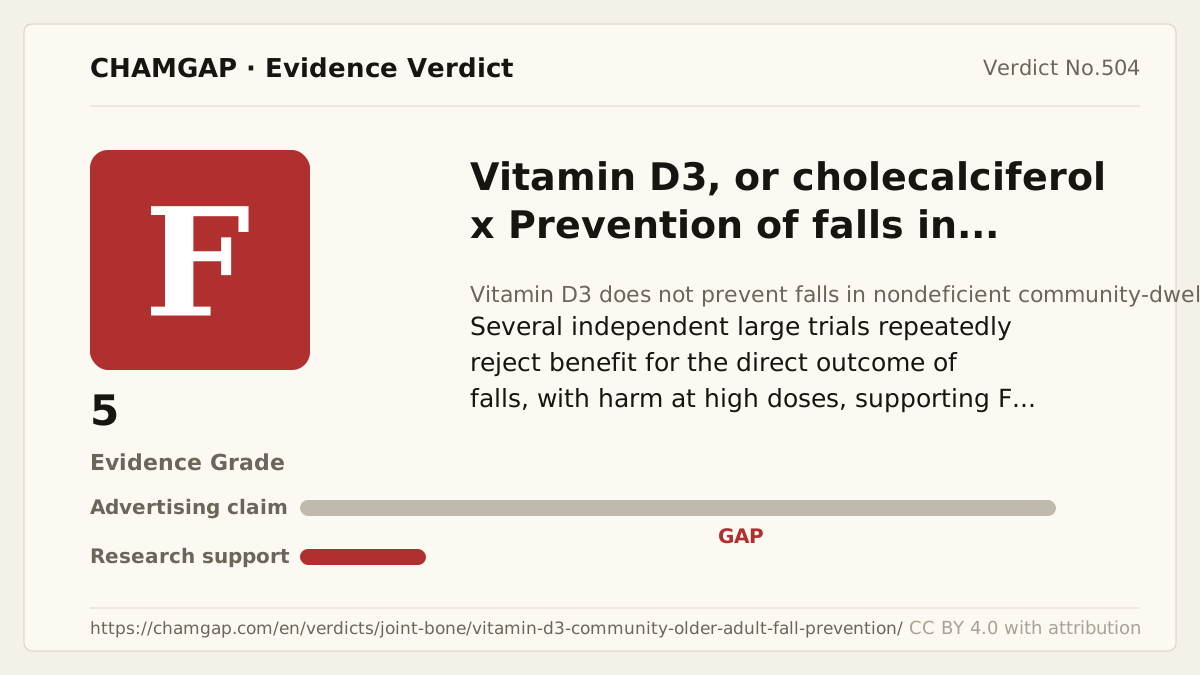
[Chamgap] Vitamin D3 x fall prevention in community-dwelling older adults — Evidence Grade F·5. 4 cited sources checked. Source: https://chamgap.com/en/verdicts/joint-bone/vitamin-d3-community-older-adult-fall-prevention/ · CC BY 4.0CC BY 4.0 — free to use with attribution; do not distort grades, numbers, or verdict meaning.
What this document does and does not do
Chamgap is an information source. It reports what research has and has not confirmed; it does not tell readers what to take or buy. That decision belongs to readers and, when needed, medical or legal professionals. This verdict reflects literature available up to the search date and may change as new research appears. Nothing here is medical advice.