
Prunes,
does it really help with Maintenance of postmenopausal bone density and prevention of osteoporosis and fractures?
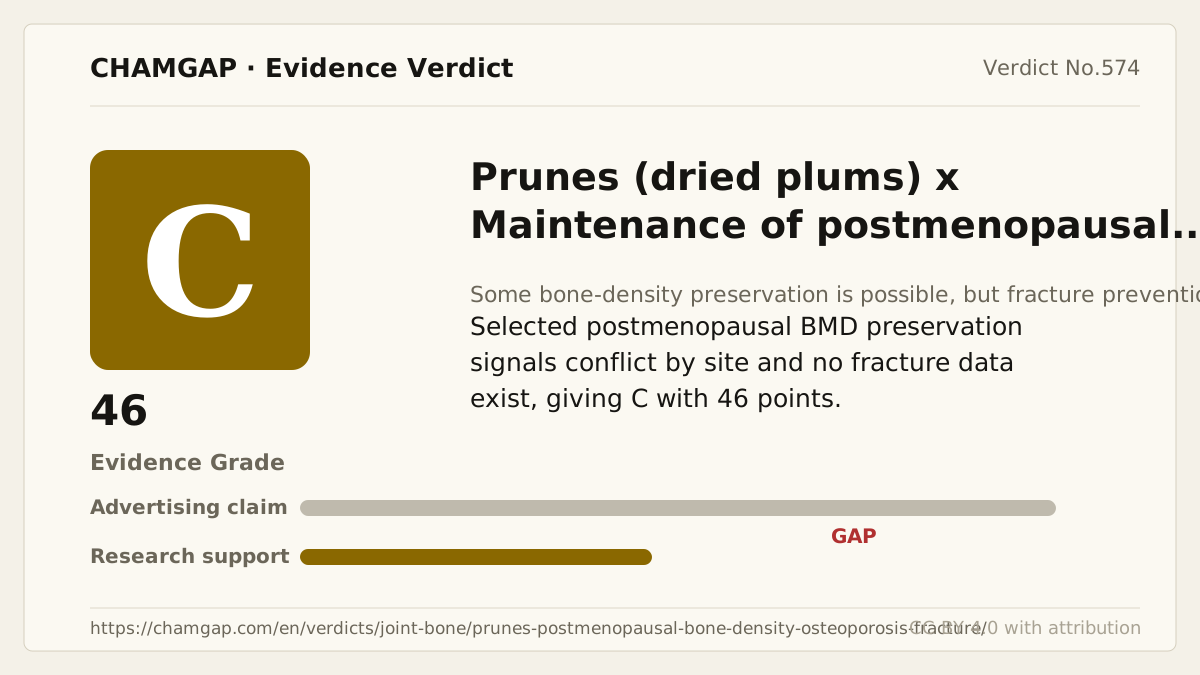
research showsPrunes are rated C because they may slow loss at selected bone-density sites in postmenopausal women, but the evidence centers on BMD and bone-turnover surrogates. In a 2022 trial of 235 women, 50 g/day reduced 12-month total-hip BMD loss from 1.1% to 0.3%, whereas the 100-g group was not significant and had 41% dropout. A 2026 meta-analysis found only a borderline lumbar-spine signal, no significant effect at other sites or on bone markers, and very high heterogeneity. Adequate trials have not shown fewer fractures.
ads claimMarketing links BMD preservation to prevention of osteoporosis and fractures. A small site-specific BMD change is not the same clinical outcome as fewer fractures.
Useful facts when choosing a product
- The most practical trial dose was 50 g per day, about five or six prunes, while long-term adherence was poor at 100 g.
- Prunes contain fiber and sorbitol, which may help constipation but can cause gas, bloating, or diarrhea.
- Dried fruit concentrates sugar and calories, so people managing diabetes or calorie intake should account for the serving within the whole diet.
- Prunes do not replace calcium and vitamin D adequacy, strength and balance exercise, fall prevention, or prescription osteoporosis treatment.
Chamgap Semantic Classification Code
Candidate index · review held
UNK.prunes.UNK.postmenopausal-bone-density-and-prevention-of-osteoporosis-and-fractures.prevent.UNKUnknown > Prunes > Unknown > postmenopausal bone density and prevention of osteoporosis and fractures > Occurrence-prevention claim > Unknown
An automated migration candidate, not an issued permanent code; exact claim scope remains under review. This machine-generated migration candidate helps retrieval but is not a permanent assignment. The original verdict ID and URL remain authoritative.
What the research actually shows
The Prune Study by De Souza et al. randomized 235 postmenopausal women to control, 50 g/day, or 100 g/day. At 12 months, total-hip BMD loss was 0.3% in the 50-g group versus 1.1% in control, but the 100-g comparison was not significant and dropout reached 41% in that group. Hooshmand et al. 2016 studied 48 osteopenic women for six months and reported that both doses limited whole-body BMD loss and reduced TRAP-5b. The 2026 meta-analysis by Arjmandi et al. pooled 11 papers and 747 participants, finding a borderline lumbar-only signal, null results at other sites and for bone markers, and high heterogeneity. None directly demonstrated fracture reduction.
Why this is classified as C (46)
The 235-participant one-year trial produced a borderline 50-g hip-BMD signal, but the 100-g arm was null and dropout was 41%. The latest lumbar-spine meta-analytic signal was also borderline, while dose and site inconsistency, high heterogeneity, industry-funding concentration, and no fracture outcome remain. The surrogate ceiling gives C with 46 points.
Counterpoint. A daily 50-g food serving may fit a balanced diet if tolerated. People at high fracture risk should not delay DXA evaluation and proven therapy.
Rejudgment record. New verdict — Accepted postmenopausal BMD trial signals but applied the rule ① ceiling of C for dose and site inconsistency, meta-analytic heterogeneity, and no fracture clinical outcome
Sub-claim grades by effect
This ingredient is marketed for several effects. A single overall grade blends strong and weak claims together, so each effect is graded separately here. The overall grade reflects the strongest disconfirming or core claim.
| Effect (sub-claim) | Grade | Basis |
|---|---|---|
| Maintenance of postmenopausal BMD | C | A 50-g hip signal exists, but results conflict by dose and site and heterogeneity is high. |
| Fracture prevention | ? | No adequate human trial has assessed a reduction in actual fractures. |
| Improved bone-turnover markers | C | Some small trials were positive, but the latest synthesis found no significant effect. |
Cross-check — AI research and Codex final gate
Evidence Table
| Study | Design | Sample | Funding | Endpoint | Result | Weight |
|---|---|---|---|---|---|---|
| De Souza MJ et al. 2022 Prune Study | Twelve-month single-center randomized controlled trial | 235 postmenopausal women | Supported by the California Prune Board | Hip, spine, and whole-body BMD and bone markers | Total-hip BMD changed by -0.3% in the 50-g group and -1.1% in control, while the 100-g comparison was not significant. | Key BMD trial with industry support |
| Hooshmand S et al. 2016 | Six-month randomized controlled trial | 48 osteopenic postmenopausal women | Supported by the California Dried Plum Board | Whole-body, hip, and spine BMD and bone-turnover markers | Both 50 g and 100 g showed signals for limiting whole-body BMD loss and reducing TRAP-5b. | Small surrogate study |
| Arjmandi BH et al. 2026 | Systematic review and meta-analysis of randomized trials | 11 papers and 747 participants | No external funding reported; many included trials had industry support | Site-specific BMD and bone formation and resorption markers | The lumbar-spine result was borderline, other BMD sites and markers were not significant, and heterogeneity was high. | Latest conflicting synthesis |
Receipt — 3 References
All 3 cited sources were verified for existence at the original page (as of 2026-07-19).
Final verification and publication gate: Codex · Evidence date: 2026-07-19 · Corrections: none
Cite this verdict
[Chamgap] Prunes x maintained postmenopausal bone density and prevention of osteoporosis and fractures — Evidence Grade C·46. 3 cited sources checked. Source: https://chamgap.com/en/verdicts/joint-bone/prunes-postmenopausal-bone-density-osteoporosis-fracture/ · CC BY 4.0CC BY 4.0 — free to use with attribution; do not distort grades, numbers, or verdict meaning.
What this document does and does not do
Chamgap is an information source. It reports what research has and has not confirmed; it does not tell readers what to take or buy. That decision belongs to readers and, when needed, medical or legal professionals. This verdict reflects literature available up to the search date and may change as new research appears. Nothing here is medical advice.