
Poly-gamma-glutamic acid,
does it really help with Enhanced calcium absorption and bone health?
research showsIn a crossover trial of 24 postmenopausal women, a single dose of γ-PGA 60 mg with calcium increased stable-isotope calcium absorption from 34.6% to 39.1%. However, this was a single-dose surrogate endpoint, with no bone-density or fracture outcomes. Limited industry-linked evidence supports C.
ads claimNatto's sticky component, attaching calcium to bone, and osteoporosis prevention expand an absorption surrogate into clinical outcomes. Ordinary natto intake is also not equivalent to a standardized 60-70 mg γ-PGA product.
Useful facts when choosing a product
- It is a Korean monographed health functional food ingredient with wording that it may help intestinal calcium absorption.
- The Korean daily intake is 60-70 mg of poly-gamma-glutamic acid.
- The clinical trial administered γ-PGA 60 mg together with calcium 200 mg as a single dose.
- Natto mucilage, γ-PGA potassium immune products, and γ-PGA for calcium absorption should not be treated as the same functionality and dose.
Chamgap Semantic Classification Code
Candidate index · review held
UNK.poly-gamma-glutamic-acid.UNK.calcium-absorption-and-bone-health.improve.UNKUnknown > Poly-gamma-glutamic acid > Unknown > calcium absorption and bone health > Improvement claim > Unknown
An automated migration candidate, not an issued permanent code; exact claim scope remains under review. This machine-generated migration candidate helps retrieval but is not a permanent assignment. The original verdict ID and URL remain authoritative.
What the research actually shows
Tanimoto 2007 gave 24 healthy postmenopausal women calcium 200 mg with γ-PGA 60 mg or calcium alone in a single-dose crossover design and measured absorption by dual stable isotopes. Mean absorption was 39.1% versus 34.6%. In the 31-participant Tanimoto 2003 study, urinary calcium and bone-resorption markers did not differ overall; increased urinary calcium appeared only in a male subgroup. Cell and rodent joint studies are not bone clinical outcomes.
Why this is classified as C (48)
Calcium-absorption RCT evidence exists, but it is small, single-dose, industry-linked, and lacks bone-density or fracture outcomes, supporting C with 48 points.
Counterpoint. A physiologic signal remains for the calcium-absorption subclaim, but it does not extend to bone clinical outcomes.
Rejudgment record. Reassessment (cross-check reflected) — A single-dose trial in 24 postmenopausal women found calcium absorption of 39.1% versus 34.6%; another 31-person study was null overall with a signal only in men, and bone density and fractures were not measured
Sub-claim grades by effect
This ingredient is marketed for several effects. A single overall grade blends strong and weak claims together, so each effect is graded separately here. The overall grade reflects the strongest disconfirming or core claim.
| Effect (sub-claim) | Grade | Basis |
|---|---|---|
| Improved calcium absorption rate | C | Single-dose pharmacokinetic surrogate with industry links |
| Bone health, including bone density and fractures | ? | Clinical outcomes were not measured |
Cross-check — AI research and Codex final gate
Evidence Table
| Study | Design | Sample | Funding | Endpoint | Result | Weight |
|---|---|---|---|---|---|---|
| Tanimoto et al. 2007 | Single-blind randomized single-dose crossover trial | 24 postmenopausal women | Included authors affiliated with Ajinomoto | Dual-stable-isotope calcium absorption | Absorption increased to 39.1% versus 34.6% with γ-PGA 60 mg. | Key surrogate |
| Tanimoto et al. 2003 | Human calcium-supplement comparison study | 31 healthy adults | Linked to Ajinomoto | Urinary calcium, pyridinoline, and deoxypyridinoline | No overall difference; urinary calcium increased only in a male subgroup and bone-resorption markers were negative. | Conflicting; subgroup |
| Lee et al. 2018 | Human precursor-cell and murine arthritis preclinical study | Cells and mice | Academic | Osteoclastogenesis and joint-tissue damage | Preclinical signal, not a human bone-health outcome. | Mechanistic support |
Receipt — 4 References
All 4 cited sources were verified for existence at the original page (as of 2026-07-17).
Final verification and publication gate: Codex · Evidence date: 2026-07-17 · Corrections: none
Cite this verdict
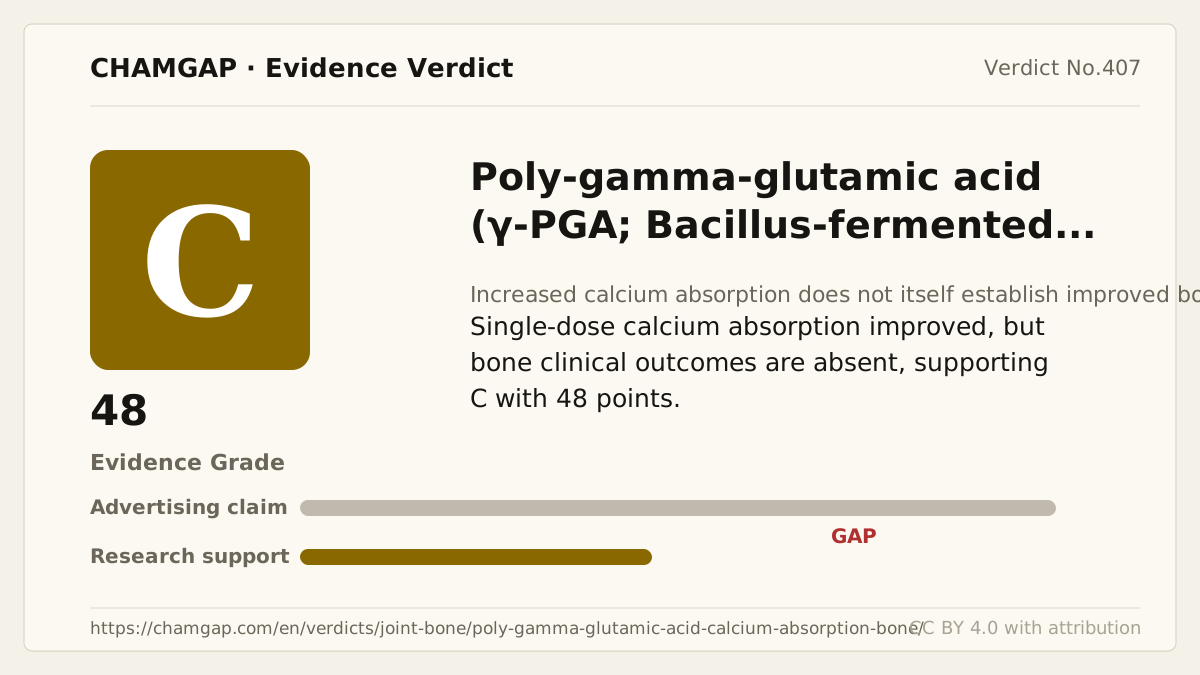
[Chamgap] Poly-gamma-glutamic acid (γ-PGA) x enhanced calcium absorption and bone health — Evidence Grade C·48. 4 cited sources checked. Source: https://chamgap.com/en/verdicts/joint-bone/poly-gamma-glutamic-acid-calcium-absorption-bone/ · CC BY 4.0CC BY 4.0 — free to use with attribution; do not distort grades, numbers, or verdict meaning.
What this document does and does not do
Chamgap is an information source. It reports what research has and has not confirmed; it does not tell readers what to take or buy. That decision belongs to readers and, when needed, medical or legal professionals. This verdict reflects literature available up to the search date and may change as new research appears. Nothing here is medical advice.