
Chrysanthemum zawadskii extract,
does it really help with Joint and cartilage health and improvement of knee pain?
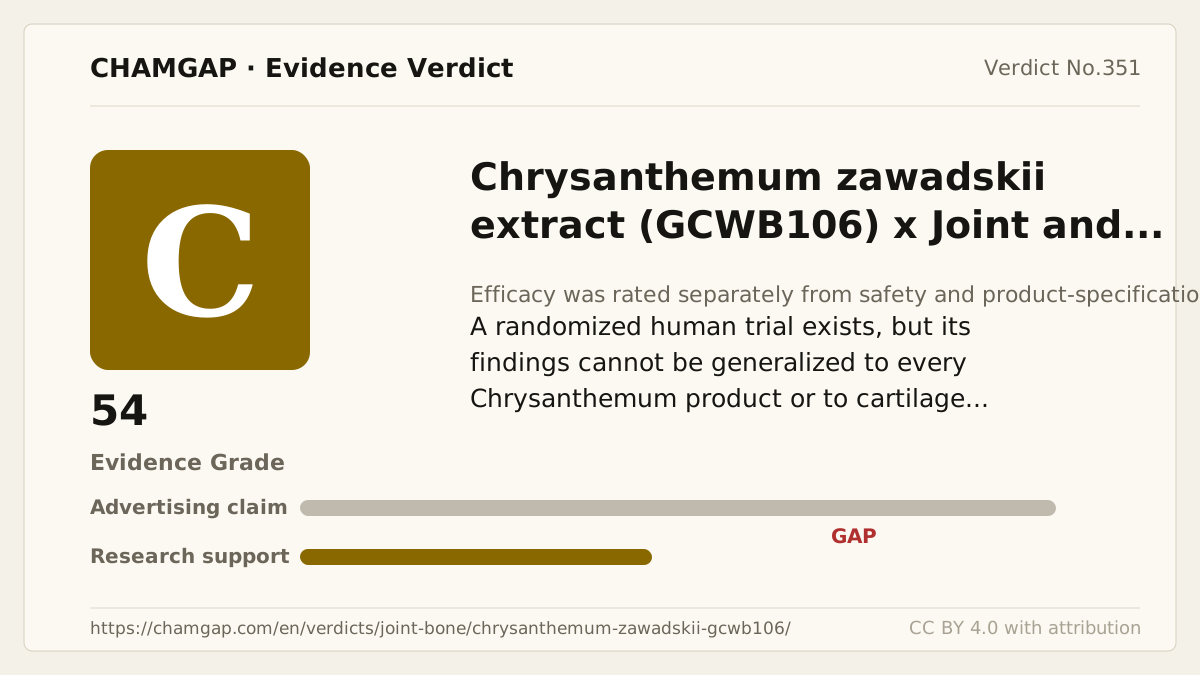
research showsA 12-week trial of one GCWB106 product found improvements over placebo in total WOMAC, function, and VAS pain. The evidence is limited by a single manufacturer-linked ingredient, subjective symptom endpoints, and a modest sample; WOMAC pain and stiffness subscales and cartilage biomarkers were not consistently significant.
ads claimIndividual regulatory recognition should not be extended to equivalent knee or cartilage efficacy for every Chrysanthemum tea, powder, or extract.
Useful facts when choosing a product
- The Korean food-safety database lists GCWB106 under individual recognition No. 2021-12 at 250 mg/day.
- The trial tablets totaled 600 mg/day and supplied 250 mg/day of Chrysanthemum extract.
- GCWB106 trial findings do not automatically apply to ordinary products with different specifications.
Chamgap Semantic Classification Code
Candidate index · review held
S.chrysanthemum-zawadskii-extract.UNK.joint-and-cartilage-health-and-improvement-of-knee-pain.improve.placeboSupplements and nutraceuticals > Chrysanthemum zawadskii extract > Unknown > Joint and cartilage health and improvement of knee pain > Improvement claim > Placebo
An automated migration candidate, not an issued permanent code; exact claim scope remains under review. This machine-generated migration candidate helps retrieval but is not a permanent assignment. The original verdict ID and URL remain authoritative.
What the research actually shows
The key evidence is one 12-week double-blind randomized placebo-controlled trial of GCWB106 at 250 mg/day. No independent multicenter replication or imaging-based structural endpoint was identified.
Why this is classified as C (54)
Because this is a limited RCT of a single manufacturer-linked proprietary ingredient using subjective symptom endpoints, boundary rule 2-b caps the grade at C.
Counterpoint. The trial prevents an unknown rating, but independent replication and objective cartilage outcomes are missing.
Rejudgment record. Reassessment (cross-check reflected) — C cap for a manufacturer-linked proprietary-ingredient RCT with subjective endpoints
Sub-claim grades by effect
This ingredient is marketed for several effects. A single overall grade blends strong and weak claims together, so each effect is graded separately here. The overall grade reflects the strongest disconfirming or core claim.
| Effect (sub-claim) | Grade | Basis |
|---|---|---|
| Improvement of knee pain and joint function | C | Subjective symptom signal from one GCWB106 trial |
| Preservation of cartilage structure | ? | No imaging or structural clinical endpoint evidence was identified |
Cross-check — AI research and Codex final gate
Evidence Table
| Study | Design | Sample | Funding | Endpoint | Result | Weight |
|---|---|---|---|---|---|---|
| Ha et al. (2021), Medicine (Baltimore) | Randomized double-blind placebo-controlled trial, 12 weeks | 110 | Supported by the Korean Ministry of Trade, Industry and Energy; one author was affiliated with GC Wellbeing | K-WOMAC, VAS pain, MMP-3, and urinary CTX-II | Total K-WOMAC, physical function, and VAS pain favored treatment; WOMAC pain and stiffness and cartilage biomarkers were not significant | Moderate |
Receipt — 2 References
All 2 cited sources were verified for existence at the original page (as of 2026-07-16).
Final verification and publication gate: Codex · Evidence date: 2026-07-16 · Corrections: none
Cite this verdict
[Chamgap] Does Chrysanthemum zawadskii extract improve knee pain and joint function? — Evidence Grade C·54. 2 cited sources checked. Source: https://chamgap.com/en/verdicts/joint-bone/chrysanthemum-zawadskii-gcwb106/ · CC BY 4.0CC BY 4.0 — free to use with attribution; do not distort grades, numbers, or verdict meaning.
What this document does and does not do
Chamgap is an information source. It reports what research has and has not confirmed; it does not tell readers what to take or buy. That decision belongs to readers and, when needed, medical or legal professionals. This verdict reflects literature available up to the search date and may change as new research appears. Nothing here is medical advice.