
CMO and cetylated fatty acids,
does it really help with Improved knee-joint pain and function?
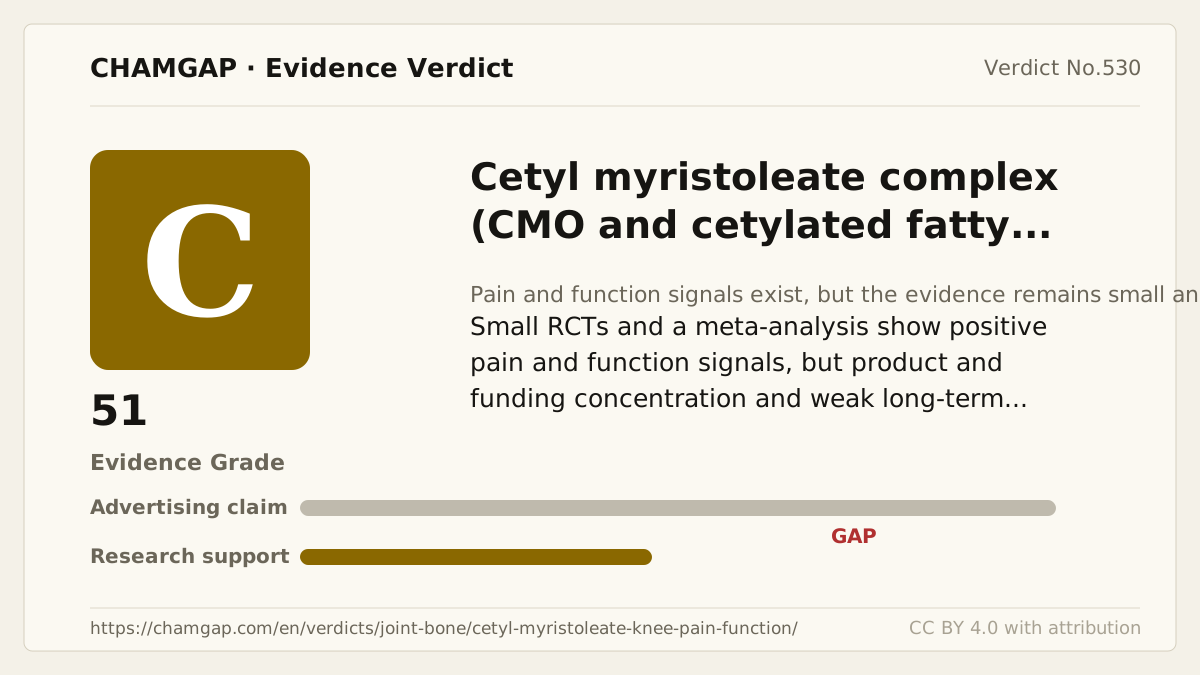
research showsSmall RCTs of cetylated fatty acids have reported improvements in knee-osteoarthritis pain, range of motion, and function, and a 2026 meta-analysis abstract pooling five RCTs found a positive pain effect. The total evidence remains only a few hundred participants, formulations and comparators vary, manufacturer supply or sponsorship is common, and long-term independent replication is limited. There is no large refuting trial, but the evidence is not confirmatory, yielding C with 51 points.
ads claimMarketing can expand short-term symptom results into lubricating joints, shutting down inflammation, or protecting and rebuilding cartilage. Clinical evidence concerns short-term pain, WOMAC, and range of motion, not cartilage regeneration or prevention of surgery.
Useful facts when choosing a product
- Study products often contain mixtures of several cetylated fatty acids rather than pure CMO, so declared CMO and total CFA doses should be distinguished.
- The Korean pilot used four capsules daily of a complex containing 12.5% CMO, with 250 mg/day of CMO in the highest-dose group for 12 weeks.
- The 2025 placebo-controlled trial used oral CFA at 1.5 g/day for 60 days. Korean listings may include cross-border and online combination products, requiring checks of content, formal import status, and labeling.
- Short trials found no major safety signal, but long-term, pregnancy, lactation, anticoagulant, and other fatty-acid-supplement co-use data are insufficient.
Chamgap Semantic Classification Code
Candidate index · review held
UNK.cetyl-myristoleate-complex.UNK.knee-joint-pain-and-function.improve.placeboUnknown > Cetyl myristoleate complex > Unknown > knee-joint pain and function > Improvement claim > Placebo
An automated migration candidate, not an issued permanent code; exact claim scope remains under review. This machine-generated migration candidate helps retrieval but is not a permanent assignment. The original verdict ID and URL remain authoritative.
What the research actually shows
The 2002 Hesslink trial in 64 patients with knee osteoarthritis found better flexion and Lequesne function after 68 days. The 2017 Korean Lee pilot assigned 28 people with mild knee pain to four groups for 12 weeks; selected doses improved numerical pain and WOMAC versus placebo, but one middle dose was non-significant for pain and each group had only six or seven participants. The 2025 Zodeleva trial gave 1.5 g/day for 60 days to 60 patients with severe knee osteoarthritis and improved visual-analog pain and range of motion, but its placebo-corrected WOMAC difference was non-significant and PharmaNutra funded the study. A 2026 meta-analysis abstract by Kayyal included seven studies with 347 participants and pooled five RCTs with 277 participants, finding pain SMD -0.68 while noting uncertain clinical importance and the need for larger long-term RCTs.
Why this is classified as C (51)
Direct clinical endpoints and a small meta-analysis prevent a D rating. Small samples, mixed formulations, manufacturer funding, selected non-significant results, and limited long-term independent replication prevent B, yielding C with 51 points. Unlike chondroitin (045), there is no independent large null trial here.
Counterpoint. A sufficiently powered independent long-term RCT using a standardized oral formulation could raise the verdict if it reproduces clinically important pain and function differences.
Rejudgment record. New verdict — Small RCTs and meta-analysis are positive for knee pain and function, but total sample size is small, CFA mixtures vary, manufacturer funding is common, some outcomes are non-significant, and long-term independent replication is limited
Sub-claim grades by effect
This ingredient is marketed for several effects. A single overall grade blends strong and weak claims together, so each effect is graded separately here. The overall grade reflects the strongest disconfirming or core claim.
| Effect (sub-claim) | Grade | Basis |
|---|---|---|
| Improvement in knee-joint pain | C | Small placebo-controlled trials and meta-analysis are positive, but formulations and funding are concentrated and long-term replication is limited. |
| Improvement in knee function and range of motion | C | Range-of-motion and function signals exist, but the placebo-corrected total WOMAC difference in the 2025 RCT was non-significant. |
Cross-check — AI research and Codex final gate
Evidence Table
| Study | Design | Sample | Funding | Endpoint | Result | Weight |
|---|---|---|---|---|---|---|
| Hesslink R Jr et al. 2002 | Placebo-controlled single-blind randomized trial | 68 | Industry-linked affiliations including Hesslink Ventures | Knee flexion and Lequesne index | Flexion and function improved versus placebo. | Supportive |
| Lee SC et al. 2017 | Double-blind four-arm placebo-controlled pilot RCT | 12 | Product supplied by SFC Bio | Numerical pain rating, WOMAC, and patient global impression | Selected doses were positive, one dose was non-significant for pain, and groups contained only six or seven participants. | Key |
| Zodeleva M et al. 2025 | Double-blind placebo-controlled RCT | 60 | Funded by PharmaNutra; one author was an employee | Visual-analog pain, range of motion, and WOMAC | Pain and range of motion improved; placebo-corrected total WOMAC was p=0.108. | Key |
| Kayyal L et al. 2026 | Systematic review and meta-analysis abstract | 277 | Authors reported no disclosures | Osteoarthritis pain, function, stiffness, and adverse events | Pain SMD was -0.68; clinical importance remained uncertain and larger long-term RCTs were needed. | Synthesis |
Receipt — 4 References
All 4 cited sources were verified for existence at the original page (as of 2026-07-18).
Final verification and publication gate: Codex · Evidence date: 2026-07-18 · Corrections: none
Cite this verdict
[Chamgap] CMO and cetylated fatty acids x knee-joint pain and function — Evidence Grade C·51. 4 cited sources checked. Source: https://chamgap.com/en/verdicts/joint-bone/cetyl-myristoleate-knee-pain-function/ · CC BY 4.0CC BY 4.0 — free to use with attribution; do not distort grades, numbers, or verdict meaning.
What this document does and does not do
Chamgap is an information source. It reports what research has and has not confirmed; it does not tell readers what to take or buy. That decision belongs to readers and, when needed, medical or legal professionals. This verdict reflects literature available up to the search date and may change as new research appears. Nothing here is medical advice.