
Acetaminophen,
does it really help with Sustained pain and function improvement in knee or hip osteoarthritis?
research showsAcetaminophen was used for decades as a first-line osteoarthritis analgesic, but a null 779-person direct trial and repeated findings from Machado 2015 and the 2019 Cochrane review placed pain and function differences far below minimal important differences, so this chronic osteoarthritis claim is rated F. NICE's 2022 advice against routine use is consistent clinical context, not a regulatory withdrawal or the basis for F, and infrequent short-term use remains when other medicines are unsuitable.
ads claimThe assumption that an analgesic must reliably work for arthritis helped preserve its old first-line status. General antipyretic and acute analgesic action cannot simply be transferred to sustained pain relief and functional recovery in chronic osteoarthritis.
Useful facts when choosing a product
- Acetaminophen is widely distributed in Korea as nonprescription products, including 500-mg immediate-release and 650-mg extended-release tablets.
- Osteoarthritis trials generally used 1.95 to 4 g/day, and higher-dose groups still did not produce clinically important pain or function improvement.
- One Korean label for 650-mg extended-release tablets directs people aged 12 years or older to take two tablets every eight hours, with no more than six tablets daily; the specific product label must be followed.
- Combining it with cold remedies or other analgesics containing acetaminophen can cause inadvertent overdose. High doses, alcohol use, liver disease, and undernutrition increase hepatotoxicity risk, so the lowest dose for the shortest duration is appropriate.
Chamgap Semantic Classification Code
Candidate index · review held
UNK.acetaminophen.UNK.sustained-pain-and-function-improvement-in-knee-or-hip-osteoarthritis.improve.placeboUnknown > Acetaminophen > Unknown > Sustained pain and function improvement in knee or hip osteoarthritis > Improvement claim > Placebo
An automated migration candidate, not an issued permanent code; exact claim scope remains under review. This machine-generated migration candidate helps retrieval but is not a permanent assignment. The original verdict ID and URL remain authoritative.
What the research actually shows
Miceli-Richard 2004 randomized 779 people with knee osteoarthritis to acetaminophen 4 g/day or placebo for six weeks and found no difference in the primary endpoint of a 30% pain reduction. Machado 2015 reported short-term differences of -3.7/100 for pain and -2.9/100 for disability in knee or hip osteoarthritis but judged them clinically unimportant. The 2019 Leopoldino Cochrane review synthesized ten placebo-controlled trials with 3,541 participants and found differences of 3.23 points for pain and 2.9 points for function, below minimal important differences of 9 and 10 points. This verdict concerns chronic knee or hip osteoarthritis, not efficacy for fever or acute headache or dental pain.
Why this is classified as F (12)
The 779-person direct trial was null on its primary endpoint, and Machado 2015 and the 2019 Cochrane review repeatedly found that pain and function effects remained below minimal important differences, meeting the repeated-refutation standard for F with 12 points. NICE 2022 is clinical context rather than a grading basis, and hepatotoxicity is recorded separately as safety.
Counterpoint. A clinician may consider infrequent short-term rescue analgesia when other drugs are contraindicated or not tolerated. This verdict does not deny acetaminophen efficacy for fever or acute pain.
Rejudgment record. New verdict — A null primary endpoint in a 779-person direct knee osteoarthritis trial and repeated failure to reach minimal important differences for pain and function in Machado 2015 and the 2019 Cochrane review
Sub-claim grades by effect
This ingredient is marketed for several effects. A single overall grade blends strong and weak claims together, so each effect is graded separately here. The overall grade reflects the strongest disconfirming or core claim.
| Effect (sub-claim) | Grade | Basis |
|---|---|---|
| Sustained pain improvement in knee or hip osteoarthritis | F | A large direct trial was null, and the roughly 3-point difference on a 100-point scale in repeated meta-analyses was below the minimal important difference. |
| Functional improvement in knee or hip osteoarthritis | F | The Cochrane function difference of 2.9 points on a 100-point scale was far below the 10-point minimal important difference. |
Cross-check — AI research and Codex final gate
Evidence Table
| Study | Design | Sample | Funding | Endpoint | Result | Weight |
|---|---|---|---|---|---|---|
| Miceli-Richard C et al. 2004 | Randomized double-blind placebo-controlled trial | 6 | Employees of Bristol-Myers Squibb were coauthors | A 30% reduction in knee pain as the primary endpoint | Response was 52.6% with 4 g/day and 51.9% with placebo, a null result (p=0.840). | Large direct null trial |
| Machado GC et al. 2015 | Systematic review and meta-analysis of randomized placebo-controlled trials | 5 | Public and academic support including the Australian NHMRC | Knee or hip pain, disability, quality of life, and liver tests | Differences were -3.7/100 for pain and -2.9/100 for disability, statistically small and clinically unimportant. | Key synthesis |
| Leopoldino AO et al. 2019 | Cochrane systematic review and meta-analysis | 3,541 | Cochrane review with author conflicts disclosed | Knee or hip pain, function, and adverse events | Improvements of 3.23/100 for pain and 2.9/100 for function were below minimal important differences of 9 and 10 points. | High-quality repeated refutation |
Receipt — 4 References
All 4 cited sources were verified for existence at the original page (as of 2026-07-18).
Final verification and publication gate: Codex · Evidence date: 2026-07-18 · Corrections: none
Cite this verdict
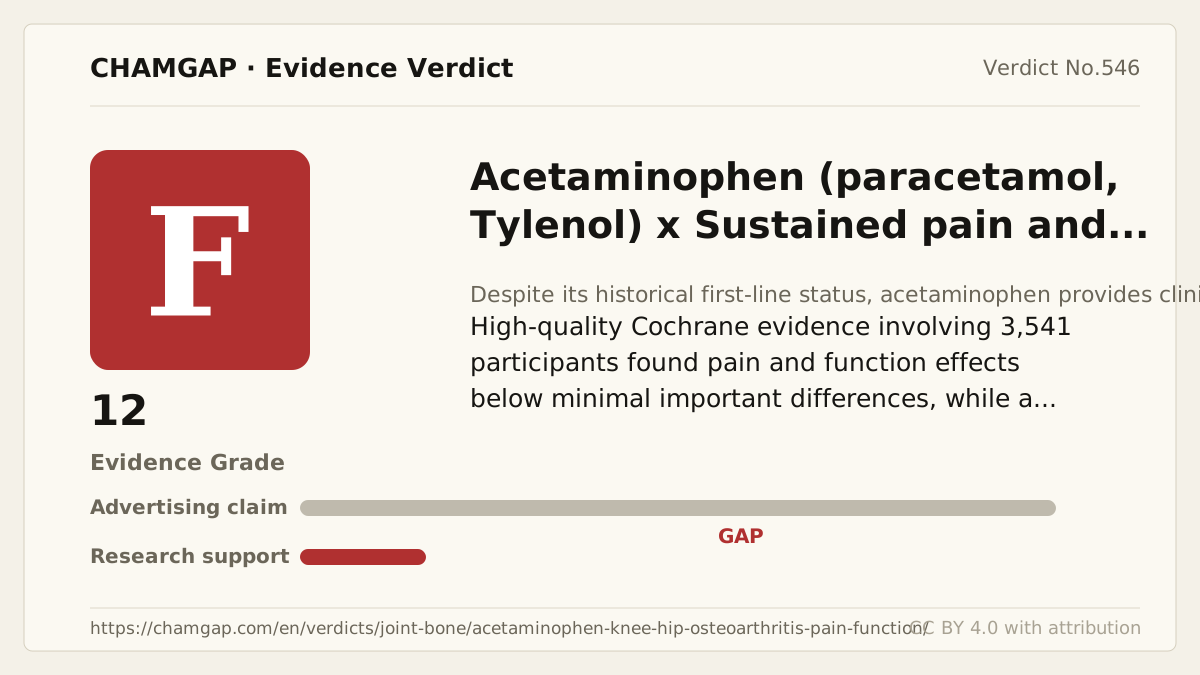
[Chamgap] Acetaminophen x sustained pain and function improvement in knee or hip osteoarthritis — Evidence Grade F·12. 4 cited sources checked. Source: https://chamgap.com/en/verdicts/joint-bone/acetaminophen-knee-hip-osteoarthritis-pain-function/ · CC BY 4.0CC BY 4.0 — free to use with attribution; do not distort grades, numbers, or verdict meaning.
What this document does and does not do
Chamgap is an information source. It reports what research has and has not confirmed; it does not tell readers what to take or buy. That decision belongs to readers and, when needed, medical or legal professionals. This verdict reflects literature available up to the search date and may change as new research appears. Nothing here is medical advice.