
Vitamin A,
does it really help with Reduced mortality among children aged 6–59 months where vitamin A deficiency is a public-health problem?
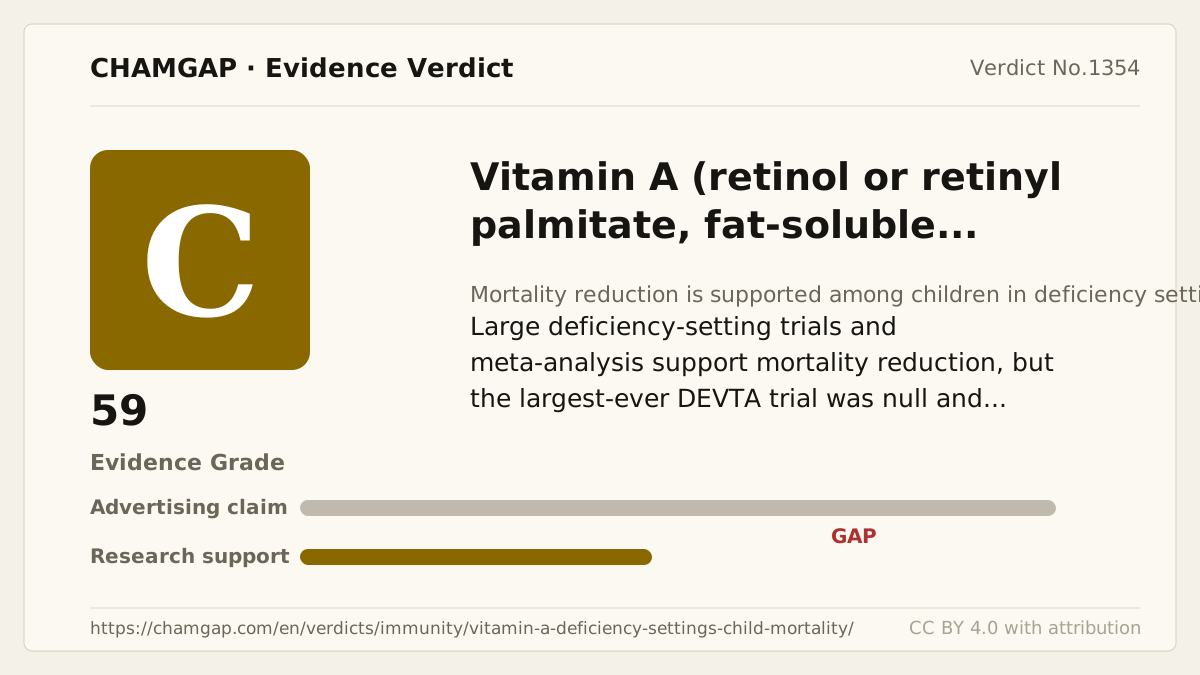
research showsVitamin A is rated C. Large trials and meta-analysis indicate that periodic high-dose supplementation reduces all-cause mortality among children aged 6–59 months where deficiency is a public-health problem, but the largest trial ever conducted—DEVTA, about one million children in northern India—was null at RR 0.96, a very large conflicting result. Nepal reported RR 0.70, Ghana VAST RR 0.81, and the 2022 Cochrane review RR 0.88 across 19 trials and more than 1.2 million children. Because the single largest trial is null, the grade cannot rise to B, and because the meta-analysis remains significant, it does not fall to D. WHO still recommends supplementation for children in deficiency settings.
ads claimThis public-health evidence should not be expanded into daily high-dose supplementation for every child or adult with adequate nutrition or into a universal infection preventive. Dose and interval are determined by deficiency prevalence and national programs.
Useful facts when choosing a product
- WHO recommends high-dose supplementation for children aged 6–59 months where vitamin A deficiency is a public-health problem by night-blindness or serum-retinol prevalence criteria.
- Typical public-health dosing is 100,000 IU once at age 6–11 months and 200,000 IU every four to six months at age 12–59 months, following national guidance and health-worker direction.
- Acute high doses can transiently cause nausea, vomiting, headache, irritability, or bulging fontanelle, while repeated excess can cause liver, skeletal, and intracranial-pressure toxicity.
- High-dose retinoids are teratogenic in people who may be pregnant, and duplicate intake from other vitamin A products or liver oils should be avoided.
Chamgap Semantic Classification Code
Candidate index · review held
S.vitamin-a.UNK.mortality-aged-where-vitamin-a-deficiency-is-a-public-health-problem.reduce.MULTISupplements and nutraceuticals > Vitamin A > Unknown > mortality aged where vitamin A deficiency is a public-health problem > Reduction claim > Multiple: primary unresolved
An automated migration candidate, not an issued permanent code; exact claim scope remains under review. This machine-generated migration candidate helps retrieval but is not a permanent assignment. The original verdict ID and URL remain authoritative.
What the research actually shows
West and colleagues conducted a double-masked community trial in 28,630 Nepalese children aged 6–72 months and found a 30% reduction in 12-month mortality. The Ghana VAST survival trial in 21,906 children across 185 clusters reported all-cause mortality RR 0.81 and gastroenteritis mortality RR 0.66. The 2022 Imdad Cochrane review found 12% reductions in all-cause and diarrhea mortality, but measles mortality was not significant, RR 0.88 (95% CI 0.69 to 1.11). DEVTA improved plasma retinol and Bitot spots but did not significantly reduce all-cause or cause-specific mortality.
Why this is classified as C (59)
Large randomized trials in Nepal and Ghana and the 2022 Cochrane all-cause mortality RR of 0.88 support a direct survival benefit in children aged 6–59 months in deficiency settings, but the null RR of 0.96 in the largest-ever DEVTA trial conflicts. Under the principle that conflicting large trials are graded C, the significant meta keeps it above D while the null flagship trial keeps it below B, yielding C with 59 points. High-dose toxicity is a separate safety issue.
Counterpoint. Supplementation does not replace dietary quality, breastfeeding, fortification, vaccination, or healthcare access, and self-directed high dosing in nondeficient settings may cause more harm than benefit.
Rejudgment record. Cross-check applied — Accepted mortality reductions in large Nepal and Ghana randomized trials and the 2022 Cochrane synthesis, but reflected the null all-cause mortality RR of 0.96 in the largest-ever DEVTA trial as a conflicting large trial, adjusting the B draft to C at cross-check; the significant meta-analysis keeps it above D
Sub-claim grades by effect
This ingredient is marketed for several effects. A single overall grade blends strong and weak claims together, so each effect is graded separately here. The overall grade reflects the strongest disconfirming or core claim.
| Effect (sub-claim) | Grade | Basis |
|---|---|---|
| Reduced all-cause mortality among children aged 6–59 months where vitamin A deficiency is a public-health problem | C | Large setting-specific trials and meta-analysis are positive, but the very large null DEVTA trial conflicts. |
| Reduced diarrhea-related mortality among children aged 6–59 months in those settings | C | The 2022 Cochrane estimate was RR 0.88 (95% CI 0.79 to 0.98), and gastroenteritis mortality also fell in Ghana VAST. |
| Reduced measles-related mortality among children aged 6–59 months in those settings | C | The 2022 Cochrane estimate favored vitamin A, RR 0.88 (95% CI 0.69 to 1.11), but was not statistically significant. |
Cross-check — AI research and Codex final gate
Evidence Table
| Study | Design | Sample | Funding | Endpoint | Result | Weight |
|---|---|---|---|---|---|---|
| West KP Jr et al. 1991 (Nepal Sarhikot) | Community randomized double-masked placebo-controlled trial | 28,630 Nepalese children aged 6–72 months | International public and academic support | All-cause mortality at 12 months | The mortality relative risk for vitamin A versus control was 0.70 (95% CI 0.56 to 0.88). | Key direct mortality evidence in a deficiency setting |
| Ghana VAST Study Team. 1993 | Cluster-randomized double-blind placebo-controlled survival trial | 21,906 children in 185 clusters in northern Ghana | International public and academic support | All-cause and cause-specific mortality | All-cause mortality RR was 0.81 (95% CI 0.68 to 0.98), and gastroenteritis mortality RR was 0.66 (95% CI 0.47 to 0.92). | Independent geographic replication |
| Awasthi S et al.; DEVTA team. 2013 | Large factorial cluster-randomized trial | About one million preschool children in 72 blocks in northern India | UK MRC, USAID, and World Bank; vitamin A donated by Roche | All-cause mortality at ages one to six years over five years | The mortality ratio was 0.96 (95% CI 0.89 to 1.03), p=0.22, and was not significant. | Very large conflicting null evidence |
| Imdad A et al. 2022 Cochrane review | Systematic review and meta-analysis of randomized trials | 19 all-cause mortality trials involving 1,202,382 children | Academic Cochrane review | All-cause and cause-specific mortality including diarrhea and measles | All-cause mortality RR was 0.88 (95% CI 0.83 to 0.93), diarrhea mortality RR 0.88 (0.79 to 0.98), and measles mortality RR 0.88 (0.69 to 1.11) was not significant. | Key current synthesis incorporating conflicting evidence |
Receipt — 4 References
All 4 cited sources were verified for existence at the original page (as of 2026-07-23).
Final verification and publication gate: Codex · Evidence date: 2026-07-23 · Corrections: none
Cite this verdict
[Chamgap] Vitamin A x reduced mortality among children aged 6–59 months in settings where deficiency is a public-health problem — Evidence Grade C·59. 4 cited sources checked. Source: https://chamgap.com/en/verdicts/immunity/vitamin-a-deficiency-settings-child-mortality/ · CC BY 4.0CC BY 4.0 — free to use with attribution; do not distort grades, numbers, or verdict meaning.
What this document does and does not do
Chamgap is an information source. It reports what research has and has not confirmed; it does not tell readers what to take or buy. That decision belongs to readers and, when needed, medical or legal professionals. This verdict reflects literature available up to the search date and may change as new research appears. Nothing here is medical advice.