
Two-dose TAK-003,
does it really help with Reduced symptomatic virologically confirmed dengue over 12 months?
research showsThe grade is B with 72 points. In the one-year primary TIDES report, dengue occurred in 61/12,700 (0.48%) versus 149/6,316 (2.36%), vaccine efficacy 80.2% (95% CI 73.3 to 85.3).
ads claimThe overall estimate applies to a two-dose regimen in children and adolescents living in endemic regions, not automatically to travelers, other ages, one dose, or every serotype equally.
Useful facts when choosing a product
- TAK-003 was given as two 0.5-mL subcutaneous injections three months apart.
- The primary endpoint covered symptomatic RT-PCR-confirmed dengue from 30 days after dose two through 12 months.
- The registration is NCT02747927.
Chamgap Semantic Classification Code
Candidate index · review held
UNK.two-doses-of-the-live-attenuated-tetravalent-dengue-vaccine-tak-003-on-days-0-and-90-in-children-aged-4-16-in-endemic-regions.UNK.symptomatic-virologically-confirmed-dengue-over.reduce.placeboUnknown > Two doses of the live-attenuated tetravalent dengue vaccine TAK-003 on days 0 and 90 in children aged 4-16 in endemic regions > Unknown > symptomatic virologically confirmed dengue over > Reduction claim > Placebo
An automated migration candidate, not an issued permanent code; exact claim scope remains under review. This machine-generated migration candidate helps retrieval but is not a permanent assignment. The original verdict ID and URL remain authoritative.
What the research actually shows
TIDES randomized 20,099 participants 2:1 at 26 sites in eight countries; 20,071 received at least one dose. The paper reports age- and region-stratified randomization; masking of participants, guardians, investigators, and sponsor conduct staff except designated pharmacists or vaccinators; and blinded case adjudication. The registered primary analysis used the per-protocol population rather than an assigned-group intention-to-treat population, and only 19,021 of 20,099 randomized participants entered that primary analysis. The PP exclusion criteria were prespecified while masked before database lock, and an assigned-group FAS sensitivity analysis gave a consistent 80.6% efficacy estimate. Those mitigating features do not justify B0 because the primary analysis remained PP. NCT02747927 matches the published primary outcome and period. Takeda Vaccines funded, designed, and analyzed the study. The one-, two-, three-, and 4.5-year papers are reports from the same NCT02747927 TIDES/DEN-301 trial, counted once; this verdict uses the one-year primary report.
Why this is classified as B (72)
A large double-blind placebo-controlled trial showed a major prespecified hard-outcome benefit, but its primary analysis used the PP rather than assigned-group ITT population. Prespecified masked exclusions and a consistent FAS sensitivity analysis mitigate but do not justify B0; absent independent replication gives B with 72 points.
Counterpoint. Long-term efficacy and safety by serostatus and serotype, local authorization, and individual contraindications remain essential.
Rejudgment record. Cross-check applied — The one-year NEJM primary report and NCT02747927 establish 20,099 randomized, 19,021 in the PP primary analysis, prespecified masked exclusions, a consistent FAS sensitivity analysis, masking, the registered outcome, Takeda funding, and the identity of later follow-up reports
| Endpoint | H | Hard endpoint - actual events such as death |
| Replication | R1 | Single confirmatory trial |
| Independence | I0 | Evidence comes only from manufacturer studies |
| Effect size | E+ | Meets the clinically important threshold |
Stored derived and displayed grades match; this is not a current recalculation or validity check (B).
Sub-claim grades by effect
This ingredient is marketed for several effects. A single overall grade blends strong and weak claims together, so each effect is graded separately here. The overall grade reflects the strongest disconfirming or core claim.
| Effect (sub-claim) | Grade | Basis |
|---|---|---|
| Prevention of symptomatic confirmed dengue across all serotypes | B | One-year vaccine efficacy was 80.2% (73.3 to 85.3). |
Cross-check — AI research and Codex final gate
Evidence Table
| Study | Design | Sample | Funding | Endpoint | Result | Weight |
|---|---|---|---|---|---|---|
| Biswal S, Reynales H, Saez-Llorens X, Lopez P, Borja-Tabora C, Kosalaraksa P, Sirivichayakul C, Watanaveeradej V, Rivera L, Espinoza F, Fernando L, Dietze R, Luz K, Venâncio da Cunha R, Jimeno J, López-Medina E, Borkowski A, Brose M, Rauscher M, LeFevre I, Bizjajeva S, Bravo L, Wallace D, TIDES Study Group. 2019 | One-year primary report of a multinational phase 3 double-blind placebo-controlled randomized trial | 20,099 randomized; 19,021 per protocol; primary event denominators 12,700/6,316 | Funded by Takeda Vaccines | Symptomatic virologically confirmed dengue from 30 days after dose two through 12 months | 61/12,700 (0.48%) versus 149/6,316 (2.36%); vaccine efficacy 80.2% (95% CI 73.3 to 85.3), P<.001 | Pivotal single trial, with later reports from the same trial not double-counted |
Receipt — 1 References
All 1 cited sources were verified for existence at the original page (as of 2026-08-15).
Final verification and publication gate: Codex · Evidence date: 2026-08-15 · Corrections: none
Cite this verdict
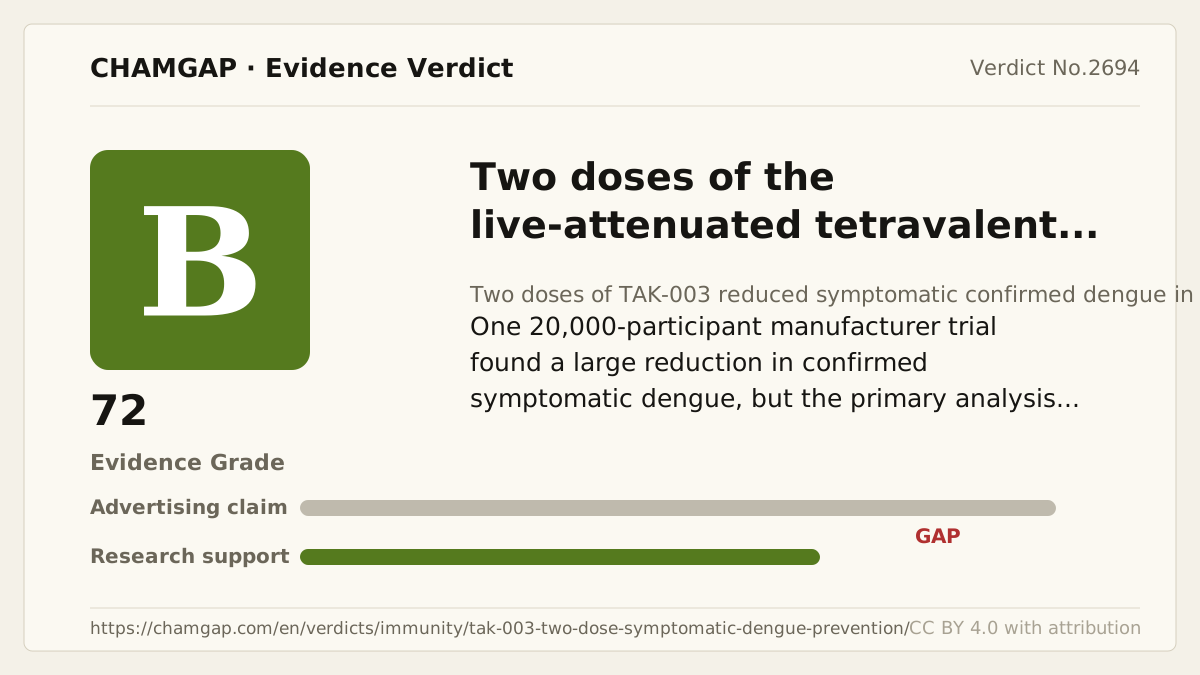
[Chamgap] Two-dose TAK-003 x prevention of symptomatic dengue — Evidence Grade B·72. 1 cited sources checked. Source: https://chamgap.com/en/verdicts/immunity/tak-003-two-dose-symptomatic-dengue-prevention/ · CC BY 4.0CC BY 4.0 — free to use with attribution; do not distort grades, numbers, or verdict meaning.
What this document does and does not do
Chamgap is an information source. It reports what research has and has not confirmed; it does not tell readers what to take or buy. That decision belongs to readers and, when needed, medical or legal professionals. This verdict reflects literature available up to the search date and may change as new research appears. Nothing here is medical advice.