
Simvastatin 80 mg daily,
does it really help with Increase in ventilator-free days through day 28 in acute respiratory distress syndrome?
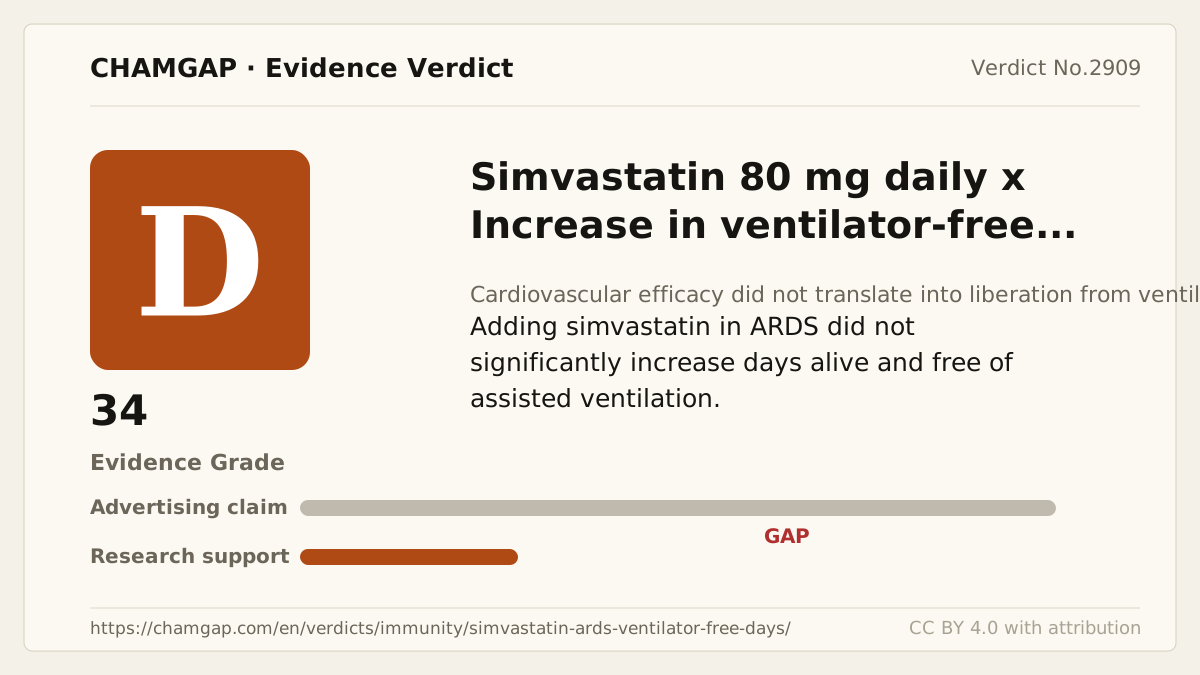
research showsGrade D, 34 points. In 540 HARP-2 participants, mean ventilator-free days were 12.6 versus 11.5, difference 1.1 days (95% CI -0.6 to 2.8), P=0.21. The upper tail still permits up to 2.8 days of benefit, so benefit was not definitively excluded.
ads claimCardiovascular anti-inflammatory and vascular effects cannot be transferred into an ARDS treatment claim.
Useful facts when choosing a product
- Patients dying before day 28 or still assisted on day 27 received zero ventilator-free days.
- This was a 540-participant hard-clinical-status RCT; day-28 mortality was 22.0% versus 26.8%, not significant.
Chamgap Semantic Classification Code
Candidate index · review held
M.simvastatin.UNK.ards-ventilator-free-days.increase.placeboMedicinal interventions > Simvastatin > Unknown > Ventilator-free days in ARDS > Increase claim > Placebo
An automated migration candidate, not an issued permanent code; exact claim scope remains under review. This machine-generated migration candidate helps retrieval but is not a permanent assignment. The original verdict ID and URL remain authoritative.
What the research actually shows
This verdict asks whether a statin saves critically ill patients with acute respiratory distress syndrome and helps them leave ventilation. Verdict 2907 asks whether to prescribe oxygen in stable COPD with moderate desaturation, while verdict 2908 asks whether adding a statin reduces exacerbations in high-risk COPD. Verdict 681 gives the same simvastatin an A with 92 points for reducing major vascular events in high-risk cardiovascular patients. The contrast - top grade in cardiovascular prevention but null for COPD exacerbations and ARDS - shows that the value lies in where the drug is used, not whether the drug is globally good or bad. Four-gate review: ① Unmasked subjective endpoint ② listed item ③ patients, clinicians, and researchers were blinded and respiratory support followed recorded criteria ④ criterion not met. ① At least 15% attrition ② listed item ③ 540 randomized and 537 in the reported primary result, only 3 excluded (0.6%) ④ criterion not met. Axis 6 B0 evidence ① Allocation concealment: "multicentre, allocation-concealed, randomised" ② Masking: "patients, clinicians and research staff will be blinded" ③ Analysis population and missingness: "Analyses will be on an intention-to-treat basis"; transferred patients were followed to day 28 ④ Prespecified primary endpoint: "The primary outcome measure is ventilator free days" - consistent with ISRCTN88244364
Why this is classified as D (34)
One 540-participant publicly funded double-blind hard-clinical-status RCT was null and retained a benefit tail, giving D, 34.
Counterpoint. The interval permits up to 2.8 additional ventilator-free days, so small benefit is not excluded.
Rejudgment record. Source checked — Null HARP-2 28-day ventilator-free-day result from a large hard-clinical-status RCT, with a remaining benefit tail
| Endpoint | H | Hard endpoint - actual events such as death |
| Replication | R1 | Single confirmatory trial |
| Independence | I2 | Decisive evidence is publicly or non-profit funded |
| Effect size | E0 | Null |
| Precision | C0 | The confidence interval leaves room for benefit |
Stored derived and displayed grades match; this is not a current recalculation or validity check (D).
Sub-claim grades by effect
This ingredient is marketed for several effects. A single overall grade blends strong and weak claims together, so each effect is graded separately here. The overall grade reflects the strongest disconfirming or core claim.
| Effect (sub-claim) | Grade | Basis |
|---|---|---|
| More ventilator-free days through day 28 | D | Difference was 1.1 days, CI -0.6 to 2.8. |
Cross-check — AI research and Codex final gate
Evidence Table
| Study | Design | Sample | Funding | Endpoint | Result | Weight |
|---|---|---|---|---|---|---|
| HARP-2 | Multicenter randomized double-blind placebo-controlled trial | 540 randomized, 537 in the primary result | Public funding from UK MRC-NIHR EME, Ireland HRB, and related bodies | Ventilator-free days through day 28 | 12.6 vs 11.5 days, difference 1.1 days (95% CI -0.6 to 2.8), P=0.21 | Pivotal publicly funded RCT |
Receipt — 2 References
All 2 cited sources were verified for existence at the original page (as of 2026-08-26).
Final verification and publication gate: Codex · Evidence date: 2026-08-26 · Corrections: none
Cite this verdict
[Chamgap] No Benefit of Simvastatin × 28-Day Ventilator-Free Days in Acute Respiratory Distress Syndrome — Evidence Grade D·34. 2 cited sources checked. Source: https://chamgap.com/en/verdicts/immunity/simvastatin-ards-ventilator-free-days/ · CC BY 4.0CC BY 4.0 — free to use with attribution; do not distort grades, numbers, or verdict meaning.
What this document does and does not do
Chamgap is an information source. It reports what research has and has not confirmed; it does not tell readers what to take or buy. That decision belongs to readers and, when needed, medical or legal professionals. This verdict reflects literature available up to the search date and may change as new research appears. Nothing here is medical advice.