
Seven-day antibiotics for bloodstream infection,
does it really help with Noninferiority to fourteen days for 90-day mortality?
research showsThe grade is B. In BALANCE, 90-day death occurred in 261/1,802 (14.5%) with seven days and 286/1,779 (16.1%) with fourteen days, difference -1.6 points, 95.7% CI -4.0 to 0.8. The prespecified margin allowed at most 4 points higher mortality with seven days; the upper bound of 0.8 remained inside it. This establishes noninferiority, not superiority.
ads claimThe precise conclusion is that a planned seven-day course was noninferior to a planned fourteen-day course in eligible hospitalized bloodstream infection.
Useful facts when choosing a product
- Drug choice, dose, and route remained at the treating team's discretion; duration was randomized.
- Bacteremia relapse was 2.6% versus 2.2%, difference 0.4 points, 95% CI -0.6 to 1.4.
- Secondary resistant-organism infection or colonization was 9.5% versus 8.5%, difference 1.1 points, 95% CI -0.8 to 2.9.
Chamgap Semantic Classification Code
Candidate index · review held
M.planned-antibiotic-strategy.UNK.noninferiority-to-fourteen-days-for-mortality.noninferior.UNKMedicinal interventions > planned antibiotic strategy > Unknown > Noninferiority to fourteen days for mortality > Noninferiority claim > Unknown
An automated migration candidate, not an issued permanent code; exact claim scope remains under review. This machine-generated migration candidate helps retrieval but is not a permanent assignment. The original verdict ID and URL remain authoritative.
What the research actually shows
The trial analyzed 3,608 hospitalized patients at 74 hospitals in seven countries. At enrollment, 55.0% were in intensive care and 45.0% on wards; 71.0% had monomicrobial gram-negative, 17.3% monomicrobial gram-positive, and 11.7% polymicrobial infection. Severe immunosuppression, S. aureus or S. lugdunensis, fungemia, and foci requiring prolonged treatment such as endocarditis, osteomyelitis, or an undrained abscess were excluded. Public funding came from CIHR, Ontario's Innovation Fund, the Canadian Frailty Network, Australian NHMRC, and New Zealand HRC. Yahav's earlier 604-person trial in stable uncomplicated gram-negative bacteremia found a 90-day composite of 45.8% versus 48.3% and mortality of 11.8% versus 10.7%, but Dafna Yahav was also a BALANCE author and the population, primary endpoint, and margin differed. Other trials such as von Dach likewise studied uncomplicated stable gram-negative infection and a composite failure endpoint, so independent replication of this exact 90-day mortality question was not established.
Why this is classified as B (76)
A large publicly funded hard-outcome trial met the four-point margin in intention-to-treat and per-protocol analyses, but noninferiority design and lack of independent exact replication give B with 76 points.
Counterpoint. The result does not apply to S. aureus, endocarditis, fungemia, severe immunosuppression, or foci requiring prolonged treatment.
Rejudgment record. Cross-check applied — BALANCE paper and protocol cross-checked for the four-point margin, intention-to-treat and per-protocol analyses, exclusions, and independent replication
| Endpoint | H | Hard endpoint - actual events such as death |
| Replication | R1 | Single confirmatory trial |
| Independence | I2 | Decisive evidence is publicly or non-profit funded |
| Effect size | E+ | Meets the clinically important threshold |
Stored derived and displayed grades match; this is not a current recalculation or validity check (B).
Sub-claim grades by effect
This ingredient is marketed for several effects. A single overall grade blends strong and weak claims together, so each effect is graded separately here. The overall grade reflects the strongest disconfirming or core claim.
| Effect (sub-claim) | Grade | Basis |
|---|---|---|
| Noninferior 90-day mortality with seven versus fourteen days in eligible hospitalized bloodstream infection | B | Both intention-to-treat and per-protocol analyses stayed within the four-point margin. |
| Stopping antibiotics whenever symptoms improve | ? | This strategy was not tested. |
| Seven days for S. aureus bacteremia | ? | This infection was excluded. |
Cross-check — AI research and Codex final gate
Evidence Table
| Study | Design | Sample | Funding | Endpoint | Result | Weight |
|---|---|---|---|---|---|---|
| Daneman N et al. 2025 BALANCE | Multinational open-label noninferiority randomized trial | 3,608 intention-to-treat, 1,814 versus 1,794; 3,581 with 90-day outcomes; 2,853 per protocol | CIHR, Ontario Innovation Fund, Canadian Frailty Network, Australian NHMRC, and New Zealand HRC | All-cause death by 90 days after bloodstream-infection diagnosis | ITT 261/1,802 (14.5%) versus 286/1,779 (16.1%), difference -1.6 points, 95.7% CI -4.0 to 0.8; per-protocol difference -2.0 points, 95% CI -4.5 to 0.6 | Decisive large publicly funded trial |
| Yahav D et al. 2019 | Open-label noninferiority trial in stable uncomplicated gram-negative bacteremia | 604 analyzed, 306 versus 298 | Israeli Ministry of Health and institutional research support; the paper did not report manufacturer funding | 90-day composite of death, clinical failure, readmission, or prolonged hospitalization | 140/306 (45.8%) versus 144/298 (48.3%), difference -2.6 points, 95% CI -10.5 to 5.3; mortality 11.8% versus 10.7% | Directionally supportive but not exact independent replication because authors, population, and endpoint differ |
Receipt — 2 References
All 2 cited sources were verified for existence at the original page (as of 2026-08-06).
Final verification and publication gate: Codex · Evidence date: 2026-08-06 · Corrections: none
Cite this verdict
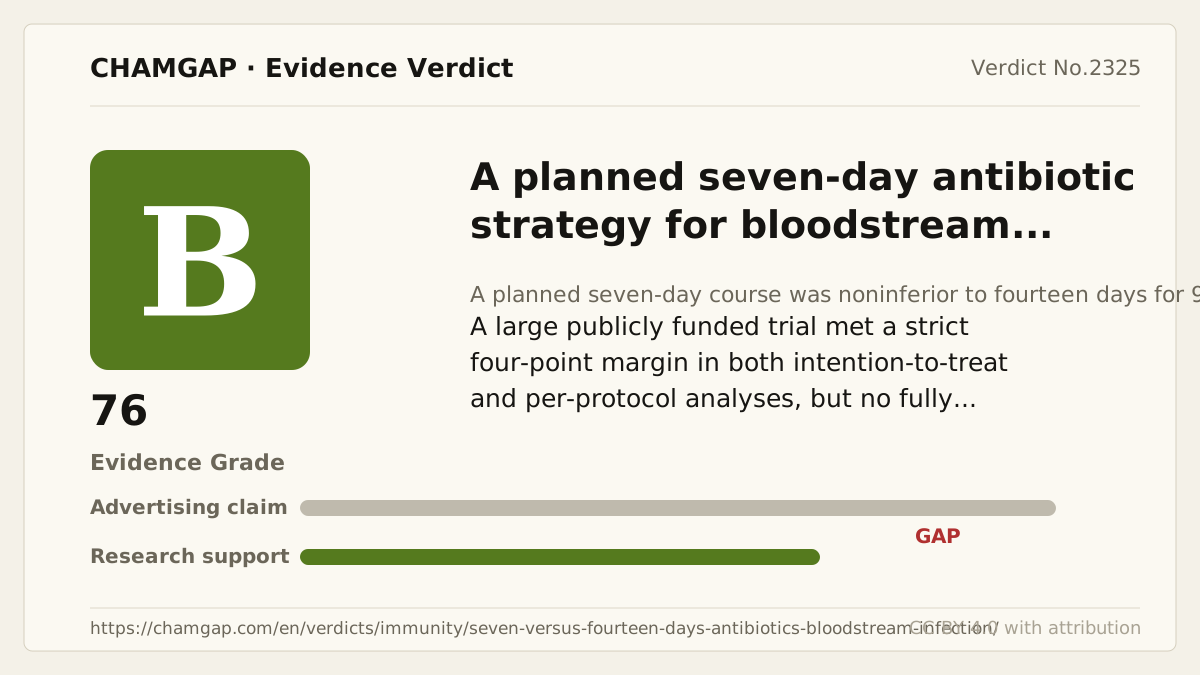
[Chamgap] Seven-day antibiotics for bloodstream infection x 90-day mortality versus fourteen days — Evidence Grade B·76. 2 cited sources checked. Source: https://chamgap.com/en/verdicts/immunity/seven-versus-fourteen-days-antibiotics-bloodstream-infection/ · CC BY 4.0CC BY 4.0 — free to use with attribution; do not distort grades, numbers, or verdict meaning.
What this document does and does not do
Chamgap is an information source. It reports what research has and has not confirmed; it does not tell readers what to take or buy. That decision belongs to readers and, when needed, medical or legal professionals. This verdict reflects literature available up to the search date and may change as new research appears. Nothing here is medical advice.