
Perioperative normothermia,
does it really help with Reduced surgical-site infection?
research showsThe grade is B. Two independent randomized trials found wound infection in 5.8% versus 18.8% and 4.7% versus 13.7% with warming versus control. The effects, RR 0.31 and 0.34, are not dismissed, but Melling was retrospectively registered and left the handling of five missing participants unclear; axis 6 is therefore B1, giving B with 76 points.
ads claimWarming is one component of infection prevention. It does not replace timely antibiotics, antisepsis, or sterile technique, and the evidence does not establish superiority of one commercial warmer.
Useful facts when choosing a product
- End-of-surgery core temperature in Kurz was 34.7±0.6°C with routine care and 36.6±0.5°C with normothermia.
- Melling applied local or forced-air whole-body warming for at least 30 minutes before surgery.
- Existing warming verdicts address other outcomes or interventions; no duplicate using these pivotal trials was identified.
Chamgap Semantic Classification Code
Candidate index · review held
P.active-preoperative-or-intraoperative-warming-to-maintain-normothermia.procedural.surgical-site-infection.reduce.UNKProcedures, devices and tests > Active preoperative or intraoperative warming to maintain normothermia > Procedural > surgical-site infection > Reduction claim > Unknown
An automated migration candidate, not an issued permanent code; exact claim scope remains under review. This machine-generated migration candidate helps retrieval but is not a permanent assignment. The original verdict ID and URL remain authoritative.
What the research actually shows
Kurz randomized 200 colorectal-surgery patients, 104 to normothermia and 96 to routine care allowing mild hypothermia. Infection occurred in 6/104 versus 18/96, recalculated RR 0.31 (95% CI 0.13-0.74). Melling randomized 421 but analyzed 416, with unclear handling of five missing participants. Warming produced 13/277 infections versus 19/139, RR 0.34 (0.18-0.68). Registration followed recruitment, and funding included Action Research and the Smith & Nephew Foundation. The effect is retained, but the methodological limitation lowers the grade ceiling.
Why this is classified as B (76)
Two distinct trials with different investigators and funding replicated clinical-infection reductions of RR 0.31 and 0.34, with both intervals excluding no effect. Melling's retrospective registration and unclear handling of five missing participants require axis 6 B1, giving B with 76 points.
Counterpoint. The trials predate current infection-prevention practice, so contemporary absolute benefit may differ even though direct replicated evidence remains.
Rejudgment record. Cross-check applied — We retained the infection rates and RRs from two independent trials while applying axis 6 B1 for Melling's 421 randomized versus 416 analyzed, unclear handling of five missing participants, retrospective registration, and Smith & Nephew Foundation funding.
| Endpoint | H | Hard endpoint - actual events such as death |
| Replication | R2 | Independently replicated across trials |
| Independence | I1 | Mixed funding sources |
| Effect size | E+ | Meets the clinically important threshold |
Stored derived and displayed grades match; this is not a current recalculation or validity check (B).
Sub-claim grades by effect
This ingredient is marketed for several effects. A single overall grade blends strong and weak claims together, so each effect is graded separately here. The overall grade reflects the strongest disconfirming or core claim.
| Effect (sub-claim) | Grade | Basis |
|---|---|---|
| Active warming to maintain normothermia reduces surgical-site infection. | B | Two independent randomized trials showed the same direction, but Melling had retrospective registration and unclear missing-data handling. |
Cross-check — AI research and Codex final gate
Evidence Table
| Study | Design | Sample | Funding | Endpoint | Result | Weight |
|---|---|---|---|---|---|---|
| Kurz et al., NEJM 1996 | Multicenter randomized controlled trial | 200 randomized and analyzed (104/96) | Support from NIH, Max Kade Foundation, Joseph Drown Foundation, and Augustine Medical | Surgical-wound infection with culture-positive pus within two weeks | 6/104 (5.8%) versus 18/96 (18.8%); recalculated RR 0.31 (95% CI 0.13-0.74) | First pivotal trial in independent replication |
| Melling et al., Lancet 2001 | Randomized controlled trial with masked outcome assessment; retrospectively registered | 421 randomized and 416 analyzed; handling of five missing participants unclear; comparison 277/139 | Supported by Action Research and the Smith & Nephew Foundation | Wound infection at two and six weeks | 13/277 (4.7%) versus 19/139 (13.7%); recalculated RR 0.34 (95% CI 0.18-0.68) | Independent replication with retrospective registration and unclear missing-data handling |
Receipt — 2 References
All 2 cited sources were verified for existence at the original page (as of 2026-08-14).
Final verification and publication gate: Codex · Evidence date: 2026-08-14 · Corrections: none
Cite this verdict
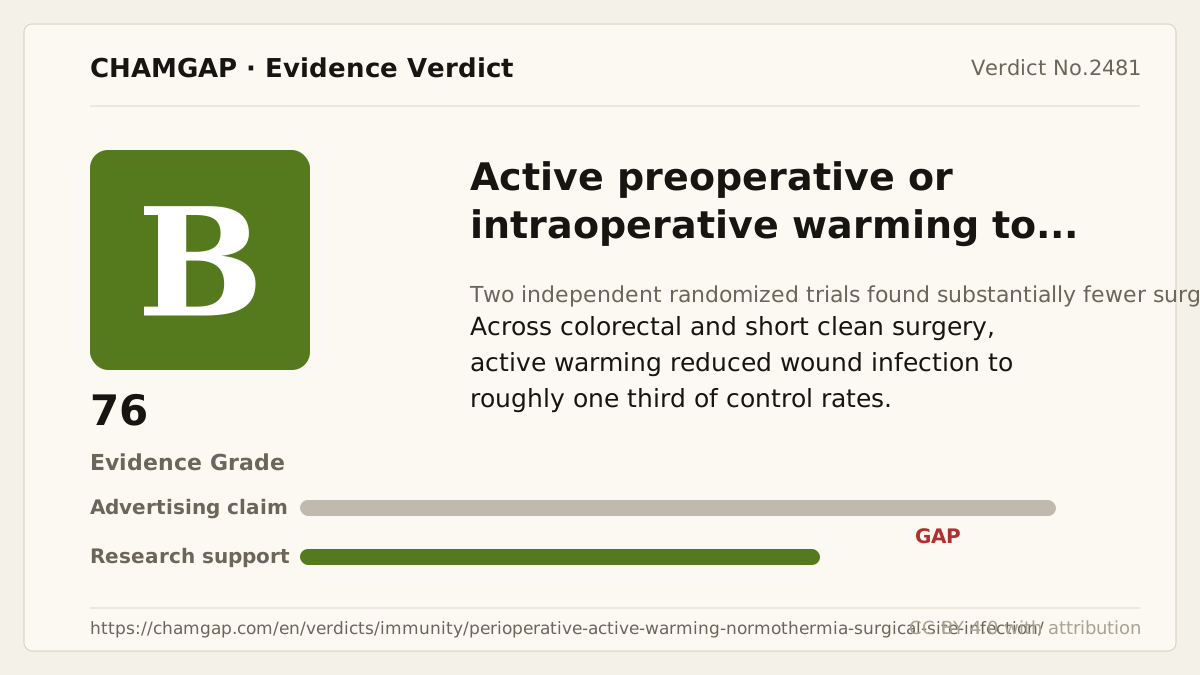
[Chamgap] Perioperative normothermia x prevention of surgical-site infection — Evidence Grade B·76. 2 cited sources checked. Source: https://chamgap.com/en/verdicts/immunity/perioperative-active-warming-normothermia-surgical-site-infection/ · CC BY 4.0CC BY 4.0 — free to use with attribution; do not distort grades, numbers, or verdict meaning.
What this document does and does not do
Chamgap is an information source. It reports what research has and has not confirmed; it does not tell readers what to take or buy. That decision belongs to readers and, when needed, medical or legal professionals. This verdict reflects literature available up to the search date and may change as new research appears. Nothing here is medical advice.