
Oral prednisone,
does it really help with Prevention of asthma relapse and additional care 7 to 21 days after discharge?
research showsThe grade is B. Chapman randomized 122 emergency patients, but the primary post-discharge analysis comprised 93 discharged participants, 48 versus 45. Relapse in the first 10 days was 3/48 versus 11/45, P<0.05. A Cochrane synthesis of six independent placebo-controlled trials and 374 participants found relapse requiring additional care at 7 to 10 days at RR 0.38 (95% CI 0.20 to 0.74), at 21 days at RR 0.47 (0.25 to 0.89), and hospitalization at RR 0.35 (0.13 to 0.95). Direct relapse events fell repeatedly, but the individual trials were small, giving B with 76 points.
ads claimThe evidence concerns a short systemic-steroid course in patients well enough for discharge after acute-care treatment. It does not support chronic maintenance prednisone or unsupervised self-treatment of every asthma flare.
Useful facts when choosing a product
- Chapman began prednisone at 40 mg and tapered to zero over eight days.
- The 122 randomized participants and 93-person post-discharge primary analysis are different denominators.
- The Cochrane pooled estimate covers systemic oral and intramuscular corticosteroids, not oral prednisone alone.
Chamgap Semantic Classification Code
Candidate index · review held
UNK.short-course-of-oral-prednisone-started-at-discharge-after-emergency-treatment-of-acute-asthma.oral.asthma-relapse-and-additional-care-after-discharge.prevent.placeboUnknown > short course of oral prednisone started at discharge after emergency treatment of acute asthma > Oral > asthma relapse and additional care after discharge > Occurrence-prevention claim > Placebo
An automated migration candidate, not an issued permanent code; exact claim scope remains under review. This machine-generated migration candidate helps retrieval but is not a permanent assignment. The original verdict ID and URL remain authoritative.
What the research actually shows
Chapman randomized 122 emergency-department patients, but post-discharge follow-up analyzed 93, with 48 prednisone and 45 placebo. Relapse on days 1 to 10 was 3/48 (6.3%) versus 11/45 (24.4%), P<0.05; the original report did not provide a 95% CI for that between-group RR. PSI Foundation funded the trial. The Rowe Cochrane review combined six trials and 374 participants and found statistically homogeneous efficacy results.
Why this is classified as B (76)
Independent placebo-controlled trials show clinically large reductions in relapse and hospitalization, but small individual trial size gives B with 76 points.
Counterpoint. The evidence supports short-term relapse prevention, not long-term asthma control or the cumulative safety of repeated courses.
Rejudgment record. Cross-check applied — Multiple independent placebo-controlled trials consistently reduced additional-care relapse and hospitalization, but every individual trial was small
| Endpoint | H | Hard endpoint - actual events such as death |
| Replication | R2 | Independently replicated across trials |
| Independence | I2 | Decisive evidence is publicly or non-profit funded |
| Effect size | E+ | Meets the clinically important threshold |
Stored derived and displayed grades match; this is not a current recalculation or validity check (B).
Sub-claim grades by effect
This ingredient is marketed for several effects. A single overall grade blends strong and weak claims together, so each effect is graded separately here. The overall grade reflects the strongest disconfirming or core claim.
| Effect (sub-claim) | Grade | Basis |
|---|---|---|
| Prevention of additional-care relapse 7 to 10 days after discharge | B | The pooled six-trial RR was 0.38 (95% CI 0.20 to 0.74). |
| Prevention of hospitalization within 21 days after discharge | B | Pooled RR was 0.35 (95% CI 0.13 to 0.95), with few events and a wide interval. |
Cross-check — AI research and Codex final gate
Evidence Table
| Study | Design | Sample | Funding | Endpoint | Result | Weight |
|---|---|---|---|---|---|---|
| Chapman KR et al. 1991 | Double-blind placebo-controlled randomized trial | 122 randomized; 93 discharged participants in the actual primary analysis (48/45) | Research grant from the nonprofit PSI Foundation | Unscheduled additional-care relapse for asthma within 21 days | First 10 days: 3/48 versus 11/45, P<0.05; new relapses on days 11 to 21: 5 versus 6 | Pivotal peer-reviewed original trial |
| Rowe BH et al. 2007 Cochrane review | Systematic review and meta-analysis of placebo-controlled trials | Six trials and 374 participants | Funding sources for the five trials other than Chapman were not confirmed | Additional-care relapse at 7 to 10 days and 21 days, plus hospitalization | RR 0.38 (95% CI 0.20 to 0.74), RR 0.47 (0.25 to 0.89), and hospitalization RR 0.35 (0.13 to 0.95); efficacy results statistically homogeneous | Replication across different study teams |
Receipt — 2 References
All 2 cited sources were verified for existence at the original page (as of 2026-08-01).
Final verification and publication gate: Codex · Evidence date: 2026-08-01 · Corrections: none
Cite this verdict
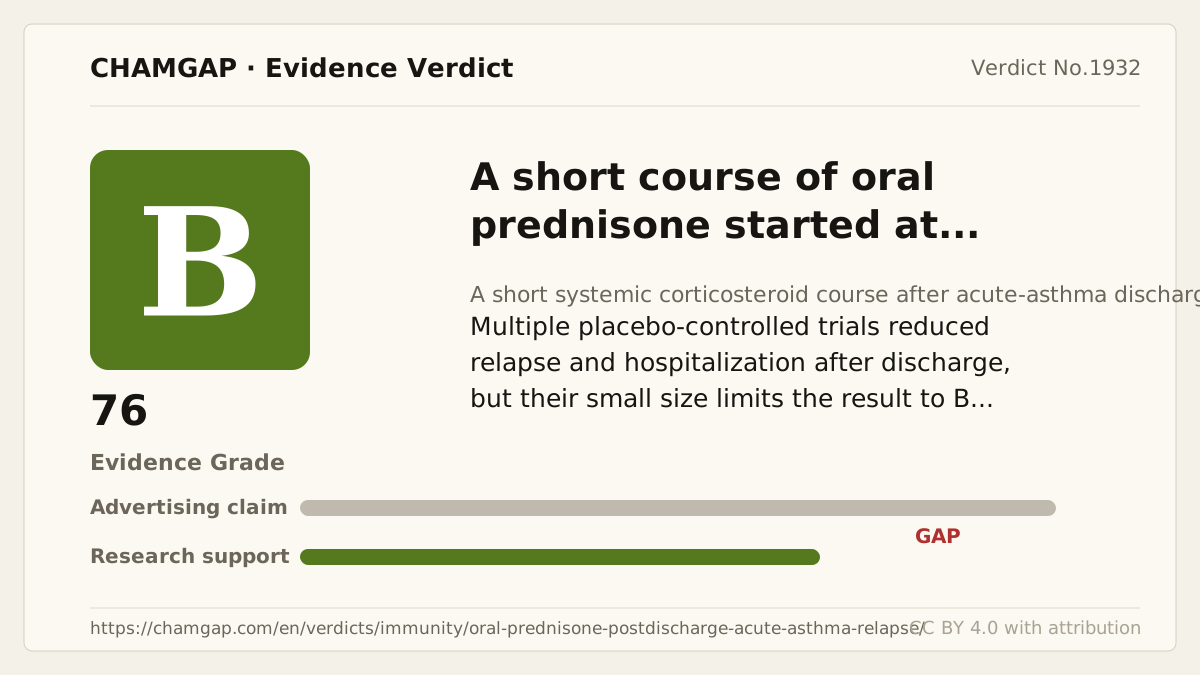
[Chamgap] Oral prednisone x prevention of relapse after discharge for acute asthma — Evidence Grade B·76. 2 cited sources checked. Source: https://chamgap.com/en/verdicts/immunity/oral-prednisone-postdischarge-acute-asthma-relapse/ · CC BY 4.0CC BY 4.0 — free to use with attribution; do not distort grades, numbers, or verdict meaning.
What this document does and does not do
Chamgap is an information source. It reports what research has and has not confirmed; it does not tell readers what to take or buy. That decision belongs to readers and, when needed, medical or legal professionals. This verdict reflects literature available up to the search date and may change as new research appears. Nothing here is medical advice.