
Oral prednisolone,
does it really help with Hearing recovery in children with persistent otitis media with effusion?
research showsThe grade is D with 34 points. Acceptable hearing at five weeks occurred in 73/183 (39.9%) with prednisolone versus 59/180 (32.8%) with placebo: absolute difference 7.1 percentage points (95% CI -2.8 to 16.8), adjusted OR 1.36 (95% CI 0.88 to 2.11), P=0.16. The result was null, but meaningful benefit was not excluded.
ads claimVerdict 1757 is D with 28 points for tympanostomy tubes preventing recurrent acute otitis media, whereas this verdict concerns hearing in persistent otitis media with effusion. Verdict 2544 is B with 70 points for antibiotic-steroid drops for acute tube otorrhea, verdict 2550 is D with 30 points for water precautions after tubes, and verdict 1923 is B with 72 points for amoxicillin-clavulanate in young children with acute otitis media.
Useful facts when choosing a product
- Oral steroids for pediatric otitis media with effusion remain a real prescribing controversy in South Korea.
- At least one diary problem occurred in 25/179 (14.0%) versus 22/170 (12.9%); hyperactivity was 3 versus 1, behavior change 2 versus 0, sleepwalking 1 versus 0, and increased appetite 3 versus 4.
- Systemic steroids can affect behavior, sleep, and appetite in children; growth concern mainly follows longer or repeated exposure, which this seven-day trial could not assess.
Chamgap Semantic Classification Code
Candidate index · review held
UNK.prednisolone.oral.hearing-recovery-with-persistent-otitis-media-with-effusion.assess.placeboUnknown > Prednisolone > Oral > Hearing recovery with persistent otitis media with effusion > Association or change assessment > Placebo
An automated migration candidate, not an issued permanent code; exact claim scope remains under review. This machine-generated migration candidate helps retrieval but is not a permanent assignment. The original verdict ID and URL remain authoritative.
What the research actually shows
Twenty UK hospitals randomized 389 children to seven days of prednisolone or matched placebo with NIHR HTA public funding. Axis 6 B0 basis: ① allocation concealment - the report states, "Recruited children were allocated the next sequentially numbered trial pack at each site pharmacy", and "The codes were then allocated to oral steroid and placebo by an independent statistician". ② blinding - it states, "Clinicians, participants, parents, audiologists and members of the research team were all blind to the intervention allocation, and the study used matched placebos to help to maintain blinding", establishing a double-blind placebo-controlled trial. ③ analysis population and missingness - it states, "All analyses were by intention to treat without imputation for those lost to follow-up"; week-five hearing was assessed in 183 versus 180 children. Substantial attrition (>=15%): actual 6.7% (26/389) - not applicable. ④ prespecified primary endpoint - the report defines, "The primary outcome was audiometry-confirmed acceptable hearing at 5 weeks", matching the five-week acceptable-hearing primary endpoint under registration ISRCTN49798431. No axis 6 limitation from the nine-item list applies.
Why this is classified as D (34)
This public-funded double-blind placebo-controlled trial measured hearing itself and has axis 6 B0. The primary result was null, no a priori clinical threshold was found, and the interval retained a benefit tail, giving D with 34 points.
Counterpoint. The five-week primary endpoint did not establish short-term benefit. Later secondary time points did not replace the failed prespecified primary endpoint.
Rejudgment record. Cross-check applied — OSTRICH and ISRCTN49798431 show allocation concealment, double-blind placebo control, ITT, 6.7% missingness, and a prespecified five-week acceptable-hearing endpoint, supporting axis 6 B0; the null estimate and wide benefit tail support D with 34 points
| Endpoint | P | Symptom or function itself is the target - including patient reports and performance tests |
| Replication | R1 | Single confirmatory trial |
| Independence | I2 | Decisive evidence is publicly or non-profit funded |
| Effect size | E0 | Null |
| Precision | C0 | The confidence interval leaves room for benefit |
Stored derived and displayed grades match; this is not a current recalculation or validity check (D).
Sub-claim grades by effect
This ingredient is marketed for several effects. A single overall grade blends strong and weak claims together, so each effect is graded separately here. The overall grade reflects the strongest disconfirming or core claim.
| Effect (sub-claim) | Grade | Basis |
|---|---|---|
| Hearing recovery at five weeks | D | The 7.1-point difference had an interval crossing zero. |
| Growth safety | ? | A seven-day exposure trial cannot establish growth safety. |
Cross-check — AI research and Codex final gate
Evidence Table
| Study | Design | Sample | Funding | Endpoint | Result | Weight |
|---|---|---|---|---|---|---|
| Francis NA et al. 2018 OSTRICH | Randomized double-blind placebo-controlled trial at 20 UK hospitals | 389 randomized; week-five analysis 183 versus 180 | NIHR Health Technology Assessment Programme | Acceptable hearing at five weeks using age-specific pure-tone average thresholds | 73/183 (39.9%) versus 59/180 (32.8%); absolute difference 7.1 points (95% CI -2.8 to 16.8); adjusted OR 1.36 (95% CI 0.88 to 2.11); P=0.16 | Pivotal single null hearing trial |
Receipt — 1 References
All 1 cited sources were verified for existence at the original page (as of 2026-08-18).
Final verification and publication gate: Codex · Evidence date: 2026-08-18 · Corrections: none
Cite this verdict
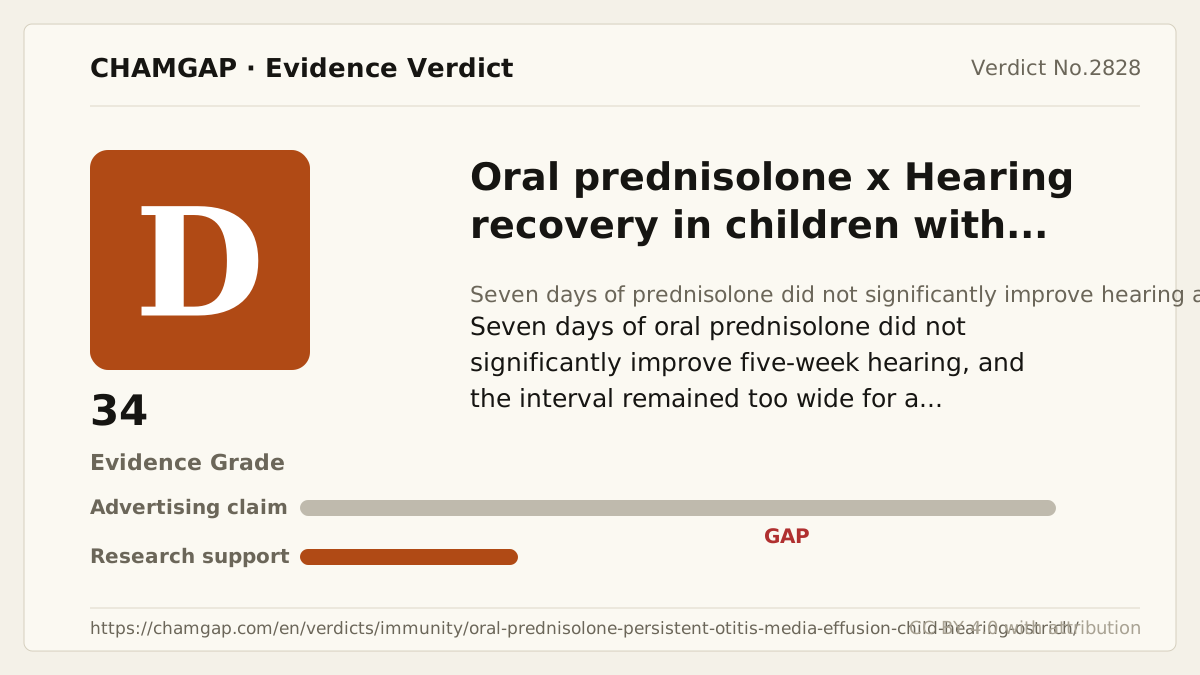
[Chamgap] Oral Prednisolone Is Ineffective for Hearing Recovery in Children With Persistent Otitis Media With Effusion: OSTRICH — Evidence Grade D·34. 1 cited sources checked. Source: https://chamgap.com/en/verdicts/immunity/oral-prednisolone-persistent-otitis-media-effusion-child-hearing-ostrich/ · CC BY 4.0CC BY 4.0 — free to use with attribution; do not distort grades, numbers, or verdict meaning.
What this document does and does not do
Chamgap is an information source. It reports what research has and has not confirmed; it does not tell readers what to take or buy. That decision belongs to readers and, when needed, medical or legal professionals. This verdict reflects literature available up to the search date and may change as new research appears. Nothing here is medical advice.