
Intravenous immune globulin,
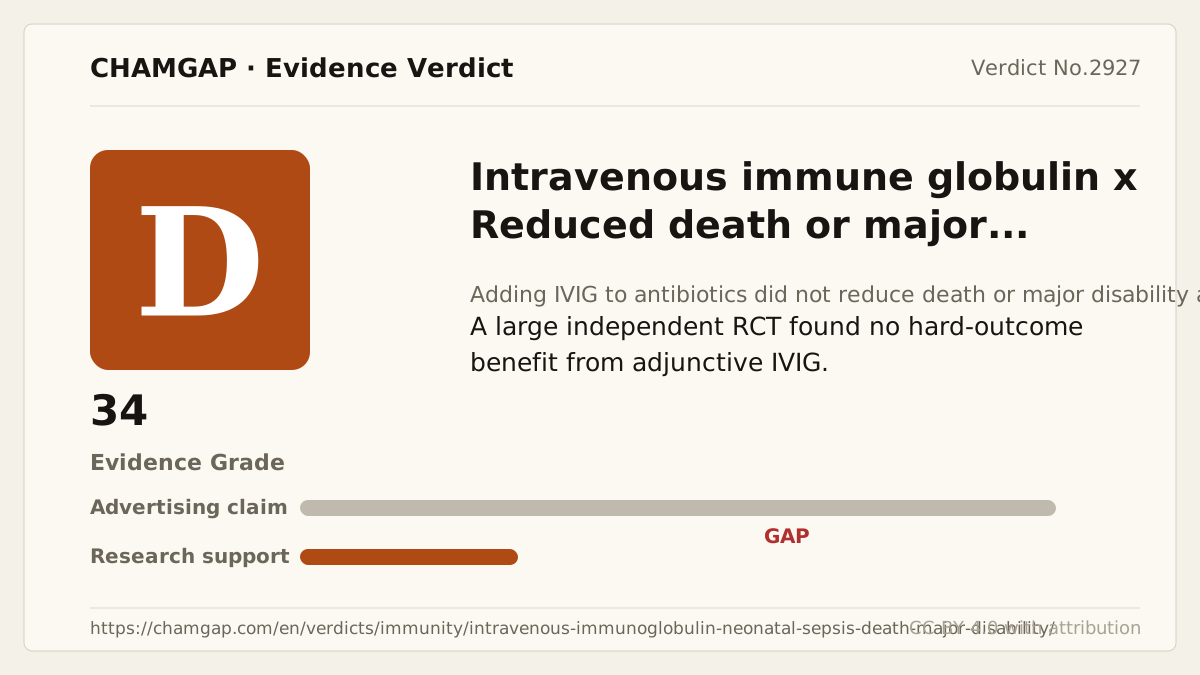
does it really help with Reduced death or major disability in neonatal sepsis receiving antibiotics?
research showsGrade D. Death or major disability at age 2 occurred in 686/1759 (39.0%) versus 677/1734 (39.0%), RR 1.00 (95% CI 0.92-1.08), absolute difference 0.0 points. The lower tail still permits a small benefit.
ads claimBiological antibody deficiency did not translate into better two-year outcomes.
Useful facts when choosing a product
- Two 500-mg/kg infusions were given 48 hours apart.
- All infants were receiving antibiotics.
- UK MRC, Australian NHMRC, and New Zealand HRC supported the trial.
Chamgap Semantic Classification Code
Candidate index · review held
M.immune-globulin.intravenous.death-or-major-disability-in-neonatal-sepsis-receiving-antibiotics.reduce.placeboMedicinal interventions > immune globulin > Intravenous > death or major disability in neonatal sepsis receiving antibiotics > Reduction claim > Placebo
An automated migration candidate, not an issued permanent code; exact claim scope remains under review. This machine-generated migration candidate helps retrieval but is not a permanent assignment. The original verdict ID and URL remain authoritative.
What the research actually shows
The trial randomized 3,493 infants at 113 hospitals and analyzed by assignment. No listed avoidable design defect was counted. The UK Medical Research Council, Australian National Health and Medical Research Council, and Health Research Council of New Zealand supported it. Adverse events numbered 12 with IVIG, including two deaths, and 10 with placebo, including four deaths; no inferential comparison was reported for these counts.
Why this is classified as D (34)
A single large null hard-outcome trial without repeated refutation or complete benefit exclusion gives D with 34 points.
Counterpoint. The CI permits a small benefit.
Rejudgment record. Cross-check applied — A 3,493-infant publicly funded hard-outcome RCT was null, with a residual confidence-interval tail
| Endpoint | H | Hard endpoint - actual events such as death |
| Replication | R1 | Single confirmatory trial |
| Independence | I2 | Decisive evidence is publicly or non-profit funded |
| Effect size | E0 | Null |
| Precision | C0 | The confidence interval leaves room for benefit |
Stored derived and displayed grades match; this is not a current recalculation or validity check (D).
Sub-claim grades by effect
This ingredient is marketed for several effects. A single overall grade blends strong and weak claims together, so each effect is graded separately here. The overall grade reflects the strongest disconfirming or core claim.
| Effect (sub-claim) | Grade | Basis |
|---|---|---|
| Reduced death or major disability | D | RR was 1.00. |
Cross-check — AI research and Codex final gate
Evidence Table
| Study | Design | Sample | Funding | Endpoint | Result | Weight |
|---|---|---|---|---|---|---|
| INIS 2011 | International multicenter double-blind placebo-controlled RCT | 3,493 infants | UK Medical Research Council, Australian National Health and Medical Research Council, and Health Research Council of New Zealand | Death or major disability at age 2 | 39.0% vs 39.0%; RR 1.00 (95% CI 0.92-1.08), absolute difference 0.0 points | Large publicly funded hard-outcome evidence |
Receipt — 1 References
All 1 cited sources were verified for existence at the original page (as of 2026-08-26).
Final verification and publication gate: Codex · Evidence date: 2026-08-26 · Corrections: none
Cite this verdict
[Chamgap] No Benefit of Intravenous Immune Globulin for Death or Major Disability in Neonatal Sepsis Receiving Antibiotics — Evidence Grade D·34. 1 cited sources checked. Source: https://chamgap.com/en/verdicts/immunity/intravenous-immunoglobulin-neonatal-sepsis-death-major-disability/ · CC BY 4.0CC BY 4.0 — free to use with attribution; do not distort grades, numbers, or verdict meaning.
What this document does and does not do
Chamgap is an information source. It reports what research has and has not confirmed; it does not tell readers what to take or buy. That decision belongs to readers and, when needed, medical or legal professionals. This verdict reflects literature available up to the search date and may change as new research appears. Nothing here is medical advice.