
Hib conjugate vaccine,
does it really help with Prevention of invasive Hib disease in infants?
research showsThe grade is A. A double-blind randomized Gambian trial assigned 42,848 infants; among 35,713 who received all three doses, invasive Hib disease occurred once with vaccine and 19 times with control, for 95% efficacy (95% CI 67 to 100). A separate double-blind Navajo trial of 5,190 randomized infants found 1 versus 22 cases in the all-randomized follow-up, efficacy 95% (72 to 99), P<0.001. Large reductions in severe infection across independent teams, settings, and conjugates give A with 86 points.
ads claimThe well-supported claim is prevention of culture-confirmed invasive Hib disease in infants. It should not be expanded into prevention of all-cause pneumonia, colds, or an identical absolute effect for every schedule.
Useful facts when choosing a product
- Hib means Haemophilus influenzae type b; despite the name, it is a bacterium, not influenza virus.
- The Gambian trial used PRP-T, conjugating Hib polysaccharide to tetanus protein, while the Navajo trial used the PRP-OMP meningococcal outer-membrane-protein conjugate.
- Invasive Hib disease includes severe events such as meningitis, bacteremia, and culture-confirmed pneumonia from normally sterile sites.
Chamgap Semantic Classification Code
Candidate index · review held
M.infant-haemophilus-influenzae-type-b-conjugate-vaccine.UNK.invasive-hib-disease.prevent.placeboMedicinal interventions > Infant Haemophilus influenzae type b conjugate vaccine > Unknown > invasive Hib disease > Occurrence-prevention claim > Placebo
An automated migration candidate, not an issued permanent code; exact claim scope remains under review. This machine-generated migration candidate helps retrieval but is not a permanent assignment. The original verdict ID and URL remain authoritative.
What the research actually shows
Finnish Eskola 1990 enrolled about 114,000 infants, roughly 58,000 versus 56,000, and found 4 versus 64 invasive-Hib cases, efficacy 94% (95% CI 83 to 98). Navajo Santosham 1991 randomized 5,190 (2,588/2,602) and found 1 versus 22 cases in the all-randomized analysis, efficacy 95% (72 to 99), with Merck funding. Gambian Mulholland 1997 randomized 42,848, but 35,713 was the three-dose analysis population rather than the full randomized analysis; it found 1 versus 19 cases, efficacy 95% (67 to 100). Gambia was funded by UK MRC, USAID, WHO, UNICEF, and the Children's Vaccine Initiative, with vaccine supplied by Pasteur Mérieux. All four trials differed in country, team, and vaccine.
Why this is classified as A (86)
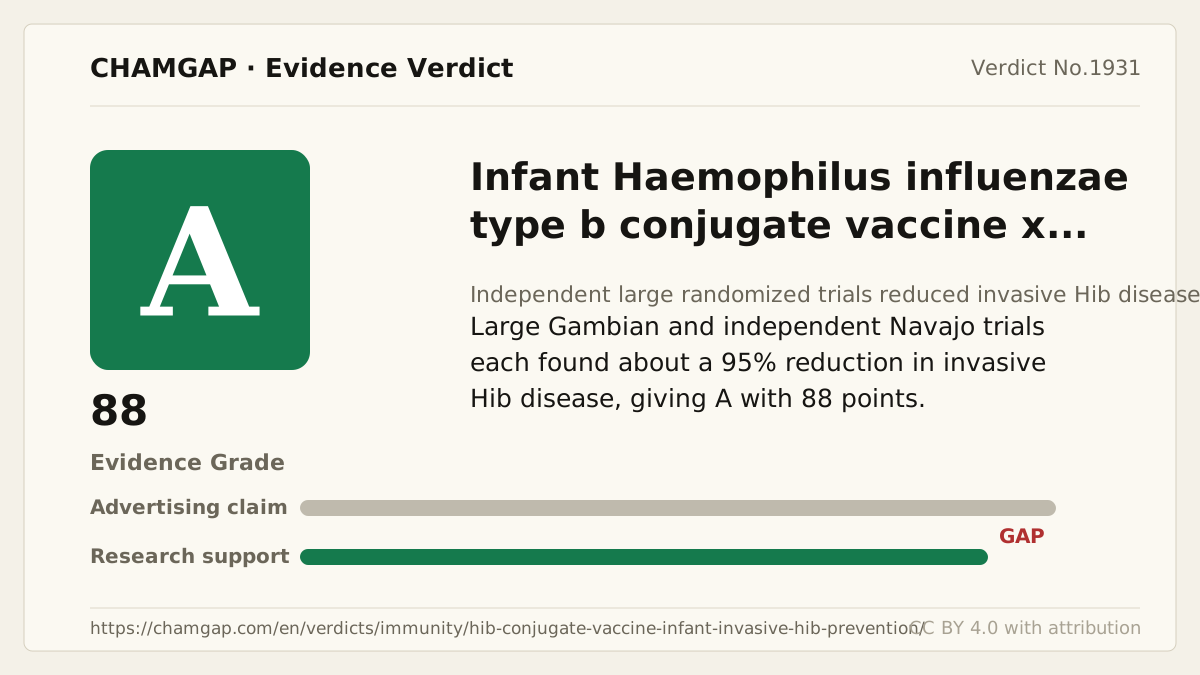
Independent large randomized trials reduced the hard outcome of invasive Hib disease by about 95%, with publicly funded evidence also present, giving A with 86 points.
Counterpoint. The most direct evidence applies to timely completion of the studied schedule. Different baseline incidence means different numbers of cases prevented per 1,000 vaccinations.
Rejudgment record. Cross-check applied — Large double-blind randomized and independent field trials replicated a large, consistent reduction in invasive Hib disease
| Endpoint | H | Hard endpoint - actual events such as death |
| Replication | R2 | Independently replicated across trials |
| Independence | I1 | Mixed funding sources |
| Effect size | E+ | Meets the clinically important threshold |
Stored derived and displayed grades match; this is not a current recalculation or validity check (A).
Sub-claim grades by effect
This ingredient is marketed for several effects. A single overall grade blends strong and weak claims together, so each effect is graded separately here. The overall grade reflects the strongest disconfirming or core claim.
| Effect (sub-claim) | Grade | Basis |
|---|---|---|
| Prevention of invasive Hib disease after a three-dose infant series | A | The Gambian trial found 1 versus 19 cases, efficacy 95%. |
| Prevention of radiographically defined pneumonia from any cause | B | The Gambian estimate was 21.1% (95% CI 4.6 to 34.9), smaller than the invasive-Hib result. |
Cross-check — AI research and Codex final gate
Evidence Table
| Study | Design | Sample | Funding | Endpoint | Result | Weight |
|---|---|---|---|---|---|---|
| Mulholland K et al. 1997 Gambian trial | Double-blind randomized controlled trial | 42,848 randomized; 40,366 received two doses; 35,713 in the three-dose primary analysis | Public and international support including UK MRC, USAID, WHO, UNICEF, and the Children's Vaccine Initiative; vaccine supplied by Pasteur Mérieux | Culture-confirmed invasive Hib disease after three doses | 1 versus 19 cases; efficacy 95% (95% CI 67 to 100) | Large publicly funded hard-outcome evidence |
| Santosham M et al. 1991 Navajo trial | Double-blind placebo-controlled randomized trial | 5,190 randomized (2,588/2,602) in the all-randomized follow-up analysis | Grant from Merck Sharp & Dohme Research Laboratories | Systemic invasive Hib disease before 18 months | 1 versus 22 cases; efficacy 95% (95% CI 72 to 99), P<0.001 | Replication by a different team, setting, and conjugate |
Receipt — 2 References
All 2 cited sources were verified for existence at the original page (as of 2026-08-01).
Final verification and publication gate: Codex · Evidence date: 2026-08-01 · Corrections: none
Cite this verdict
[Chamgap] Hib conjugate vaccine x prevention of invasive Hib disease in infants — Evidence Grade A·86. 2 cited sources checked. Source: https://chamgap.com/en/verdicts/immunity/hib-conjugate-vaccine-infant-invasive-hib-prevention/ · CC BY 4.0CC BY 4.0 — free to use with attribution; do not distort grades, numbers, or verdict meaning.
What this document does and does not do
Chamgap is an information source. It reports what research has and has not confirmed; it does not tell readers what to take or buy. That decision belongs to readers and, when needed, medical or legal professionals. This verdict reflects literature available up to the search date and may change as new research appears. Nothing here is medical advice.