
EpiCor dried yeast fermentate,
does it really help with Reduction of cold and flu-like symptoms and immune support?
research showsIn a 116-person adult trial, EpiCor at 500 mg/day reduced the number of cold or flu-like episodes but did not significantly reduce duration or severity. In a 256-child trial, the primary incidence endpoint was null while selected symptom and medication-use secondary endpoints improved. All clinical evidence was linked to Embria's EpiCor ingredient and its corporate research network.
ads claimThe labels postbiotic or immune support do not establish prevention or treatment of cold or influenza infection.
Useful facts when choosing a product
- Major clinical trials used EpiCor at 500 mg/day.
- Imported products containing 500 mg of EpiCor are sold through Korean online and cross-border channels.
- Generic yeast fermentates or other postbiotics cannot be assumed equivalent to the EpiCor trial material.
Chamgap Semantic Classification Code
Candidate index · review held
UNK.epicor-dried-yeast-fermentate.UNK.cold-and-flu-like-symptoms-and-immune-support.reduce.placeboUnknown > EpiCor dried yeast fermentate > Unknown > cold and flu-like symptoms and immune support > Reduction claim > Placebo
An automated migration candidate, not an issued permanent code; exact claim scope remains under review. This machine-generated migration candidate helps retrieval but is not a permanent assignment. The original verdict ID and URL remain authoritative.
What the research actually shows
The key trials are a 116-person adult study lasting 12 weeks and a 256-child study lasting 84 days. Both used 500 mg/day, but results were inconsistent across endpoints and populations.
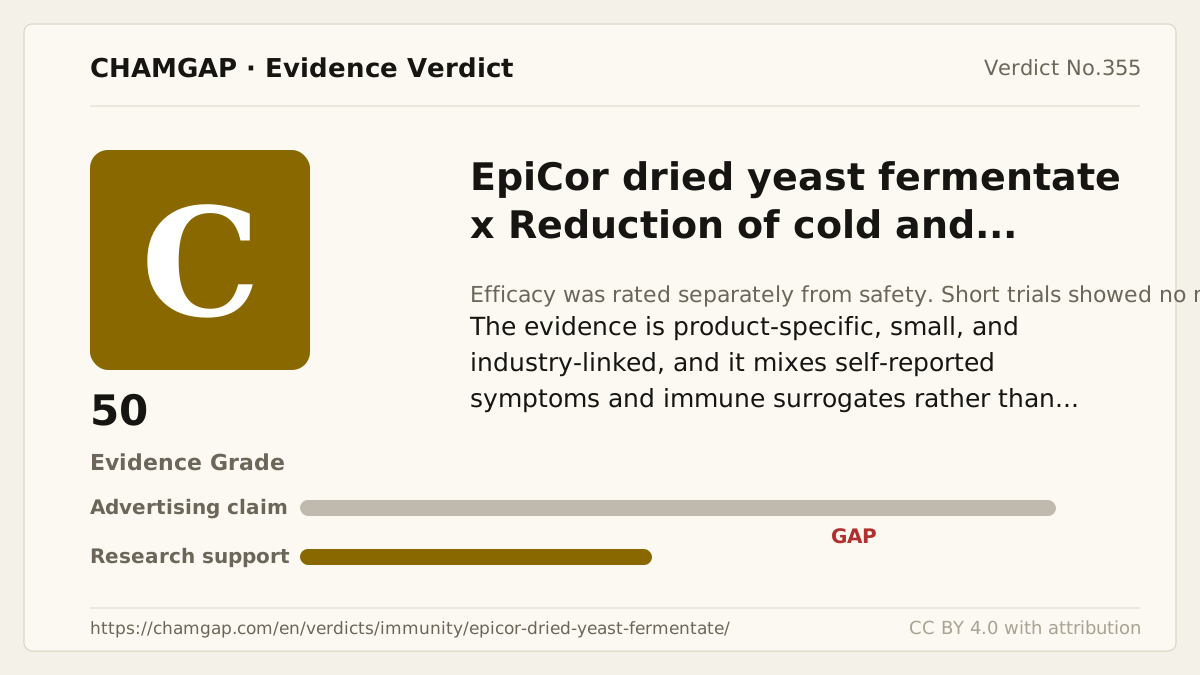
Why this is classified as C (50)
A proprietary manufacturer-linked ingredient, small trials, and mixed or conflicting primary and secondary endpoints warrant C.
Counterpoint. Some symptom signals recur, but confirmed infections and a large independent trial are needed.
Rejudgment record. Reassessment (cross-check reflected) — C cap for industry-linked proprietary-ingredient RCTs with conflicting primary and secondary endpoints
Sub-claim grades by effect
This ingredient is marketed for several effects. A single overall grade blends strong and weak claims together, so each effect is graded separately here. The overall grade reflects the strongest disconfirming or core claim.
| Effect (sub-claim) | Grade | Basis |
|---|---|---|
| Reduction in cold and flu-like symptom incidence | C | Positive adult result but null pediatric primary endpoint |
| Reduction in symptom duration and severity | C | Null in adults with selected positive pediatric secondary endpoints |
| Immune support | C | Primarily product-specific surrogate and symptom evidence |
Cross-check — AI research and Codex final gate
Evidence Table
| Study | Design | Sample | Funding | Endpoint | Result | Weight |
|---|---|---|---|---|---|---|
| Moyad et al. (2010), Journal of Alternative and Complementary Medicine | Randomized double-blind placebo-controlled trial, 12 weeks | 116 | Funded by Embria Health Sciences; authors included company employees and consultants | Cold or flu-like episode incidence, duration, and severity | Episode count was significantly lower at 1.32 versus 1.51; duration at p=0.10 and severity at p=0.90 were not significant | Moderate-low |
| Singh et al. (2024), Pediatric Research | Randomized double-blind placebo-controlled pediatric trial, 84 days | 256 | Funded by Cargill, owner of Embria's EpiCor business; authors included Cargill and contract-research employees | Primary cold or flu symptom incidence, symptom severity, and medication use | The primary incidence endpoint was not significant; selected symptom and medication-use secondary endpoints improved | Moderate |
Receipt — 2 References
All 2 cited sources were verified for existence at the original page (as of 2026-07-16).
Final verification and publication gate: Codex · Evidence date: 2026-07-16 · Corrections: none
Cite this verdict
[Chamgap] Does EpiCor reduce cold and flu-like symptoms and support immunity? — Evidence Grade C·50. 2 cited sources checked. Source: https://chamgap.com/en/verdicts/immunity/epicor-dried-yeast-fermentate/ · CC BY 4.0CC BY 4.0 — free to use with attribution; do not distort grades, numbers, or verdict meaning.
What this document does and does not do
Chamgap is an information source. It reports what research has and has not confirmed; it does not tell readers what to take or buy. That decision belongs to readers and, when needed, medical or legal professionals. This verdict reflects literature available up to the search date and may change as new research appears. Nothing here is medical advice.