
Dual-strain L. reuteri lozenges,
does it really help with Additional reduction of residual periodontal-pocket depth after nonsurgical periodontal therapy?
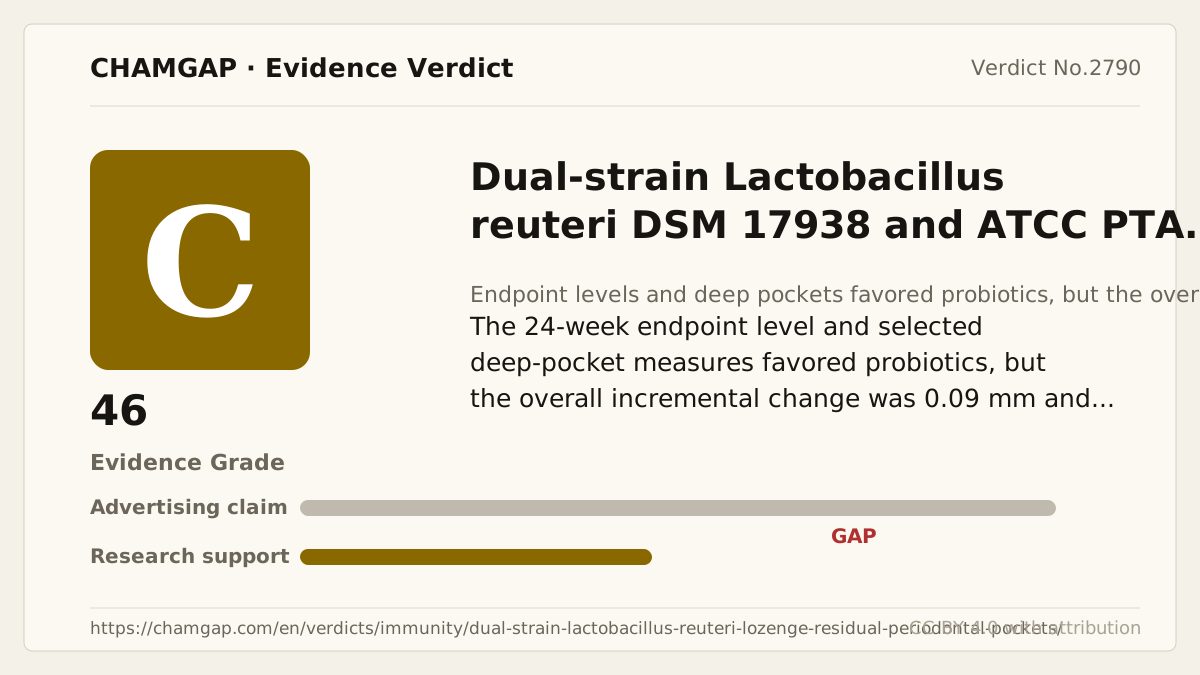
research showsThe grade is C. Forty-four participants were randomized, but the prespecified analysis population included 39 who attended week 12, 19 probiotic and 20 placebo. At week 24, whole-mouth mean probing depth was 2.64±0.33 mm versus 2.92±0.42 mm, P=.034, while change from baseline was -0.45 versus -0.36 mm and the between-group change test was P=.375. The effect was far below the 1-mm difference assumed for sample size, and the small modified analysis included manufacturer funding and products, giving C with 46 points.
ads claimMarketing cannot claim that the probiotic reduced residual pockets by an additional 1 mm. The overall incremental change was 0.09 mm, while favorable signals concentrated in endpoint levels, deeper pockets, and closure measures.
Useful facts when choosing a product
- Dental recall timing in verdict 2787 is D with 30 points and P11-4 for early caries in verdict 2789 is C with 50 points. Those ask about visit timing and early enamel lesions, not residual pockets after periodontal treatment.
- Fluoride toothpaste in verdict 701 is A with 92 points, xylitol in verdict 748 is C with 45 points, fissure sealants in verdict 1841 are A with 86 points, supervised fluoride brushing in verdict 2515 is C with 50 points, and the Hall technique in verdict 2712 is B with 70 points. These are caries prevention or restoration questions.
- Water flossing in verdict 2359 is C with 46 points and mouthwash in verdict 2707 is C with 50 points for gingival or plaque control; periodontal treatment during pregnancy in verdict 2226 is D with 34 points for preterm birth. They differ from adjunctive treatment of residual pockets.
- BioGaia supplied intervention and placebo lozenges, not the periodontal probe used for assessment.
Chamgap Semantic Classification Code
Candidate index · review held
UNK.dual-strain-lactobacillus-reuteri-dsm-17938-and-atcc-pta-5289-lozenges.UNK.residual-periodontal-pocket-depth-after-nonsurgical-periodontal-therapy.reduce.placeboUnknown > Dual-strain Lactobacillus reuteri DSM 17938 and ATCC PTA 5289 lozenges > Unknown > residual periodontal-pocket depth after nonsurgical periodontal therapy > Reduction claim > Placebo
An automated migration candidate, not an issued permanent code; exact claim scope remains under review. This machine-generated migration candidate helps retrieval but is not a permanent assignment. The original verdict ID and URL remain authoritative.
What the research actually shows
At one KU Leuven center, 44 nonsmoking adults with residual pockets after initial scaling and root planing were double-masked to probiotic or identical-appearance and identical-taste placebo. Everyone received full-mouth reinstrumentation and used lozenges twice daily for 12 weeks, with follow-up to 24 weeks. Five participants lost before week 12, exposed to antibiotics, or violating protocol were excluded; the article called the remaining 39 an intention-to-treat last-observation-carried-forward analysis. This was not a full all-randomized analysis. There was no early stopping. BioGaia partially funded the study and supplied both probiotic and placebo products; KU Leuven and FWO also supported it. Teughels disclosed speaker fees from BioGaia for probiotics. Avoidable limitations were sample size below 200 and the modified analysis of 39/44 randomized participants.
Why this is classified as C (46)
Endpoint levels and selected deep-pocket results were positive, but the overall incremental effect was small in a mixed-funded small modified analysis, giving C with 46 points.
Counterpoint. C does not mean every periodontal measure was null. Deep-pocket and closure signals justify independent follow-up trials.
Rejudgment record. Cross-check applied — Cross-checks the primary PPD, endpoint and change tests, 44-participant flow and LOCF population, BioGaia funding and product supply, and speaker-fee disclosure in the full PDF
| Endpoint | S | Surrogate marker - laboratory or imaging measures |
| Replication | R1 | Single confirmatory trial |
| Independence | I1 | Mixed funding sources |
| Effect size | E~ | Statistically positive but below the threshold |
Stored derived and displayed grades match; this is not a current recalculation or validity check (C).
Sub-claim grades by effect
This ingredient is marketed for several effects. A single overall grade blends strong and weak claims together, so each effect is graded separately here. The overall grade reflects the strongest disconfirming or core claim.
| Effect (sub-claim) | Grade | Basis |
|---|---|---|
| Additional reduction in whole-mouth residual pocket depth | C | The incremental change was 0.09 mm, P=.375. |
| Reduction in deep periodontal pockets | C | Deep-pocket change was -2.32 versus -1.70 mm, P=.043, a secondary subset result. |
Cross-check — AI research and Codex final gate
Evidence Table
| Study | Design | Sample | Funding | Endpoint | Result | Weight |
|---|---|---|---|---|---|---|
| Laleman I et al. 2020 | Single-center double-blind placebo-controlled randomized trial | 44 randomized, 22 per arm; 39 in the post-week-12 LOCF analysis, 19 versus 20 | Partial BioGaia funding and active/placebo product supply, with KU Leuven and FWO support; author speaker fees from BioGaia | Whole-mouth probing pocket depth at 24 weeks | Endpoint 2.64±0.33 versus 2.92±0.42 mm, P=.034; change -0.45 versus -0.36 mm, between-group P=.375 | Small mixed-funded trial with selected positive results but a small overall incremental effect |
Receipt — 1 References
All 1 cited sources were verified for existence at the original page (as of 2026-08-18).
Final verification and publication gate: Codex · Evidence date: 2026-08-18 · Corrections: none
Cite this verdict
[Chamgap] Dual-strain L. reuteri lozenges x residual periodontal pockets — Evidence Grade C·46. 1 cited sources checked. Source: https://chamgap.com/en/verdicts/immunity/dual-strain-lactobacillus-reuteri-lozenge-residual-periodontal-pockets/ · CC BY 4.0CC BY 4.0 — free to use with attribution; do not distort grades, numbers, or verdict meaning.
What this document does and does not do
Chamgap is an information source. It reports what research has and has not confirmed; it does not tell readers what to take or buy. That decision belongs to readers and, when needed, medical or legal professionals. This verdict reflects literature available up to the search date and may change as new research appears. Nothing here is medical advice.