
BCG vaccine,
does it really help with Reduced active tuberculosis after a first dose in previously unvaccinated children?
research showsYes. In the Brazilian BCG-REVAC cluster-randomized trial, an analysis of 39,129 previously unvaccinated schoolchildren found tuberculosis incidence rates of 54.9 per 100,000 person-years with first BCG vaccination and 72.7 without it, for vaccine effectiveness of 25% (95% CI 3% to 43%). Randomized-trial syntheses also support protection, particularly in infants and children rigorously screened as uninfected. Effectiveness varies substantially by region, latitude, exposure setting, age, and trial design, so the verdict is B.
ads claimClaims that one dose prevents every form of tuberculosis for life, or that repeated adult doses necessarily improve protection, exceed the evidence. This verdict is limited to a first dose in previously unvaccinated children and active disease; national schedules and contraindications still apply.
Useful facts when choosing a product
- BCG is a live attenuated Mycobacterium bovis vaccine, generally given once at birth or as early as possible in settings with a high tuberculosis burden.
- BCG provides relatively strong protection against severe childhood forms such as tuberculous meningitis and miliary tuberculosis, while efficacy against pulmonary disease varies greatly by setting and study.
- This verdict concerns a first dose in children who have never received BCG. The same effect cannot be assumed for adult revaccination.
- Common effects include a local papule, ulcer, scar, and regional lymphadenitis. Severe immunodeficiency must be screened because live BCG can rarely cause disseminated infection.
Chamgap Semantic Classification Code
Candidate index · review held
M.bcg-vaccine.UNK.active-tuberculosis-after-a-first-dose-in-previously-unvaccinated-children.reduce.UNKMedicinal interventions > BCG vaccine > Unknown > active tuberculosis after a first dose in previously unvaccinated children > Reduction claim > Unknown
An automated migration candidate, not an issued permanent code; exact claim scope remains under review. This machine-generated migration candidate helps retrieval but is not a permanent assignment. The original verdict ID and URL remain authoritative.
What the research actually shows
BCG-REVAC was a cluster trial that randomized 763 schools. The final previously unvaccinated subgroup comprised 20,622 vaccine recipients in 385 schools and 18,507 controls in 365 schools, totaling 750 schools and 39,129 participants. Over approximately nine years (1997–2006/1999–2007 observation periods), incidence was 54.9 versus 72.7 per 100,000 person-years and vaccine effectiveness was 25%. A systematic review of 18 pulmonary-tuberculosis randomized trials reported RR 0.41 in infants and RR 0.26 in children rigorously screened as tuberculin-negative, with substantial between-study variation.
Why this is classified as B (64)
A large cluster-randomized trial found that first BCG vaccination reduced active tuberculosis in previously unvaccinated children, and a systematic review of randomized trials supported protection in uninfected children and infants. A moderate Brazilian effect estimate and substantial geographic heterogeneity, including 34% in Salvador versus 8% in Manaus, give B with 64 points.
Counterpoint. Cluster randomization can retain school-level differences, and classifying prior vaccination by BCG scar can misclassify some children. Results in Brazilian schoolchildren also cannot be transferred unchanged to vaccination at birth or to other epidemiologic settings.
Rejudgment record. Cross-check applied — The first dose in previously unvaccinated children was isolated and evaluated with an active-tuberculosis cluster-randomized trial plus a systematic review of randomized trials. Large heterogeneity by geography, latitude, and age, and non-generalizability to adult revaccination, reduced the score.
Sub-claim grades by effect
This ingredient is marketed for several effects. A single overall grade blends strong and weak claims together, so each effect is graded separately here. The overall grade reflects the strongest disconfirming or core claim.
| Effect (sub-claim) | Grade | Basis |
|---|---|---|
| Reduced active tuberculosis after first BCG vaccination in previously unvaccinated children | B | BCG-REVAC found vaccine effectiveness of 25% (95% CI 3% to 43%), reinforced by a synthesis of randomized trials. Local reactions and lymphadenitis are separate safety outcomes. |
| Reduced tuberculous meningitis and miliary tuberculosis in children | B | Randomized trials and syntheses find protection against severe childhood tuberculosis more consistent than protection against pulmonary disease. Disseminated BCG infection in severe immunodeficiency is a separate harm requiring contraindication screening. |
| Reduced active tuberculosis after BCG revaccination in adults | D | Randomized revaccination trials in Brazil, Malawi, and elsewhere exist, but effects are null or mixed, making this D (uncertain efficacy), not literature absence (?). |
Cross-check — AI research and Codex final gate
Evidence Table
| Study | Design | Sample | Funding | Endpoint | Result | Weight |
|---|---|---|---|---|---|---|
| Pereira SM et al. BCG-REVAC first-vaccination analysis | School-level cluster-randomized controlled trial | 39,129 previously unvaccinated children in 750 schools; 20,622 vaccinated in 385 schools and 18,507 controls in 365 schools | UK Department for International Development and Brazilian National Health Foundation | Incident active tuberculosis over approximately nine years (1997–2006/1999–2007 observation periods) | Incidence was 54.9 versus 72.7 per 100,000 person-years, for vaccine effectiveness of 25% (95% CI 3% to 43%); regional estimates were 34% (8% to 53%) in Salvador and 8% in Manaus. | Large randomized trial directly matching the claim |
| Mangtani P et al. randomized-trial systematic review | Systematic review and meta-analysis of randomized BCG tuberculosis-prevention trials | 18 randomized trials of pulmonary tuberculosis and 6 of meningeal or miliary tuberculosis | UK National Institute for Health Research Evaluation, Trials and Studies Coordinating Centre | Pulmonary, meningeal, and miliary tuberculosis | RR was 0.41 (95% CI 0.29 to 0.58) for infant vaccination and 0.26 (0.18 to 0.37) in children rigorously screened as tuberculin-negative; latitude, age, and infection screening explained part of the heterogeneity. | Multi-trial reinforcement and heterogeneity assessment |
| Roy A et al. pediatric BCG meta-analysis | Meta-analysis of observational evidence on tuberculosis infection and active disease in BCG-vaccinated children | 3,855 children in 14 infection studies and 1,745 in 6 active-disease studies | Detailed funding information was not reported in the PubMed abstract | Tuberculosis infection and progression to active disease after exposure | Estimated protection was 19% against infection, 58% against progression among infected children, and 71% against active disease among all exposed children. | Supportive mechanistic and pediatric active-disease evidence |
Receipt — 5 References
All 5 cited sources were verified for existence at the original page (as of 2026-07-24).
Final verification and publication gate: Codex · Evidence date: 2026-07-24 · Corrections: none
Cite this verdict
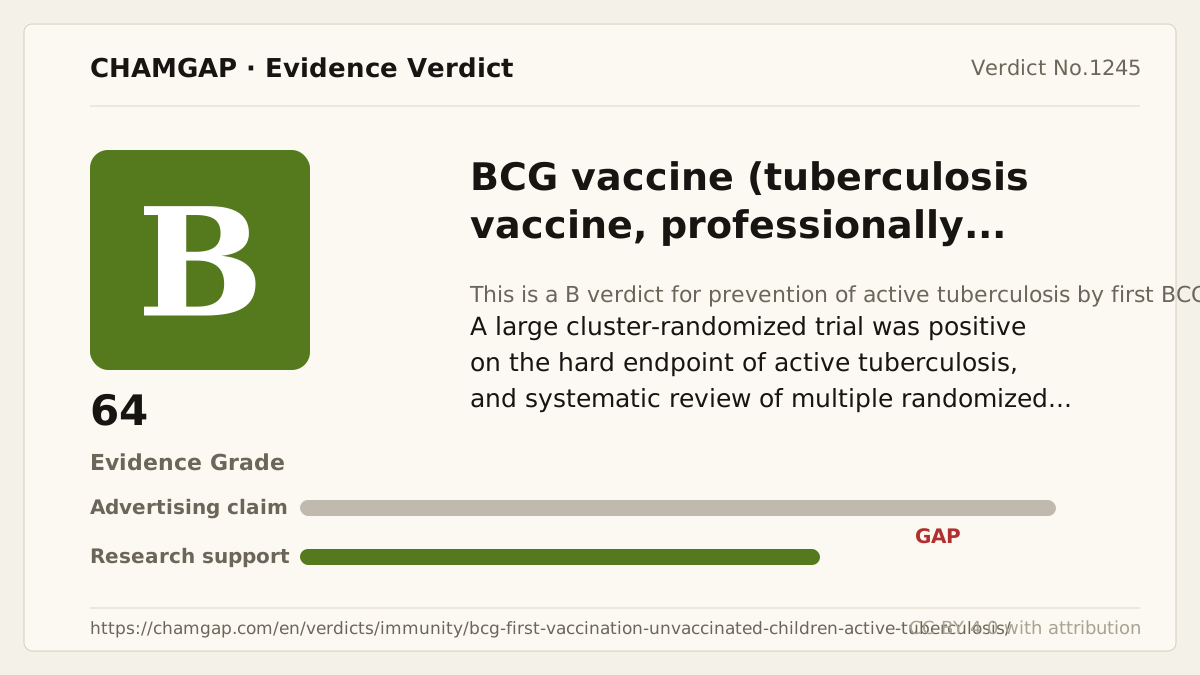
[Chamgap] Does a first BCG vaccination reduce active tuberculosis in previously unvaccinated children? — Evidence Grade B·64. 5 cited sources checked. Source: https://chamgap.com/en/verdicts/immunity/bcg-first-vaccination-unvaccinated-children-active-tuberculosis/ · CC BY 4.0CC BY 4.0 — free to use with attribution; do not distort grades, numbers, or verdict meaning.
What this document does and does not do
Chamgap is an information source. It reports what research has and has not confirmed; it does not tell readers what to take or buy. That decision belongs to readers and, when needed, medical or legal professionals. This verdict reflects literature available up to the search date and may change as new research appears. Nothing here is medical advice.