
Antipyretics during fever,
does it really help with Prevention of febrile-seizure recurrence during later febrile illnesses?
research showsThe grade is D with 30 points. Rosenbloom et al. pooled three distinct randomized trials with 540 children. Recurrence over one to two years occurred in 79/348 (22.7%) receiving antipyretics and 47/192 (24.4%) receiving placebo, OR 0.90 (95% CI 0.57-1.43). Repeated null results were present, but the interval still allowed a 43% reduction in the odds of recurrence. With no validated clinical threshold or prespecified equivalence margin, meaningful benefit was not excluded, so this is D rather than F.
ads claimLowering temperature or improving comfort is a different claim from preventing a future febrile seizure. Evidence for one cannot substitute for the other.
Useful facts when choosing a product
- Pooled absolute recurrence was 22.7% versus 24.4%.
- The ibuprofen trial observed 31/111 versus 36/119 recurrences.
- The Strengell antipyretic comparison was 23.4% versus 23.5%.
Chamgap Semantic Classification Code
Candidate index · review held
UNK.prophylactic-acetaminophen.UNK.febrile-seizure-recurrence-during-later-febrile-illnesses.prevent.MULTIUnknown > Prophylactic acetaminophen > Unknown > febrile-seizure recurrence during later febrile illnesses > Occurrence-prevention claim > Multiple: primary unresolved
An automated migration candidate, not an issued permanent code; exact claim scope remains under review. This machine-generated migration candidate helps retrieval but is not a permanent assignment. The original verdict ID and URL remain authoritative.
What the research actually shows
Rosenbloom, Finkelstein, Adams-Webber, and Kozer pooled three placebo-controlled randomized trials with 540 children. These were distinct enrollments and protocols rather than repeated re-analysis of one dataset, although Uhari 1995 and Strengell 2009 shared some investigators. Of the children, 348 received acetaminophen 15 mg/kg, ibuprofen 5-10 mg/kg, or diclofenac 1.5 mg/kg, and 192 received placebo. An ibuprofen trial randomized 111 versus 119 children and observed first recurrence in 31 versus 36; two-year probabilities were 32% versus 39%, hazard ratio 0.90 (0.60-1.50). Strengell's double-blind factorial trial found 46/197 (23.4%) with any antipyretic strategy versus 8/34 (23.5%) with complete placebo, difference 0.2 points (95% CI -12.8 to 17.6), P=.99. An older acetaminophen trial was also null, but its public abstract did not provide adequate drug-specific absolute denominators. Funding for every underlying trial could not be directly verified and was not assumed independent.
Why this is classified as D (30)
Repeated null trials included acetaminophen and ibuprofen, but the pooled interval of 0.57-1.43 did not exclude substantial benefit, giving D with 30 points rather than F.
Counterpoint. This verdict does not deny the separate use of correctly dosed antipyretics for comfort.
Rejudgment record. Cross-check applied — Cross-checked absolute recurrence, drug-specific trials, distinct study networks, time horizons, and the benefit-side confidence bound before retesting the F criteria
| Endpoint | H | Hard endpoint - actual events such as death |
| Replication | RX | Repeatedly refuted in the same indication |
| Independence | I1 | Mixed funding sources |
| Effect size | E0 | Null |
| Precision | C0 | The confidence interval leaves room for benefit |
Stored derived and displayed grades match; this is not a current recalculation or validity check (D).
Sub-claim grades by effect
This ingredient is marketed for several effects. A single overall grade blends strong and weak claims together, so each effect is graded separately here. The overall grade reflects the strongest disconfirming or core claim.
| Effect (sub-claim) | Grade | Basis |
|---|---|---|
| Prevention of recurrence in later febrile episodes | D | Trials were repeatedly null, but the pooled interval allowed substantial benefit. |
| Prevention of recurrence within the same fever episode | C | One acetaminophen study reported 9.1% versus 23.5%, but this is a separate time horizon. |
Cross-check — AI research and Codex final gate
Evidence Table
| Study | Design | Sample | Funding | Endpoint | Result | Weight |
|---|---|---|---|---|---|---|
| Rosenbloom et al. 2013 | Meta-analysis of three placebo-controlled randomized trials | 540 children; 348 antipyretic and 192 placebo | Funding for all individual trials could not be verified | Febrile-seizure recurrence during one to two years | 79/348 (22.7%) versus 47/192 (24.4%), OR 0.90 (0.57-1.43) | Repeatedly null in the same indication but unable to exclude benefit |
| Strengell et al. 2009 | Five-hospital double-blind randomized factorial trial | 231 children; 197 in antipyretic analyses and 34 complete placebo | Could not be established from publicly accessible reporting | Febrile-seizure recurrence over two years | 46/197 (23.4%) versus 8/34 (23.5%), difference 0.2 points (-12.8 to 17.6), P=.99 | Directly null evidence for aggressive drug-specific antipyretic strategies |
Receipt — 3 References
All 3 cited sources were verified for existence at the original page (as of 2026-08-05).
Final verification and publication gate: Codex · Evidence date: 2026-08-05 · Corrections: none
Cite this verdict
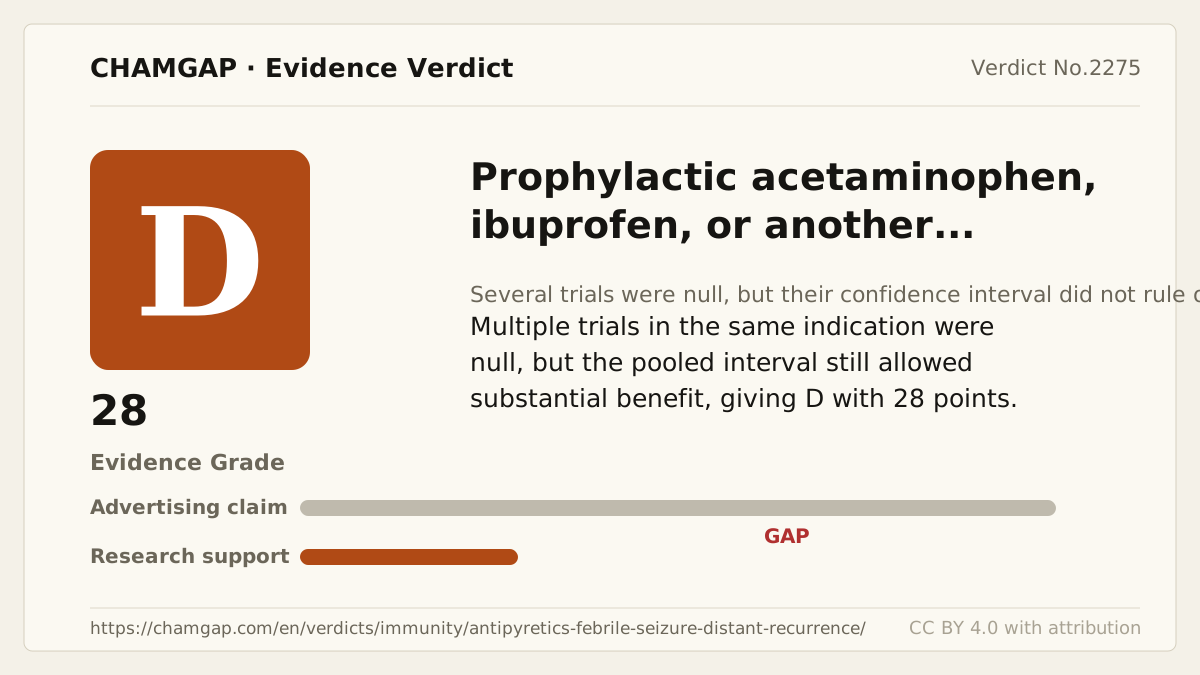
[Chamgap] Antipyretics during fever x recurrent febrile seizures — Evidence Grade D·30. 3 cited sources checked. Source: https://chamgap.com/en/verdicts/immunity/antipyretics-febrile-seizure-distant-recurrence/ · CC BY 4.0CC BY 4.0 — free to use with attribution; do not distort grades, numbers, or verdict meaning.
What this document does and does not do
Chamgap is an information source. It reports what research has and has not confirmed; it does not tell readers what to take or buy. That decision belongs to readers and, when needed, medical or legal professionals. This verdict reflects literature available up to the search date and may change as new research appears. Nothing here is medical advice.