
Amoxicillin-clavulanate,
does it really help with Reduced short-term treatment failure in rigorously diagnosed acute otitis media among infants and toddlers?
research showsThe grade is B. The Finnish trial analyzed all 319 randomized children and found treatment failure in 18.6% versus 44.9%, HR 0.38 (95% CI 0.25 to 0.59), P<0.001. An independent U.S. trial of 291 children reproduced lower clinical failure at days 10 to 12, 16% versus 51%, giving B with 72 points.
ads claimThe effect size comes from children meeting stringent acute symptoms and tympanic-membrane criteria. It should not be transferred to uncertain diagnoses, other ages, or nonspecific ear pain.
Useful facts when choosing a product
- Tähtinen used amoxicillin 40 mg/kg/day plus clavulanate 5.7 mg/kg/day for seven days.
- Hoberman used amoxicillin 90 mg/kg/day plus clavulanate 6.4 mg/kg/day for ten days.
- Both trials required middle-ear effusion and tympanic-membrane bulging under stringent diagnostic criteria.
Chamgap Semantic Classification Code
Candidate index · review held
M.amoxicillin-clavulanate.UNK.short-term-treatment-failure-in-rigorously-diagnosed-acute-otitis-media-and-toddlers.reduce.placeboMedicinal interventions > Amoxicillin-clavulanate > Unknown > short-term treatment failure in rigorously diagnosed acute otitis media and toddlers > Reduction claim > Placebo
An automated migration candidate, not an issued permanent code; exact claim scope remains under review. This machine-generated migration candidate helps retrieval but is not a permanent assignment. The original verdict ID and URL remain authoritative.
What the research actually shows
Tähtinen randomized 319 children aged 6 to 35 months, 161 versus 158, and analyzed all as assigned; failure was 18.6% versus 44.9%, difference -26.3 percentage points (95% CI -36.5 to -16.1), HR 0.38 (0.25 to 0.59). Hoberman randomized and analyzed 291 children aged 6 to 23 months; failure at days 10 to 12 was 16% versus 51%, difference -35 percentage points (95% CI -45 to -25). The first used European pediatric infectious-disease and Finnish nonprofit foundation and hospital support, the second NIAID funding, and author lists did not overlap. Adverse-event rates were diarrhea 47.8% versus 26.6% and eczema 8.7% versus 3.2% in Tähtinen, and diarrhea 25% versus 15% and diaper-area dermatitis 51% versus 35% in Hoberman.
Why this is classified as B (72)
Two independent publicly funded blinded trials substantially reduced clinical treatment failure, but the evidence is confined to short acute treatment, giving B with 72 points.
Counterpoint. Diarrhea was common and antibiotic resistance makes diagnostic certainty important.
Rejudgment record. Cross-check applied — Two independent publicly funded blinded trials substantially reduced short-term clinical failure in rigorously diagnosed young children
| Endpoint | P | Symptom or function itself is the target - including patient reports and performance tests |
| Replication | R2 | Independently replicated across trials |
| Independence | I2 | Decisive evidence is publicly or non-profit funded |
| Effect size | E+ | Meets the clinically important threshold |
Stored derived and displayed grades match; this is not a current recalculation or validity check (B).
Sub-claim grades by effect
This ingredient is marketed for several effects. A single overall grade blends strong and weak claims together, so each effect is graded separately here. The overall grade reflects the strongest disconfirming or core claim.
| Effect (sub-claim) | Grade | Basis |
|---|---|---|
| Reduced short-term treatment failure in rigorously diagnosed infant acute otitis media | B | Two independent trials reproduced large absolute differences. |
Cross-check — AI research and Codex final gate
Evidence Table
| Study | Design | Sample | Funding | Endpoint | Result | Weight |
|---|---|---|---|---|---|---|
| Tähtinen PA et al. 2011 | Double-blind placebo-controlled randomized trial | 319 randomized, 161 versus 158, with all 319 analyzed | European Society for Paediatric Infectious Diseases fellowship and Finnish nonprofit foundation and hospital research funds | Time to first treatment failure | Failure 18.6% versus 44.9%; HR 0.38 (95% CI 0.25 to 0.59), P<0.001 | Pivotal all-randomized evidence |
| Hoberman A et al. 2011 | Double-blind placebo-controlled randomized trial | 291 randomized and analyzed | U.S. National Institute of Allergy and Infectious Diseases | Clinical failure at days 4 to 5 and 10 to 12 | Clinical failure at days 10 to 12 was 16% versus 51%, P<0.001 | Independent replication evidence |
Receipt — 2 References
All 2 cited sources were verified for existence at the original page (as of 2026-08-01).
Final verification and publication gate: Codex · Evidence date: 2026-08-01 · Corrections: none
Cite this verdict
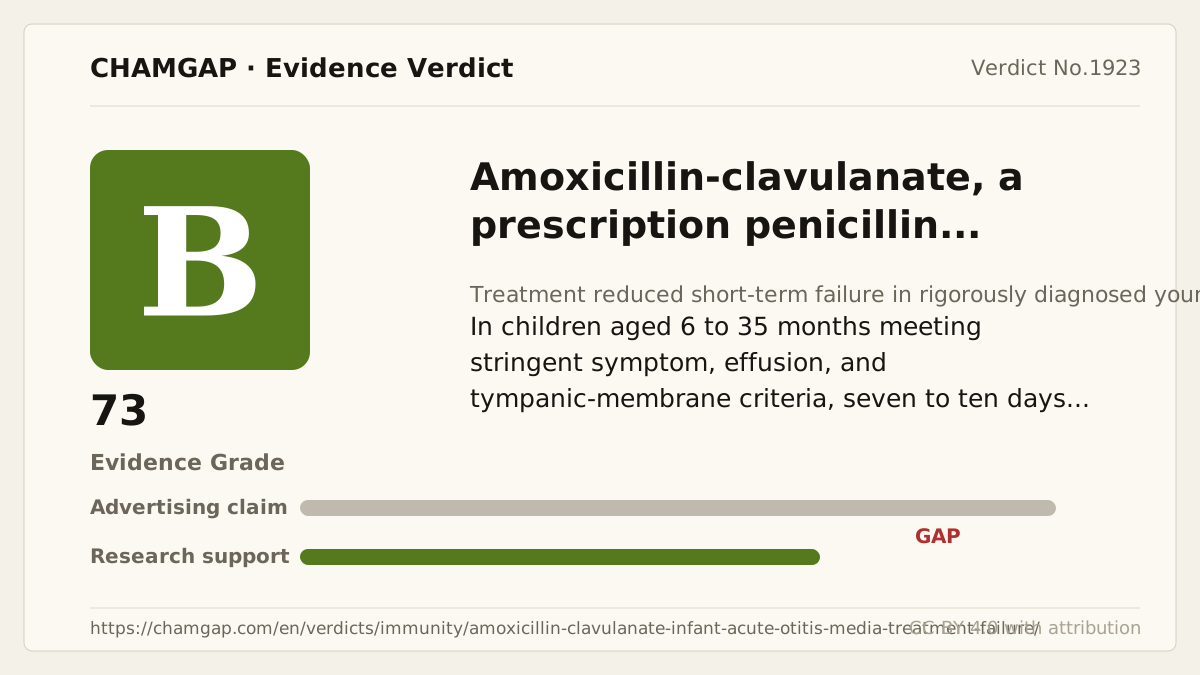
[Chamgap] Amoxicillin-clavulanate x treatment failure in infant acute otitis media — Evidence Grade B·72. 2 cited sources checked. Source: https://chamgap.com/en/verdicts/immunity/amoxicillin-clavulanate-infant-acute-otitis-media-treatment-failure/ · CC BY 4.0CC BY 4.0 — free to use with attribution; do not distort grades, numbers, or verdict meaning.
What this document does and does not do
Chamgap is an information source. It reports what research has and has not confirmed; it does not tell readers what to take or buy. That decision belongs to readers and, when needed, medical or legal professionals. This verdict reflects literature available up to the search date and may change as new research appears. Nothing here is medical advice.