
Lumbrokinase,
does it really help with Thrombolysis and prevention of myocardial infarction and stroke?
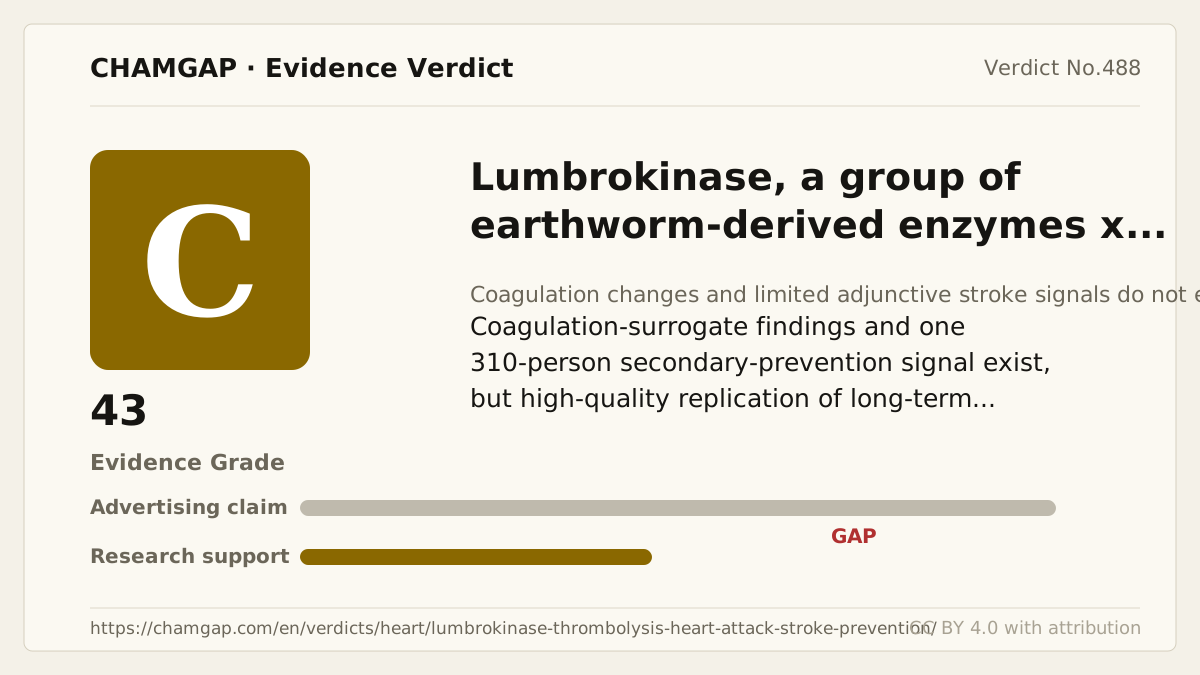
research showsStudies from China and Indonesia report lower fibrinogen, blood viscosity, and D-dimer and better post-stroke functional scores when lumbrokinase is added to standard care. A one-year open trial in 310 participants also reported fewer recurrent cerebrovascular events, so the evidence is not purely preclinical. However, event counts were very small, independent large double-blind replication is absent, and there are no direct data for myocardial-infarction prevention or primary prevention in healthy people, supporting C.
ads claimMarketing uses phrases such as oral thrombolytic enzyme, vessel cleansing, and prevention of myocardial infarction and stroke. Research largely concerns adjunctive treatment after stroke and does not establish emergency recanalization of an occluded vessel or prevention of a first myocardial infarction in healthy people.
Useful facts when choosing a product
- Korean online marketplaces list imported lumbrokinase products using non-equivalent labels such as 20 mg or 600,000 international units.
- The Cao trial added an enteric-coated 600,000-unit capsule three times daily to standard stroke care for one year.
- Milligrams, international units, and manufacturer-specific activity units cannot be converted directly, and earthworm species, enzyme fractions, and enteric formulations create substantial product variation.
- Long-term evidence is insufficient to exclude bruising, bleeding, or gastrointestinal bleeding. It should not be combined independently with anticoagulants, aspirin, or clopidogrel or used instead of prescribed therapy.
Chamgap Semantic Classification Code
Candidate index · review held
UNK.lumbrokinase.UNK.thrombolysis-and-prevention-of-myocardial-infarction-and-stroke.prevent.usual-careUnknown > Lumbrokinase > Unknown > Thrombolysis and prevention of myocardial infarction and stroke > Occurrence-prevention claim > Usual care
An automated migration candidate, not an issued permanent code; exact claim scope remains under review. This machine-generated migration candidate helps retrieval but is not a permanent assignment. The original verdict ID and URL remain authoritative.
What the research actually shows
The 2020 Sukmawan meta-analysis pooled two studies with 727 participants and reported lower fibrinogen and plasma viscosity, while warning about high heterogeneity and the small number of studies. The 2013 Cao trial assigned 310 patients after ischemic stroke or transient ischemic attack to standard care or standard care plus enteric-coated lumbrokinase at 600,000 units three times daily and followed them for one year. Total vascular events were reported in 2.08% of the treatment group and 6.78% of controls, but the study was open-label and had few events. The 180-person open randomized trial by Pinzon in 2021 reported better 30-day National Institutes of Health Stroke Scale and Barthel scores with adjunctive DLBS1033, but the favorable modified Rankin Scale difference was nonsignificant and a manufacturer researcher was an author. A 2025 meta-analysis reported positive functional and coagulation outcomes, but many small Chinese trials, very high heterogeneity, and limited evidence quality prevent confirmation.
Why this is classified as C (43)
Human surrogate outcomes, short-term functional scores, and one 310-person secondary-prevention event signal keep the rating above D. The absence of independent large double-blind event trials and direct myocardial-infarction or primary-prevention evidence supports C with 43 points; bleeding risk and product variation are recorded separately.
Counterpoint. Possible benefit as an adjunct to standard stroke care remains a target for independent trials. Current evidence does not support replacing anticoagulant or antiplatelet treatment.
Rejudgment record. New verdict — Separated surrogate and small adjunctive-treatment outcomes from prevention of clinical cardiovascular events and discounted the low reproducibility of one open event trial
Sub-claim grades by effect
This ingredient is marketed for several effects. A single overall grade blends strong and weak claims together, so each effect is graded separately here. The overall grade reflects the strongest disconfirming or core claim.
| Effect (sub-claim) | Grade | Basis |
|---|---|---|
| Improvement in coagulation surrogates such as fibrinogen, blood viscosity, and D-dimer | C | Positive meta-analytic findings exist, but they come from few, highly heterogeneous, geographically concentrated studies. |
| Prevention of recurrent stroke or transient ischemic attack | C | This rests on one small-event signal from a 310-person, one-year open trial without independent double-blind replication. |
| Prevention of myocardial infarction, primary prevention, or acute thrombolysis | D | No high-quality human trial directly testing these clinical outcomes was identified. |
Cross-check — AI research and Codex final gate
Evidence Table
| Study | Design | Sample | Funding | Endpoint | Result | Weight |
|---|---|---|---|---|---|---|
| Sukmawan YP. 2020 | Systematic review and meta-analysis | 727 | Unknown | Fibrinogen and blood and plasma viscosity | Lower fibrinogen and plasma viscosity were reported, but only two studies were included and heterogeneity was high. | Key surrogate evidence |
| Cao YJ et al. 2013 | Multicenter randomized open-label parallel controlled trial | 1 | Unknown; study product supplied by a Chinese research institute | Total vascular events, recurrent stroke or transient ischemic attack, fibrinogen, carotid measures, and stroke severity | A total-vascular-event signal of 2.08% versus 6.78% was reported, but event counts were small and the trial was unblinded. | Key but limited clinical-event evidence |
| Pinzon RT et al. 2021 | Single-center randomized open-label adjunctive-treatment trial | 30 | A researcher from the DLBS1033 manufacturer was a coauthor | National Institutes of Health Stroke Scale, Barthel Index, and modified Rankin Scale | The stroke-severity and Barthel scores improved, but the difference in modified Rankin Scale below 2 was nonsignificant. | Supportive functional evidence |
| Wiyarta E et al. 2025 | Meta-analysis of randomized trials in acute ischemic stroke | 64 | One author was affiliated with a pharmaceutical company | Stroke severity, Barthel Index, coagulation markers, and safety | Multiple positive results were reported, but heterogeneity often exceeded 90% and the authors urged caution because evidence was limited. | Contextual, low confidence |
Receipt — 4 References
All 4 cited sources were verified for existence at the original page (as of 2026-07-18).
Final verification and publication gate: Codex · Evidence date: 2026-07-18 · Corrections: none
Cite this verdict
[Chamgap] Lumbrokinase x thrombolysis and prevention of myocardial infarction and stroke — Evidence Grade C·43. 4 cited sources checked. Source: https://chamgap.com/en/verdicts/heart/lumbrokinase-thrombolysis-heart-attack-stroke-prevention/ · CC BY 4.0CC BY 4.0 — free to use with attribution; do not distort grades, numbers, or verdict meaning.
What this document does and does not do
Chamgap is an information source. It reports what research has and has not confirmed; it does not tell readers what to take or buy. That decision belongs to readers and, when needed, medical or legal professionals. This verdict reflects literature available up to the search date and may change as new research appears. Nothing here is medical advice.