
Low-dose colchicine,
does it really help with Reduced recurrence of myocardial infarction, stroke, and other major cardiovascular events in coronary disease?
research showsLow-dose colchicine is rated B because two large randomized trials reduced major cardiovascular events in stable coronary disease and after recent myocardial infarction. The primary composite occurred in 6.8% versus 9.6% of 5,522 LoDoCo2 participants and in 5.5% versus 7.1% of 4,745 COLCOT participants. However, CLEAR SYNERGY/OASIS-9, enrolling 7,062 patients treated soon after acute myocardial infarction, was negative at 9.1% versus 9.3%, and neither all-cause nor cardiovascular mortality reduction is established. Repeated benefit on direct clinical outcomes is therefore accepted, but acute-setting inconsistency and uncertain mortality benefit prevent an A and yield B with 73 points.
ads claimPromotion can compress the evidence into a drug that prevents another heart attack or stroke. The actual evidence concerns low-dose add-on therapy to standard care; it does not establish the same benefit for every acute post-infarction patient, mortality reduction, or unrelated inflammatory cardiovascular indications.
Useful facts when choosing a product
- Colchicine does not replace antiplatelet therapy or statins; it is a prescription anti-inflammatory add-on for selected patients with coronary disease.
- Cardiovascular outcome trials generally used 0.5 mg once daily, while the approved indication and dose of each Korean colchicine product must be checked in its prescribing information.
- Diarrhea, nausea, and abdominal pain are common, while bone-marrow suppression, myopathy, and rhabdomyolysis can occur rarely and risks rise with severe kidney or liver impairment.
- Strong CYP3A4 or P-glycoprotein inhibitors can cause fatal toxicity, and muscle toxicity should be monitored when colchicine is combined with certain statins.
Chamgap Semantic Classification Code
Candidate index · review held
M.colchicine.UNK.recurrence-of-myocardial-infarction-stroke-and-other-major-cardiovascular-events-in-coronary-disease.reduce.MULTIMedicinal interventions > colchicine > Unknown > recurrence of myocardial infarction, stroke, and other major cardiovascular events in coronary disease > Reduction claim > Multiple: primary unresolved
An automated migration candidate, not an issued permanent code; exact claim scope remains under review. This machine-generated migration candidate helps retrieval but is not a permanent assignment. The original verdict ID and URL remain authoritative.
What the research actually shows
LoDoCo2 randomized 5,522 patients with chronic coronary disease to colchicine 0.5 mg daily or placebo for a median 28.6 months; the primary composite was 6.8% versus 9.6% (HR 0.69). COLCOT enrolled 4,745 patients within 30 days after myocardial infarction and reduced composite ischemic events from 7.1% to 5.5% (HR 0.77). A 2021 meta-analysis likewise reported reductions in major cardiovascular events, myocardial infarction, stroke, and revascularization. CLEAR SYNERGY/OASIS-9, however, randomized 7,062 patients within 72 hours of PCI for myocardial infarction and found no difference over a median three years, 9.1% versus 9.3% (HR 0.99). Efficacy may depend on population and timing, and mortality benefit remains unproven.
Why this is classified as B (73)
The independent large randomized LoDoCo2 and COLCOT trials receive high weight because they demonstrated reductions in direct major cardiovascular outcomes. The large negative CLEAR SYNERGY/OASIS-9 result and lack of established mortality reduction nevertheless create material inconsistency. The strong-and-consistent threshold for A is not met, so the verdict is B with 73 points; gastrointestinal effects, myotoxicity, and interactions remain separate safety issues.
Counterpoint. Absolute benefit varies with baseline risk and treatment timing. Kidney and liver function, blood counts, concomitant medicines, and muscle symptoms require review, and colchicine should not be self-started or used to treat acute chest pain.
Rejudgment record. New verdict — Gave high weight to the large direct clinical-outcome benefits in LoDoCo2 and COLCOT, but applied B rather than A because the large CLEAR SYNERGY/OASIS-9 trial was negative and mortality reduction remains unestablished
Sub-claim grades by effect
This ingredient is marketed for several effects. A single overall grade blends strong and weak claims together, so each effect is graded separately here. The overall grade reflects the strongest disconfirming or core claim.
| Effect (sub-claim) | Grade | Basis |
|---|---|---|
| Reduced recurrent major cardiovascular events in coronary disease | B | Large positive direct outcomes in LoDoCo2 and COLCOT are offset by the large negative CLEAR SYNERGY trial, limiting consistency. |
| Reduced all-cause or cardiovascular mortality | ? | Individual trials and pooled evidence have not established a mortality reduction. |
| Extension to immediate post-infarction use or other indications | ? | The large immediate-treatment trial was negative, and other indications fall outside the direct evidence assessed here. |
Cross-check — AI research and Codex final gate
Evidence Table
| Study | Design | Sample | Funding | Endpoint | Result | Weight |
|---|---|---|---|---|---|---|
| Nidorf SM et al. LoDoCo2, 2020 | Multicenter randomized double-blind placebo-controlled outcome trial | 5,522 patients with chronic coronary disease | Australian public and research-foundation support; investigator initiated | Composite of cardiovascular death, spontaneous myocardial infarction, ischemic stroke, or ischemia-driven revascularization | The primary outcome fell from 9.6% to 6.8%, HR 0.69 (95% CI 0.57 to 0.83). | Key large positive direct clinical outcome evidence |
| Tardif JC et al. COLCOT, 2019 | Multicenter randomized double-blind placebo-controlled outcome trial | 4,745 patients with recent myocardial infarction | Government of Quebec, Canadian Institutes of Health Research, foundations, and industry support | Composite of cardiovascular death, cardiac arrest, myocardial infarction, stroke, or urgent revascularization hospitalization | The primary outcome fell from 7.1% to 5.5%, HR 0.77 (95% CI 0.61 to 0.96). | Key large positive direct clinical outcome evidence |
| Jolly SS et al. CLEAR SYNERGY/OASIS-9, 2024 | International multicenter 2-by-2 factorial randomized double-blind placebo-controlled outcome trial | 7,062 patients undergoing PCI after acute myocardial infarction | Public and nonprofit support including the Canadian Institutes of Health Research | Composite of cardiovascular death, recurrent myocardial infarction, stroke, or unplanned ischemia-driven revascularization | At a median three years, the primary outcome was 9.1% versus 9.3%, HR 0.99 (95% CI 0.85 to 1.16), showing no benefit. | Large direct negative trial limiting consistency |
Receipt — 4 References
All 4 cited sources were verified for existence at the original page (as of 2026-07-19).
Final verification and publication gate: Codex · Evidence date: 2026-07-19 · Corrections: none
Cite this verdict
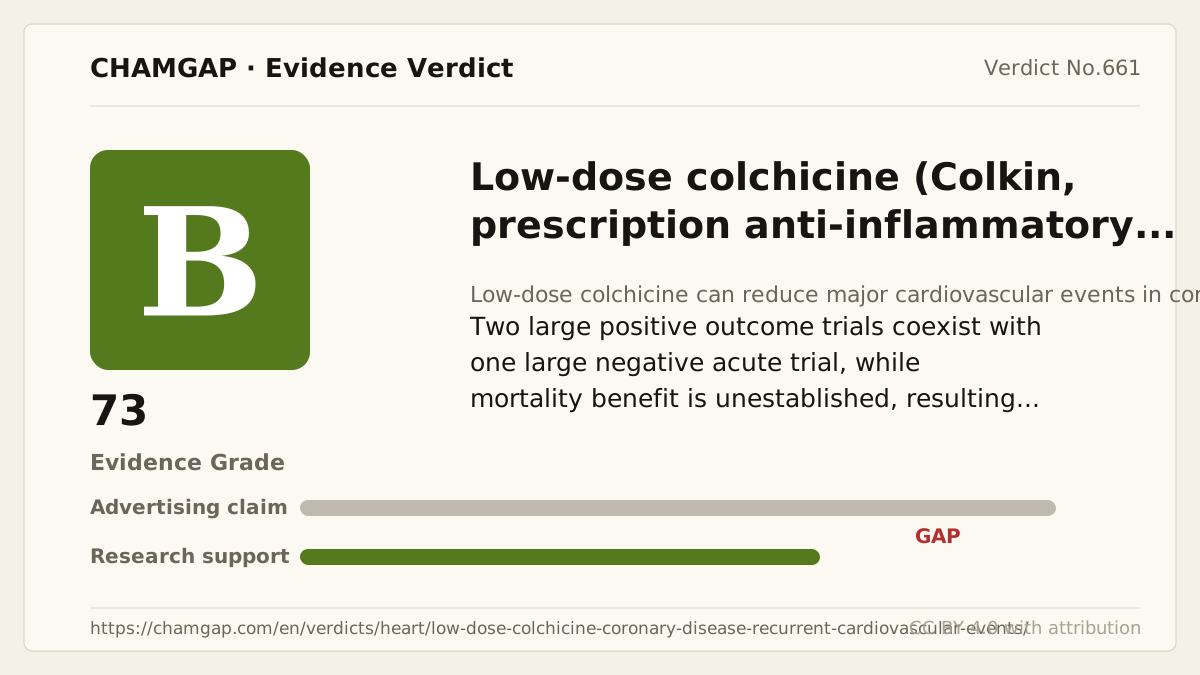
[Chamgap] Low-dose colchicine x reduced recurrent cardiovascular events in coronary disease — Evidence Grade B·73. 4 cited sources checked. Source: https://chamgap.com/en/verdicts/heart/low-dose-colchicine-coronary-disease-recurrent-cardiovascular-events/ · CC BY 4.0CC BY 4.0 — free to use with attribution; do not distort grades, numbers, or verdict meaning.
What this document does and does not do
Chamgap is an information source. It reports what research has and has not confirmed; it does not tell readers what to take or buy. That decision belongs to readers and, when needed, medical or legal professionals. This verdict reflects literature available up to the search date and may change as new research appears. Nothing here is medical advice.