
Dapagliflozin,
does it really help with Reduced composite risk of worsening heart failure or hospitalization and cardiovascular death regardless of diabetes status?
research showsDapagliflozin is rated B because separate large trials in HFrEF and HFmrEF or HFpEF repeatedly reduced the composite risk of worsening heart failure or hospitalization and cardiovascular death. The primary composite hazard ratio was 0.74 in 4,744 DAPA-HF participants and 0.82 in 6,263 DELIVER participants, with no major difference by diabetes status. Both pivotal trials were manufacturer funded, however, and benefit was driven more clearly by fewer worsening-heart-failure events, so extending the result to a certain reduction in cardiovascular death alone is an overstatement. Genital infection, ketoacidosis, volume depletion, hypotension, and early kidney-function changes remain separate safety issues.
ads claimMarketing may present cardiovascular-death reduction as though every component of the composite was certainly reduced. The accurate wording is reduced risk of worsening heart failure or hospitalization and cardiovascular death as a composite, with dapagliflozin added to rather than replacing standard heart-failure therapy.
Useful facts when choosing a product
- Dapagliflozin is an SGLT2 inhibitor generally prescribed at 10 mg once daily for heart failure after checking kidney function, volume status, and overall suitability.
- The heart-failure benefit in DAPA-HF and DELIVER was not explained solely by glucose lowering, and the composite-outcome direction was consistent in participants without diabetes.
- Fasting, acute illness, and the perioperative period can precipitate ketoacidosis even with normal glucose, so temporary interruption should be discussed with a clinician.
- Genital fungal infection, increased urination, volume depletion, hypotension, and an early eGFR decline can occur and warrant clinical monitoring.
Chamgap Semantic Classification Code
Candidate index · review held
M.dapagliflozin.UNK.composite-risk-of-worsening-heart-failure-or-hospitalization-and-cardiovascular-death-regardless-of-diabetes-status.reduce.placeboMedicinal interventions > Dapagliflozin > Unknown > composite risk of worsening heart failure or hospitalization and cardiovascular death regardless of diabetes status > Reduction claim > Placebo
An automated migration candidate, not an issued permanent code; exact claim scope remains under review. This machine-generated migration candidate helps retrieval but is not a permanent assignment. The original verdict ID and URL remain authoritative.
What the research actually shows
DAPA-HF by McMurray and colleagues assigned 4,744 patients with HFrEF to dapagliflozin 10 mg or placebo and assessed worsening heart failure or cardiovascular death. Over a median 18.2 months, events occurred in 16.3% versus 21.2%, for a hazard ratio of 0.74, with similar direction in participants with and without diabetes. DELIVER by Solomon and colleagues followed 6,263 patients with left ventricular ejection fraction above 40% for a median 2.3 years and found 16.4% versus 19.5% for the same composite, a hazard ratio of 0.82. In DELIVER, worsening heart failure was reduced, while cardiovascular death alone had a hazard ratio of 0.88 (95% CI 0.74 to 1.05). Regulatory authorization reflects the trials and scope but is not itself used as the grade basis.
Why this is classified as B (78)
Large placebo-controlled trials in 4,744 HFrEF and 6,263 HFmrEF or HFpEF participants repeatedly reduced direct composite clinical events, with hazard ratios of 0.74 and 0.82. Manufacturer funding was concentrated across both trials and cardiovascular death alone was not significant in DELIVER, so the overall composite cannot be generalized to mortality. High directness and replication, balanced against independence and component limitations, support B with 78 points.
Counterpoint. This verdict concerns the heart-failure evidence for dapagliflozin and does not automatically substitute for other SGLT2 inhibitors or establish separate glucose and kidney claims. Prescribing should account for ejection fraction, kidney function, blood pressure, diuretics, and acute-illness risk.
Rejudgment record. New verdict — Applied upper B because DAPA-HF and DELIVER repeatedly reduced direct worsening-heart-failure or cardiovascular-death composite events across the ejection-fraction range, while accounting for manufacturer funding concentration and uncertainty for cardiovascular death alone
Sub-claim grades by effect
This ingredient is marketed for several effects. A single overall grade blends strong and weak claims together, so each effect is graded separately here. The overall grade reflects the strongest disconfirming or core claim.
| Effect (sub-claim) | Grade | Basis |
|---|---|---|
| Reduced composite risk of worsening heart failure or hospitalization and cardiovascular death | B | Direct composite events were repeatedly reduced in two large trials spanning HFrEF and HFmrEF or HFpEF. |
| Certain reduction in cardiovascular death alone | ? | This is a separate expansion of the composite result, and no consistent human efficacy literature establishes the absolute wording. |
| Universal application to every patient with heart failure regardless of diabetes status | ? | Trial subgroups had consistent direction, but no human efficacy literature establishes universal application in every clinical setting. |
Cross-check — AI research and Codex final gate
Evidence Table
| Study | Design | Sample | Funding | Endpoint | Result | Weight |
|---|---|---|---|---|---|---|
| McMurray JJV et al. 2019 DAPA-HF | Multinational randomized double-blind placebo-controlled event trial | 4,744 patients with HFrEF | Funded by the manufacturer, AstraZeneca | First composite event of worsening heart failure or cardiovascular death | Over a median 18.2 months, rates were 16.3% versus 21.2%, HR 0.74 (95% CI 0.65 to 0.85), with consistent direction by diabetes status. | Pivotal direct-event randomized trial in HFrEF |
| Solomon SD et al. 2022 DELIVER | Multinational randomized double-blind placebo-controlled event trial | 6,263 patients with heart failure and LVEF above 40% | Funded by the manufacturer, AstraZeneca | First composite event of worsening heart failure or cardiovascular death | Over a median 2.3 years, rates were 16.4% versus 19.5%, HR 0.82 (95% CI 0.73 to 0.92), while cardiovascular death alone had HR 0.88 (0.74 to 1.05). | Replicated direct-event randomized trial in HFmrEF and HFpEF |
Receipt — 2 References
All 2 cited sources were verified for existence at the original page (as of 2026-07-19).
Final verification and publication gate: Codex · Evidence date: 2026-07-19 · Corrections: none
Cite this verdict
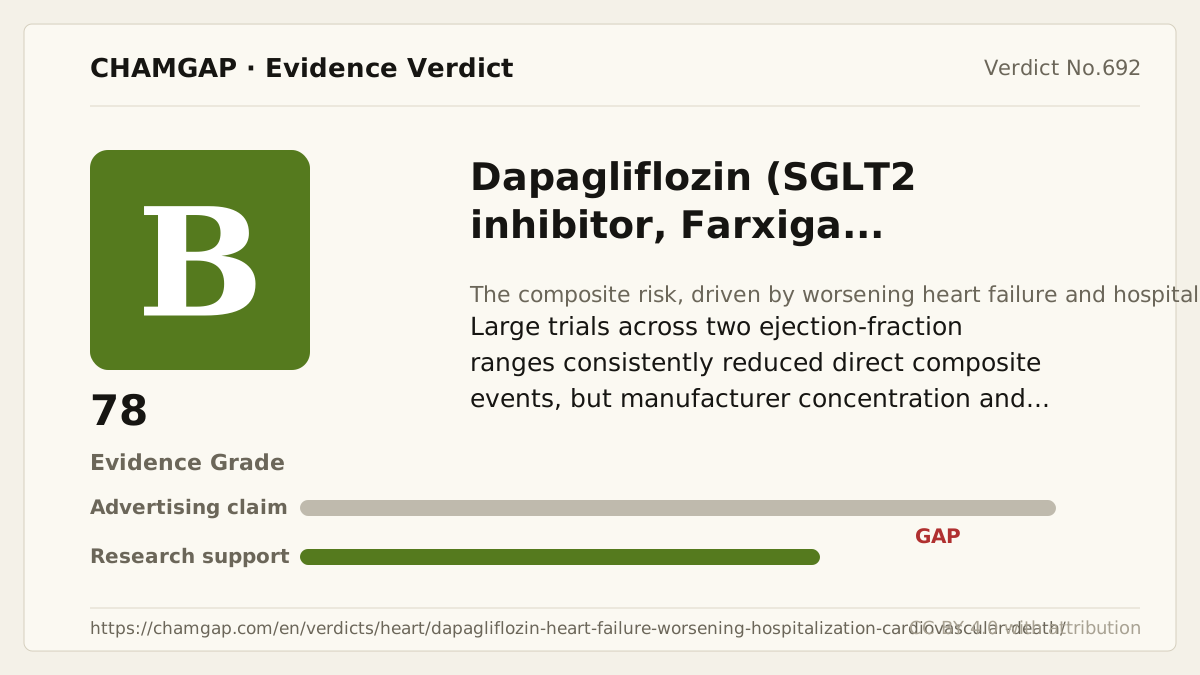
[Chamgap] Dapagliflozin x reduced composite risk of worsening heart failure, hospitalization, and cardiovascular death — Evidence Grade B·78. 2 cited sources checked. Source: https://chamgap.com/en/verdicts/heart/dapagliflozin-heart-failure-worsening-hospitalization-cardiovascular-death/ · CC BY 4.0CC BY 4.0 — free to use with attribution; do not distort grades, numbers, or verdict meaning.
What this document does and does not do
Chamgap is an information source. It reports what research has and has not confirmed; it does not tell readers what to take or buy. That decision belongs to readers and, when needed, medical or legal professionals. This verdict reflects literature available up to the search date and may change as new research appears. Nothing here is medical advice.