
Black raspberry extract,
does it really help with Blood-pressure control?
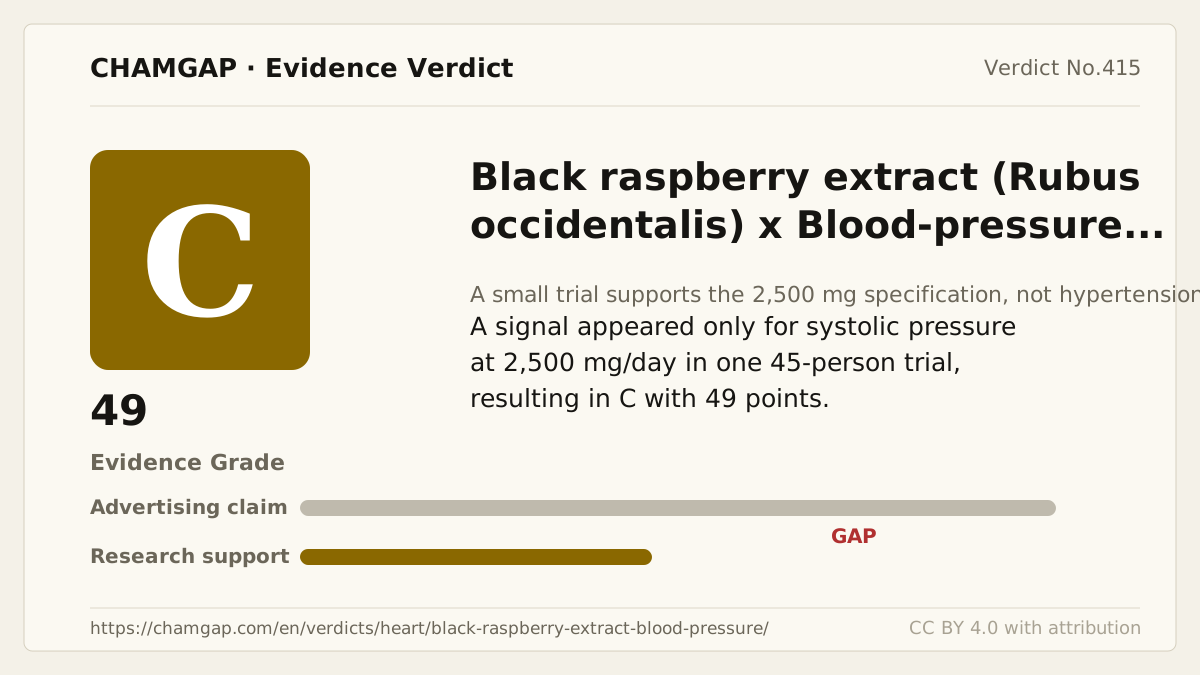
research showsIn an eight-week RCT of 45 adults with prehypertension, the 2,500 mg/day group had lower 24-hour and nighttime systolic blood pressure than placebo, but the 1,500 mg/day group and most other vascular and inflammatory markers were not significant. Small, dose-selective surrogate evidence supports C with 49 points.
ads claimThe color, polyphenols, and antioxidant image of berries do not automatically establish blood-pressure lowering or cardiovascular protection. The ingredient judged here is black raspberry, Rubus occidentalis. Evidence from red raspberry, R. idaeus, or bokbunja, R. coreanus, is neither mixed with nor transferred to this claim.
Useful facts when choosing a product
- The Korean individually recognized intake for black raspberry extract is 2,500 mg/day.
- In the pivotal trial, the blood-pressure signal appeared at 2,500 mg/day, not 1,500 mg/day.
- Korean health-functional and function-labeled products are distributed, but ordinary black raspberry powder or juice is not necessarily equivalent to the recognized extract specification.
- The pivotal RCT tested R. occidentalis extract; evidence from R. idaeus or R. coreanus is not included in this blood-pressure assessment.
- No prominent serious safety signal emerged in the short trial, but evidence for pregnancy, lactation, long-term use, and combination with antihypertensive drugs is insufficient.
Chamgap Semantic Classification Code
Candidate index · review held
S.black-raspberry-extract.UNK.blood-pressure-control.assess.placeboSupplements and nutraceuticals > Black raspberry extract > Unknown > Blood-pressure control > Association or change assessment > Placebo
An automated migration candidate, not an issued permanent code; exact claim scope remains under review. This machine-generated migration candidate helps retrieval but is not a permanent assignment. The original verdict ID and URL remain authoritative.
What the research actually shows
The Jeong 2016 RCT assigned 45 adults with prehypertension to placebo, 1,500 mg/day, or 2,500 mg/day for eight weeks. The high-dose group had reductions in 24-hour and nighttime systolic pressure versus placebo, while most other measurements were not significant. Studies by the same research network examined arterial stiffness and endothelial surrogate markers in metabolic syndrome, but this small trial is the pivotal direct evidence for the blood-pressure claim.
Why this is classified as C (49)
Ambulatory blood pressure is a strength, but the evidence is one eight-week trial of 45 people with only selected high-dose systolic outcomes positive, supporting C with 49 points.
Counterpoint. A short-term systolic-pressure signal remains for the 2,500 mg/day standardized extract. This does not establish diastolic-pressure improvement, hypertension treatment, or cardiovascular-event prevention.
Rejudgment record. New verdict — One eight-week RCT of 45 people found positive 24-hour and nighttime systolic pressure at 2,500 mg/day, while the lower dose and most other markers were null
Cross-check — AI research and Codex final gate
Evidence Table
| Study | Design | Sample | Funding | Endpoint | Result | Weight |
|---|---|---|---|---|---|---|
| Jeong HS et al. 2016 | Randomized double-blind placebo-controlled trial | 45 | Participation by a Gochang black-raspberry research institute; detailed funding unclear | Twenty-four-hour and day-night blood pressure, central pressure, pulse-wave velocity, and inflammatory markers | The 2,500 mg/day dose reduced 24-hour and nighttime systolic pressure; most other markers were not significant. | Key |
| MFDS individually recognized black raspberry extract | Regulatory ingredient information | Not applicable | Recognized function and intake | Registered for helping control blood pressure at 2,500 mg/day. | Product information |
Receipt — 2 References
All 2 cited sources were verified for existence at the original page (as of 2026-07-17).
Final verification and publication gate: Codex · Evidence date: 2026-07-17 · Corrections: none
Cite this verdict
[Chamgap] Black raspberry extract x blood-pressure control — Evidence Grade C·49. 2 cited sources checked. Source: https://chamgap.com/en/verdicts/heart/black-raspberry-extract-blood-pressure/ · CC BY 4.0CC BY 4.0 — free to use with attribution; do not distort grades, numbers, or verdict meaning.
What this document does and does not do
Chamgap is an information source. It reports what research has and has not confirmed; it does not tell readers what to take or buy. That decision belongs to readers and, when needed, medical or legal professionals. This verdict reflects literature available up to the search date and may change as new research appears. Nothing here is medical advice.