
Arjuna bark,
does it really help with Improvement of angina symptoms, exercise tolerance, and cardiac function?
research showsArjuna bark extract is rated C because short-term signals exist for angina symptoms and exercise testing. The pivotal study was a crossover trial in 58 men who received arjuna, a nitrate, and placebo for one week each; a systematic review judged the included 10-to-58-person, four-to-12-week studies small and methodologically poor. Long-term outcomes such as myocardial infarction, hospitalization, and death have not been studied.
ads claimMarketing turns short-term symptom and treadmill signals into heart strengthening, artery cleansing, or prevention of heart attacks. There is no evidence to stop or replace prescribed antianginals, antiplatelets, or statins.
Useful facts when choosing a product
- The studied products were specific alcoholic or water extracts of Terminalia arjuna stem bark and may not match the extraction ratio or standardization of retail capsules.
- The pivotal angina trial used 500 mg every eight hours for one week, which does not establish efficacy or safety of long-term self-treatment.
- Reported adverse events included constipation, headache, body ache, abdominal discomfort, and dizziness and were generally mild, while long-term safety data remain limited.
- Possible pharmacologic overlap with blood-pressure, cardiac, anticoagulant, or antiplatelet medicines warrants clinician review, and chest pain must not be self-treated with a supplement.
Chamgap Semantic Classification Code
Candidate index · review held
S.arjuna-bark.UNK.angina-symptoms-exercise-tolerance-and-cardiac-function.improve.MULTISupplements and nutraceuticals > Arjuna bark > Unknown > angina symptoms, exercise tolerance, and cardiac function > Improvement claim > Multiple: primary unresolved
An automated migration candidate, not an issued permanent code; exact claim scope remains under review. This machine-generated migration candidate helps retrieval but is not a permanent assignment. The original verdict ID and URL remain authoritative.
What the research actually shows
Bharani et al. gave 58 men with provokable ischemia and chronic stable angina arjuna 500 mg three times daily, isosorbide mononitrate 40 mg, and placebo in crossover periods. Arjuna increased exercise duration from 4.76 to 6.14 minutes versus placebo and reduced angina and rescue-drug use. The review by Kaur et al. found poor study design and no significant pooled advantage over controls. In a separate 100-person heart-failure trial, 12 weeks of arjuna did not improve the primary endpoint of left-ventricular ejection fraction.
Why this is classified as C (47)
The direct symptom and exercise-test signals from a short 58-person placebo-controlled trial are accepted, but the systematic review identified poor design and null pooled results, with no long-term cardiovascular events, yielding C with 47 points. Mild adverse effects and possible medicine interactions remain separate safety issues.
Counterpoint. Adjunctive study in stable patients already receiving standard care remains worthwhile. New or worsening chest pain, pain at rest, or breathlessness requires urgent assessment first.
Rejudgment record. New verdict — Accepted angina and treadmill improvements in the 58-man randomized double-blind short crossover trial, but applied rule ① because the systematic review found small samples, poor designs, and null pooled outcomes and no myocardial-infarction or mortality endpoint exists
Sub-claim grades by effect
This ingredient is marketed for several effects. A single overall grade blends strong and weak claims together, so each effect is graded separately here. The overall grade reflects the strongest disconfirming or core claim.
| Effect (sub-claim) | Grade | Basis |
|---|---|---|
| Improvement of angina symptoms and exercise tolerance | C | A short 58-person crossover trial was positive, but the systematic review found weak study quality and pooled results. |
| Improvement of long-term outcomes such as myocardial infarction or death | ? | No human efficacy literature evaluates these long-term clinical outcomes. |
| Definitive cardiac-function improvement beyond small weak studies | ? | No large independent replication exists, and the LVEF primary endpoint was null in a separate 100-person heart-failure trial. |
Cross-check — AI research and Codex final gate
Evidence Table
| Study | Design | Sample | Funding | Endpoint | Result | Weight |
|---|---|---|---|---|---|---|
| Bharani A et al. 2002 | Randomized double-blind placebo- and active-controlled crossover trial | 58 men with chronic stable angina | Not reported in the abstract | Angina frequency, rescue nitrate, exercise duration, ST depression, and recovery time | One week of arjuna improved symptoms and treadmill measures versus placebo and did not significantly differ from isosorbide mononitrate. | Key direct short-term positive trial |
| Kaur N et al. 2014 | Systematic review and limited meta-analysis | 10 to 58 participants per study and four to 12 weeks | Indian government and academic support | Angina, exercise tests, LVEF, and adverse events | Study designs were poor and poolable outcomes did not significantly differ from controls, precluding a firm conclusion. | Key critical synthesis |
| Maulik SK et al. 2016 | Double-blind randomized placebo-controlled add-on trial | 100 people with chronic heart failure over 12 weeks | Funded by the Indian Department of Biotechnology; one author was a Dabur employee | Primary LVEF; six-minute walk, quality of life, BNP, and other outcomes | LVEF and most prespecified secondary outcomes did not improve over placebo; only selected post hoc subgroups were positive. | Direct null evidence for the cardiac-function claim |
Receipt — 3 References
All 3 cited sources were verified for existence at the original page (as of 2026-07-19).
Final verification and publication gate: Codex · Evidence date: 2026-07-19 · Corrections: none
Cite this verdict
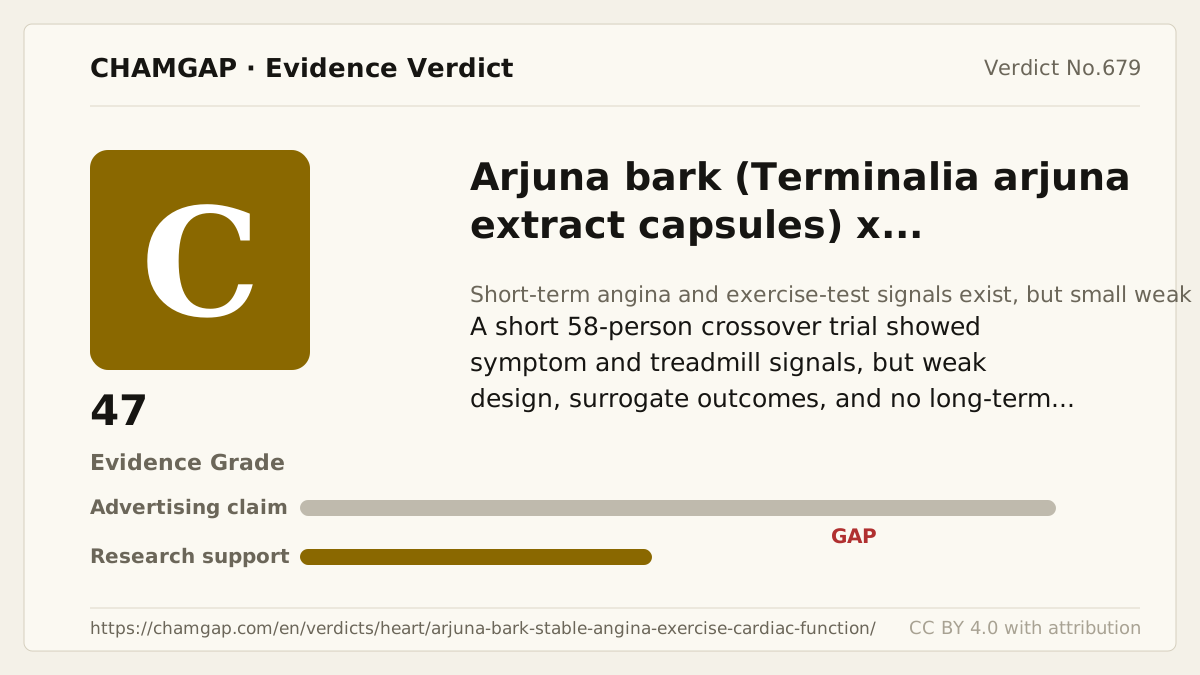
[Chamgap] Arjuna bark x angina, exercise tolerance, and cardiac function — Evidence Grade C·47. 3 cited sources checked. Source: https://chamgap.com/en/verdicts/heart/arjuna-bark-stable-angina-exercise-cardiac-function/ · CC BY 4.0CC BY 4.0 — free to use with attribution; do not distort grades, numbers, or verdict meaning.
What this document does and does not do
Chamgap is an information source. It reports what research has and has not confirmed; it does not tell readers what to take or buy. That decision belongs to readers and, when needed, medical or legal professionals. This verdict reflects literature available up to the search date and may change as new research appears. Nothing here is medical advice.