
L. plantarum 299v,
does it really help with Relief of IBS abdominal pain, gas, and bloating?
research showsFive IBS RCTs specifically testing strain 299v exist, and a 214-person trial reported improvements in abdominal pain and bloating. Positive and null results conflict, however, the studies were generally short, and some key positive evidence was linked to Probi and other industry sources. Certainty is low and the overall rating is B.
ads claimMarketing can imply that any probiotic helps IBS or transfer 299v findings to every L. plantarum product and every probiotic. This verdict applies only to the exact 299v strain, also designated DSM 9843.
Useful facts when choosing a product
- Products sold in or shipped to Korea may label about 10 billion CFU of LP299V per capsule; whether this is guaranteed through the end of shelf life should be checked.
- An L. plantarum product that does not specify 299v or DSM 9843 does not share this evidence.
- Clinical trials generally used about 10 billion CFU daily for four to eight weeks.
- People with severe illness or immunocompromise should discuss probiotic use with a clinician; this safety issue is separate from the efficacy grade.
Chamgap Semantic Classification Code
Candidate index · review held
UNK.lactiplantibacillus-plantarum-299v.UNK.ibs-abdominal-pain-gas-and-bloating.relieve.placeboUnknown > Lactiplantibacillus plantarum 299v > Unknown > IBS abdominal pain, gas, and bloating > Symptom-relief claim > Placebo
An automated migration candidate, not an issued permanent code; exact claim scope remains under review. This machine-generated migration candidate helps retrieval but is not a permanent assignment. The original verdict ID and URL remain authoritative.
What the research actually shows
Five strain-specific IBS RCTs were identified. Ducrotte 2012 randomized 214 people for four weeks and reported improved abdominal-pain frequency and severity and bloating; the study was supported by the Rosell-Lallemand Institute and Probi AB. Stevenson 2014 found no difference in pain, bloating, or quality of life in an 81-person eight-week RCT. Moeen-Ul-Haq 2022 randomized 120 people and found no significant advantage for pain or bloating. Differences in duration, IBS subtype, and endpoints produce conflicting results and low certainty.
Why this is classified as B (65)
Five strain-specific RCTs and a 214-person positive trial support B, while conflicting null results, low certainty, short subjective-outcome studies, and some manufacturer support yield B with 65 points.
Counterpoint. Any benefit may be limited to selected IBS populations and the exact 299v preparation and cannot be transferred to all probiotics.
Rejudgment record. Reassessment (cross-check reflected) — Multiple strain-specific IBS RCTs for 299v, but conflicting positive and null findings, short subjective outcomes, and some Probi links
Sub-claim grades by effect
This ingredient is marketed for several effects. A single overall grade blends strong and weak claims together, so each effect is graded separately here. The overall grade reflects the strongest disconfirming or core claim.
| Effect (sub-claim) | Grade | Basis |
|---|---|---|
| IBS abdominal pain | B | A medium-sized positive RCT coexists with independent null RCTs |
| Gas | B | Some early trials were positive, but repeated findings and endpoints are inconsistent |
| Bloating | B | Positive and null findings conflict and outcomes are largely subjective |
Cross-check — AI research and Codex final gate
Evidence Table
| Study | Design | Sample | Funding | Endpoint | Result | Weight |
|---|---|---|---|---|---|---|
| Ducrotte P et al. 2012 | Randomized double-blind placebo-controlled trial | 214 | Supported by the Rosell-Lallemand Institute and Probi AB | Abdominal-pain frequency and severity and bloating | Pain and bloating improved in the 299v group after four weeks. | Key; industry-supported |
| Stevenson C et al. 2014 | Randomized double-blind placebo-controlled trial | 81 | Partly supported by the Nestle Nutrition Institute Africa and other sources | Abdominal pain, bloating, and quality of life | No significant between-group difference after eight weeks. | Key null result |
| Moeen-Ul-Haq et al. 2022 | Randomized controlled trial | 108 | Unknown | Abdominal pain, bloating, and incomplete evacuation | No significant benefit from adding 299v was confirmed. | Key null result |
Receipt — 3 References
All 3 cited sources were verified for existence at the original page (as of 2026-07-16).
Final verification and publication gate: Codex · Evidence date: 2026-07-16 · Corrections: none
Cite this verdict
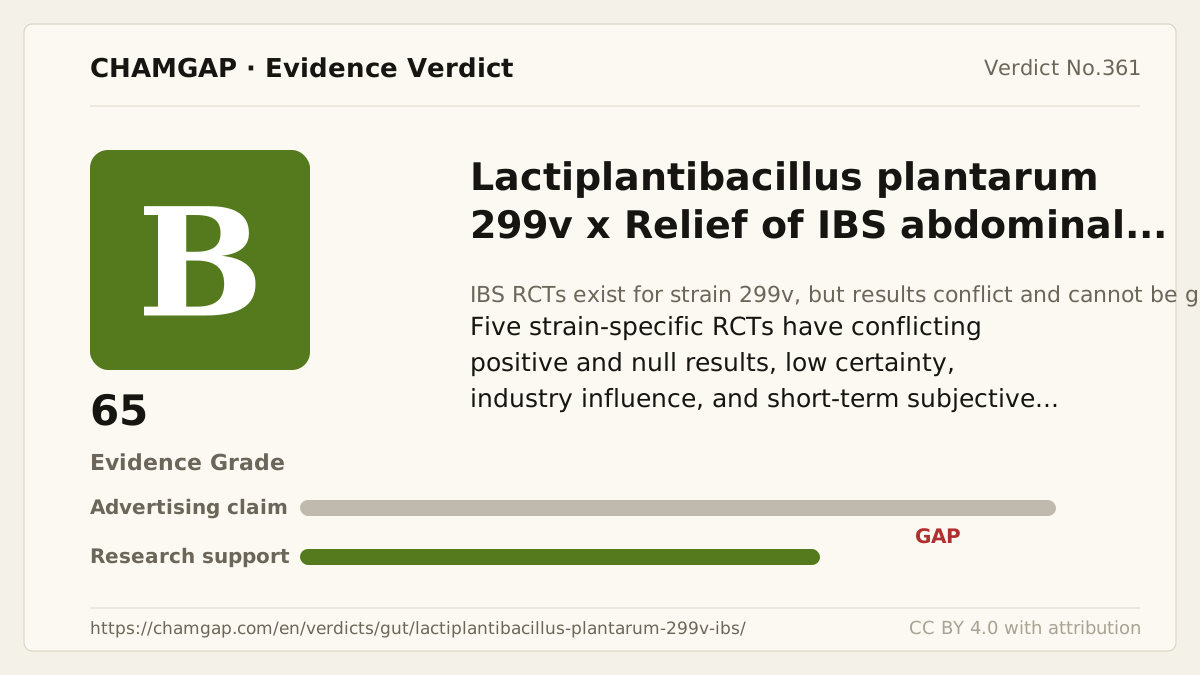
[Chamgap] L. plantarum 299v x IBS abdominal pain, gas, and bloating — Evidence Grade B·65. 3 cited sources checked. Source: https://chamgap.com/en/verdicts/gut/lactiplantibacillus-plantarum-299v-ibs/ · CC BY 4.0CC BY 4.0 — free to use with attribution; do not distort grades, numbers, or verdict meaning.
What this document does and does not do
Chamgap is an information source. It reports what research has and has not confirmed; it does not tell readers what to take or buy. That decision belongs to readers and, when needed, medical or legal professionals. This verdict reflects literature available up to the search date and may change as new research appears. Nothing here is medical advice.