
Vitamin D3,
does it really help with Prevention of cancer incidence in generally healthy adults?
research showsVitamin D3 supplementation does not prevent cancer incidence in generally vitamin D-replete adults. In 25,871 VITAL participants, the hazard ratio for invasive cancer was a null 0.96. ViDA in 5,108 participants and D-Health in 21,308 participants were also null, with hazard ratios of 1.01 and 1.02. A high-certainty meta-analysis of 13 randomized trials reported a risk ratio of 0.99. Repeated refutation in large independent trials supports F.
ads claimMarketing converts observational associations between low vitamin D blood concentrations and cancer into a claim that supplementation prevents cancer. Blood concentration can reflect illness, adiposity, and activity, while randomized supplementation results provide the stronger causal test.
Useful facts when choosing a product
- Vitamin D3 is widely distributed in Korea as standalone, multivitamin, and calcium-combination products with doses such as 400 to 2,000 IU/day.
- VITAL tested 2,000 IU/day, ViDA tested 100,000 IU monthly, and D-Health tested 60,000 IU monthly; neither daily nor intermittent regimens established cancer-incidence prevention.
- Correction of vitamin D deficiency and bone-health management are separate efficacy axes. This F verdict does not deny a medical need to treat deficiency.
- Chronic excessive intake can cause hypercalcemia and kidney stones, so combined doses across products and individual clinical status matter.
Chamgap Semantic Classification Code
Candidate index · review held
S.vitamin-d3.UNK.cancer-incidence-in-generally-healthy-adults.prevent.MULTISupplements and nutraceuticals > Vitamin D3 (cholecalciferol) > Unknown > cancer incidence in generally healthy adults > Occurrence-prevention claim > Multiple: primary unresolved
An automated migration candidate, not an issued permanent code; exact claim scope remains under review. This machine-generated migration candidate helps retrieval but is not a permanent assignment. The original verdict ID and URL remain authoritative.
What the research actually shows
VITAL randomized 25,871 adults to vitamin D3 2,000 IU/day or placebo and recorded 1,617 invasive cancers, yielding a hazard ratio of 0.96. ViDA gave an initial 200,000 IU followed by 100,000 IU monthly to 5,108 participants and reported a cancer hazard ratio of 1.01. D-Health gave 60,000 IU monthly for up to five years to 21,308 adults aged 60 to 85 years and reported a hazard ratio of 1.02. A 2022 meta-analysis of 13 trials found risk ratios of 0.99 for incidence and 0.93 for cancer mortality, both null, with high certainty.
Why this is classified as F (12)
VITAL, ViDA, and D-Health are independent large randomized trials, and a high-certainty meta-analysis repeatedly refutes prevention of cancer incidence, supporting F with 12 points. Safety and deficiency correction are separated from efficacy grading.
Counterpoint. Cancer prevention specifically in severely deficient populations remains inadequately tested, and mortality or normal-body-mass-index signals merit research. They do not apply to the current claim of preventing cancer incidence in general adults.
Rejudgment record. New verdict — VITAL, ViDA, and D-Health and a high-certainty randomized-trial meta-analysis repeatedly found no reduction in total cancer incidence among general adults
Sub-claim grades by effect
This ingredient is marketed for several effects. A single overall grade blends strong and weak claims together, so each effect is graded separately here. The overall grade reflects the strongest disconfirming or core claim.
| Effect (sub-claim) | Grade | Basis |
|---|---|---|
| Prevention of total cancer incidence in generally vitamin D-replete adults | F | Multiple independent large randomized trials and a high-certainty meta-analysis were repeatedly null. |
| Reduction in cancer mortality | B | Evidence is divided: some meta-analyses signal about a 13% reduction in cancer mortality, while the large VITAL and D-Health trials were null. |
| Prevention of cancer incidence in people with severe vitamin D deficiency | ? | Deficiency correction may be medically indicated, but adequate large cancer-incidence trials targeted to this population are absent. |
Cross-check — AI research and Codex final gate
Evidence Table
| Study | Design | Sample | Funding | Endpoint | Result | Weight |
|---|---|---|---|---|---|---|
| Manson JE et al. 2019, VITAL | Nationwide multicenter randomized double-blind placebo-controlled factorial trial | 1,617 | Public funding from the United States National Institutes of Health; some study products supplied by industry | Primary total invasive cancer incidence; secondary cancer mortality and site-specific cancers | At 2,000 IU/day, invasive cancer was null with a hazard ratio of 0.96, and the cancer-mortality confidence interval for 0.83 included one. | Key |
| Scragg R et al. 2018, ViDA | Post hoc cancer analysis of a randomized double-blind placebo-controlled trial | 328 | Public support including the Health Research Council of New Zealand | Total invasive and in situ cancer incidence | An initial 200,000 IU followed by 100,000 IU monthly was null with a cancer hazard ratio of 1.01. | Replication |
| Neale RE et al. 2025, D-Health | Large randomized double-blind placebo-controlled trial linked to cancer registries | 2,640 | Public funding from the Australian National Health and Medical Research Council | Total cancer incidence excluding keratinocyte cancers | Monthly 60,000 IU produced no difference, with a cancer hazard ratio of 1.02. | Key replication |
| Cheema HAC et al. 2022 | Systematic review and meta-analysis of randomized trials | 13 | Reported no external funding | Total cancer incidence, cancer mortality, and all-cause mortality | Cancer incidence was null at 0.99 and cancer mortality was null at 0.93, with high certainty. | Synthesis |
Receipt — 5 References
All 5 cited sources were verified for existence at the original page (as of 2026-07-18).
Final verification and publication gate: Codex · Evidence date: 2026-07-18 · Corrections: none
Cite this verdict
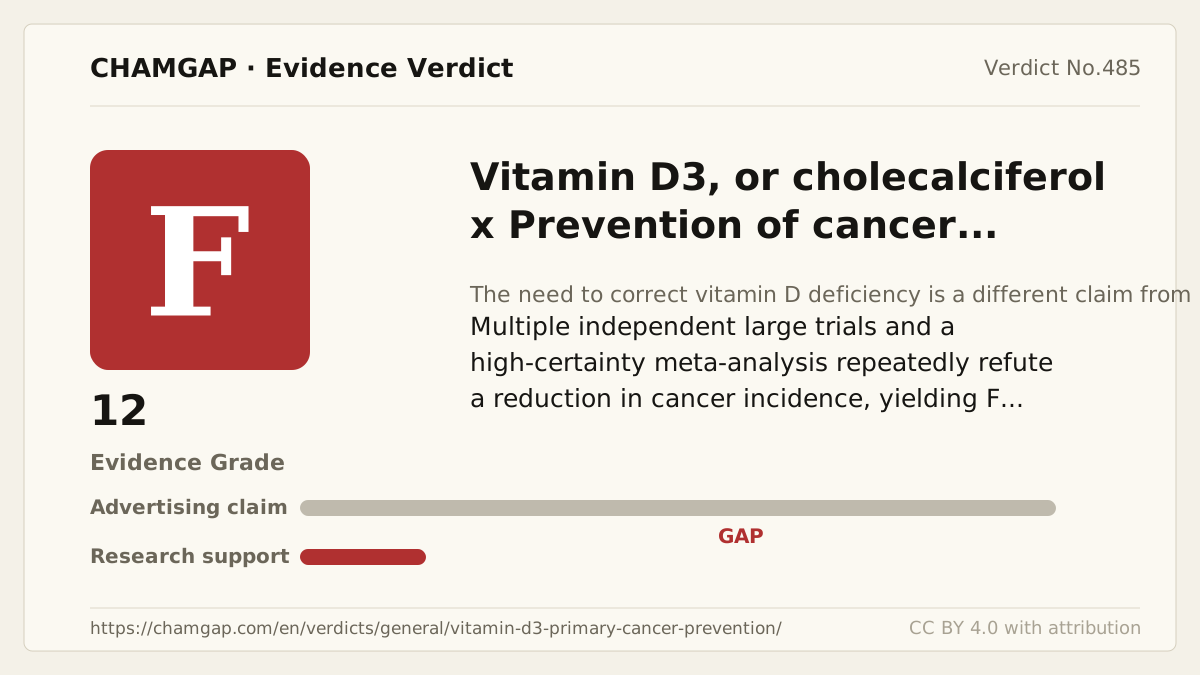
[Chamgap] Vitamin D3 x primary prevention of cancer incidence in adults — Evidence Grade F·12. 5 cited sources checked. Source: https://chamgap.com/en/verdicts/general/vitamin-d3-primary-cancer-prevention/ · CC BY 4.0CC BY 4.0 — free to use with attribution; do not distort grades, numbers, or verdict meaning.
What this document does and does not do
Chamgap is an information source. It reports what research has and has not confirmed; it does not tell readers what to take or buy. That decision belongs to readers and, when needed, medical or legal professionals. This verdict reflects literature available up to the search date and may change as new research appears. Nothing here is medical advice.