
Tauroursodeoxycholic acid,
does it really help with Slowing ALS progression and extending survival?
research showsAn early 34-person phase 2 trial suggested slower functional decline when TUDCA 2 g/day was added to riluzole, but the confirmatory 18-month TUDCA-ALS phase 3 trial in 336 participants across 25 centers in seven countries was null for the primary ALS Functional Rating Scale-Revised endpoint, survival, and neurofilament light. This decisive null result from one confirmatory phase 3 trial supports D, not F, which would require repeated confirmatory contradiction.
ads claimMarketing and patient discussions turn preclinical phrases such as bile-acid neuroprotection, mitochondrial protection, and reduced motor-neuron death into claims of slower ALS progression. Mechanistic plausibility is not the same as improved function or survival in humans, and the confirmatory trial did not support the latter.
Useful facts when choosing a product
- Consumers in Korea can encounter imported TUDCA supplements such as 250-mg capsules, but these are not equivalent to an approved ALS medicine.
- The phase 2 and phase 3 trials added TUDCA 1 g twice daily, or 2 g/day, to riluzole and other standard care. This equals eight 250-mg capsules daily.
- Purity, content, enteric properties, and impurity control of supplements cannot be assumed to match the investigational medicinal product.
- The phase 3 product was generally well tolerated, with mostly mild gastrointestinal effects, but long-term high-dose self-treatment, hepatobiliary disease, and concomitant medicines warrant specialist review. It must not replace standard ALS care.
Chamgap Semantic Classification Code
Candidate index · review held
UNK.tauroursodeoxycholic-acid.UNK.slowing-als-progression-and-extending-survival.assess.MULTIUnknown > Tauroursodeoxycholic acid > Unknown > Slowing ALS progression and extending survival > Association or change assessment > Multiple: primary unresolved
An automated migration candidate, not an issued permanent code; exact claim scope remains under review. This machine-generated migration candidate helps retrieval but is not a permanent assignment. The original verdict ID and URL remain authoritative.
What the research actually shows
The 2016 Elia proof-of-principle trial assigned 34 patients with ALS receiving riluzole to TUDCA 1 g twice daily or placebo for 54 weeks and reported responder and functional-decline signals. TUDCA-ALS tested this finding in a randomized double-blind phase 3 trial at 25 centers in seven countries; 336 of the planned 440 participants enrolled. At 18 months, the ALS Functional Rating Scale-Revised responder endpoint, survival time, and neurofilament light were all nonsignificant. PHOENIX studied AMX0035, a sodium phenylbutyrate-taurursodiol combination, in 664 participants and was not a confirmatory trial of TUDCA alone.
Why this is classified as D (28)
A small randomized phase 2 signal exists, but the larger 336-person, 18-month multinational phase 3 trial was null for the primary functional endpoint, survival, and biomarkers. One decisive null confirmatory trial supports D with 28 points. PHOENIX cannot establish repeated contradiction because it tested a combination product rather than TUDCA alone.
Counterpoint. Recruitment shortfall and attrition during the coronavirus pandemic leave room for exploratory analyses by progression speed. Post hoc subgroup hypotheses do not reverse the overall phase 3 failure.
Rejudgment record. Reassessment (cross-check reflected) — Prioritized the null functional, survival, and biomarker results from the 336-person, 18-month multinational confirmatory phase 3 trial over the 34-person phase 2 signal, while excluding the AMX0035 PHOENIX combination trial from repeated contradiction of TUDCA alone
Sub-claim grades by effect
This ingredient is marketed for several effects. A single overall grade blends strong and weak claims together, so each effect is graded separately here. The overall grade reflects the strongest disconfirming or core claim.
| Effect (sub-claim) | Grade | Basis |
|---|---|---|
| Slowing functional decline and disease progression in ALS | D | The primary responder endpoint based on the ALS Functional Rating Scale-Revised was null in the single 336-person, 18-month confirmatory phase 3 trial |
| Extending survival in ALS | D | Survival time did not differ significantly in the same single confirmatory phase 3 trial |
Cross-check — AI research and Codex final gate
Evidence Table
| Study | Design | Sample | Funding | Endpoint | Result | Weight |
|---|---|---|---|---|---|---|
| Elia AE et al. 2016 | Randomized double-blind placebo-controlled phase 2 proof-of-principle trial | 34 | Investigator-led, noncommercial support | ALS Functional Rating Scale-Revised responders, functional decline, and safety | An early signal of slower functional decline was reported with add-on TUDCA 1 g twice daily. | Early positive |
| TUDCA-ALS Consortium 2024 | Randomized double-blind placebo-controlled multinational phase 3 trial | 18 | European public and research-consortium support with study product supplied | ALS Functional Rating Scale-Revised responders, survival time, and neurofilament light | The primary endpoint failed, with no significant difference in survival time or the biomarker. | Decisive contradiction |
| Lombardo F et al. 2023 | Phase 3 statistical analysis plan | 336 | TUDCA-ALS consortium | Prespecified responder analysis based on the ALS Functional Rating Scale-Revised and secondary outcomes | The analysis and endpoints were documented before results were announced. | Methodological |
| Paganoni S et al. 2020; PHOENIX 2024 | Phase 2 and subsequent phase 3 trials of AMX0035 | 664 | Amylyx Pharmaceuticals | ALS Functional Rating Scale-Revised, survival, and prespecified primary and secondary outcomes | After an early combination-product signal, PHOENIX failed its prespecified endpoints and the product was withdrawn. | Combination-product context |
Receipt — 5 References
All 5 cited sources were verified for existence at the original page (as of 2026-07-18).
Final verification and publication gate: Codex · Evidence date: 2026-07-18 · Corrections: none
Cite this verdict
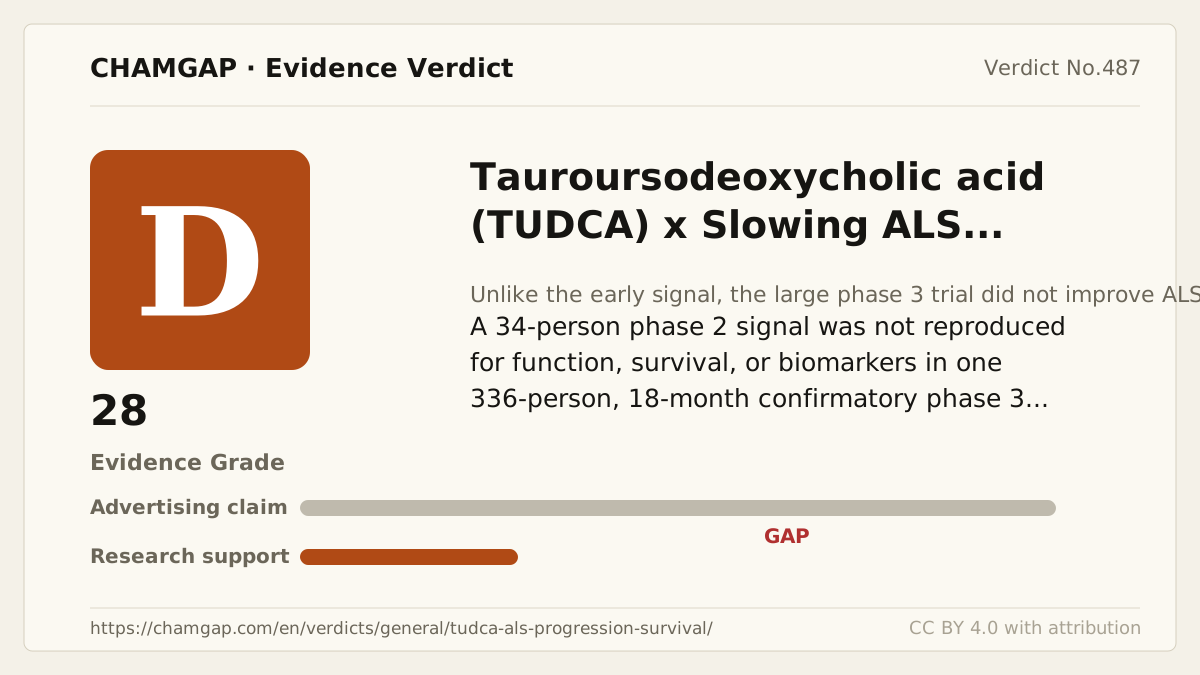
[Chamgap] Tauroursodeoxycholic acid (TUDCA) x slowing ALS progression and extending survival — Evidence Grade D·28. 5 cited sources checked. Source: https://chamgap.com/en/verdicts/general/tudca-als-progression-survival/ · CC BY 4.0CC BY 4.0 — free to use with attribution; do not distort grades, numbers, or verdict meaning.
What this document does and does not do
Chamgap is an information source. It reports what research has and has not confirmed; it does not tell readers what to take or buy. That decision belongs to readers and, when needed, medical or legal professionals. This verdict reflects literature available up to the search date and may change as new research appears. Nothing here is medical advice.