
Saffron extract,
does it really help with Visual function and contrast sensitivity in age-related macular degeneration?
research showsSmall randomized trials and a 100-person crossover trial have tested saffron at 20-30 mg/day in early or moderate AMD, with repeated signals in ERG, contrast sensitivity, or other visual-function measures. Studies remain heavily single-center and short-term; in an open long-term extension, ERG improved while best-corrected visual acuity worsened slightly. Prevention of AMD progression has not been demonstrated, so the grade is C.
ads claimThe evidence cannot be expanded to better vision in healthy people, treatment of AMD, or replacement of AREDS supplements. Participants had AMD, and outcomes were mainly short-term visual function and electrophysiology rather than prevention of blindness or disease progression.
Useful facts when choosing a product
- AMD studies mainly used 20-30 mg/day of saffron for 3-12 months.
- Many saffron supplements sold in Korea are branded extracts or combinations marketed for mood or sleep and may not match the AMD study products or doses.
- Saffron powder, crocin-standardized extracts, and branded extracts should not be treated as interchangeable.
- No major related adverse-event signal emerged at study doses, but caution is appropriate with high doses, pregnancy, anticoagulants, and blood-pressure medication.
Chamgap Semantic Classification Code
Candidate index · review held
S.saffron-extract.UNK.visual-function-and-contrast-sensitivity-in-age-related-macular-degeneration.assess.placeboSupplements and nutraceuticals > Saffron extract > Unknown > Visual function and contrast sensitivity in age-related macular degeneration > Association or change assessment > Placebo
An automated migration candidate, not an issued permanent code; exact claim scope remains under review. This machine-generated migration candidate helps retrieval but is not a permanent assignment. The original verdict ID and URL remain authoritative.
What the research actually shows
The 2010 Falsini crossover trial gave 20 mg/day for three months to 25 patients with early AMD and reported improvement in macular focal ERG amplitude and flicker sensitivity. The 2016 Lashay trial tested 30 mg/day for six months in 60 patients with wet or dry AMD and found an ERG signal at three months, although some effects were no longer present at six months. The 2019 Broadhead study was a double-blind placebo-controlled crossover trial in 100 people with mild or moderate AMD and reported improvement in visual acuity and contrast sensitivity. In the 12-month open extension of 93 participants, multifocal ERG response density improved, but mean best-corrected visual acuity worsened by 1.6 letters.
Why this is classified as C (54)
AMD randomized trials from more than one team support a signal above the lowest evidence tier, but ERG, contrast sensitivity, and short-term vision dominate; progression and blindness-prevention outcomes are absent and extensions are uncontrolled. The result is C with 54 points.
Counterpoint. A short-term adjunctive visual-function effect at 20-30 mg/day in patients with AMD remains plausible.
Rejudgment record. New verdict — Repeated ERG, contrast-sensitivity, and visual-function signals in AMD trials, but limited scale, centers, duration, and no disease-progression outcome
Sub-claim grades by effect
This ingredient is marketed for several effects. A single overall grade blends strong and weak claims together, so each effect is graded separately here. The overall grade reflects the strongest disconfirming or core claim.
| Effect (sub-claim) | Grade | Basis |
|---|---|---|
| Improvement in visual function and ERG in AMD | C | Signals recur in small and crossover randomized trials, but long-term clinical significance is uncertain. |
| Improvement in contrast sensitivity | C | A signal exists, including in a 100-person crossover trial, but evidence is short-term and single-center and cannot be extrapolated to healthy people. |
| Prevention of AMD progression or vision loss | ? | No long-term controlled trial directly demonstrating this outcome was identified. |
Cross-check — AI research and Codex final gate
Evidence Table
| Study | Design | Sample | Funding | Endpoint | Result | Weight |
|---|---|---|---|---|---|---|
| Falsini B et al. 2010 | Randomized placebo-controlled crossover trial | 25 | Public and academic support | Macular focal ERG amplitude and threshold | Focal ERG amplitude increased and threshold improved after 20 mg/day for three months. | Key |
| Broadhead GK et al. 2019 | Randomized double-blind placebo-controlled crossover trial | 100 | No specific commercial grant declared | Best-corrected visual acuity, contrast sensitivity, multifocal ERG, and microperimetry | Signals of improved visual acuity and contrast sensitivity with 20 mg/day in a short-term crossover design. | Key |
| Lashay A et al. 2016 | Randomized double-blind placebo-controlled trial | 60 | Unknown | OCT, ERG, and visual acuity | ERG improved at three months with 30 mg/day, but some effects were absent at six months. | Supportive |
| Broadhead GK et al. 2024 | Twelve-month open-label single-arm extension | 93 | No specific grant | Multifocal ERG and best-corrected visual acuity | Multifocal ERG response density improved, while mean best-corrected visual acuity worsened by 1.6 letters. | Supportive |
Receipt — 4 References
All 4 cited sources were verified for existence at the original page (as of 2026-07-17).
Final verification and publication gate: Codex · Evidence date: 2026-07-17 · Corrections: none
Cite this verdict
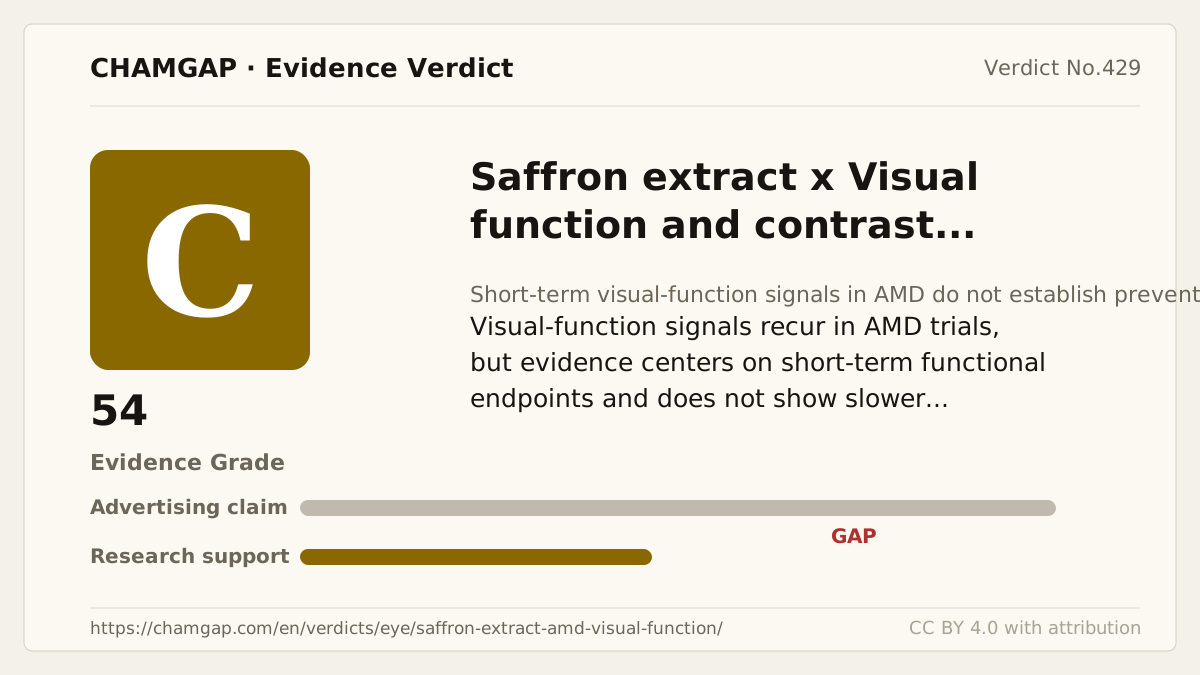
[Chamgap] Saffron extract x visual function and contrast sensitivity in age-related macular degeneration — Evidence Grade C·54. 4 cited sources checked. Source: https://chamgap.com/en/verdicts/eye/saffron-extract-amd-visual-function/ · CC BY 4.0CC BY 4.0 — free to use with attribution; do not distort grades, numbers, or verdict meaning.
What this document does and does not do
Chamgap is an information source. It reports what research has and has not confirmed; it does not tell readers what to take or buy. That decision belongs to readers and, when needed, medical or legal professionals. This verdict reflects literature available up to the search date and may change as new research appears. Nothing here is medical advice.