
Meso-zeaxanthin,
does it really help with Increased macular pigment, improved contrast sensitivity, and reduced glare disability?
research showsCombinations of lutein, zeaxanthin, and meso-zeaxanthin have increased macular pigment optical density and improved some contrast-sensitivity and glare measures in randomized trials. Meso-zeaxanthin, however, was almost always administered in a combination. In a direct 121-person AMD trial, improvements were similar with and without adding 10 mg of meso-zeaxanthin. Its independent contribution is unclear, so the grade is C.
ads claimDescriptions such as 'the third carotenoid that fills the center of the macula,' 'stronger than lutein for glare,' or 'an upgraded AREDS2' run ahead of direct comparisons. AREDS2 did not test meso-zeaxanthin, and combination results should not be advertised as a stand-alone ingredient effect.
Useful facts when choosing a product
- Common study formulations used 10 mg lutein, 2 mg zeaxanthin, and 10 mg meso-zeaxanthin per day, or other ratios of all three carotenoids.
- Products sold in Korea and abroad are usually lutein-zeaxanthin combinations rather than stand-alone meso-zeaxanthin.
- Responses can vary with the macular-pigment method, baseline pigment, and oil or micellar formulation.
- Serious safety signals were uncommon in trials, but long-term stand-alone meso-zeaxanthin data are sparser than combination-product data.
Chamgap Semantic Classification Code
Candidate index · review held
UNK.meso-zeaxanthin.UNK.macular-pigment-improved-contrast-sensitivity-and-reduced-glare-disability.reduce.placeboUnknown > Meso-zeaxanthin > Unknown > macular pigment, improved contrast sensitivity, and reduced glare disability > Reduction claim > Placebo
An automated migration candidate, not an issued permanent code; exact claim scope remains under review. This machine-generated migration candidate helps retrieval but is not a permanent assignment. The original verdict ID and URL remain authoritative.
What the research actually shows
The 36-person Loughman trial reported improved macular pigment and visual function in the lutein-zeaxanthin-meso-zeaxanthin group, but the sample was small and all three carotenoids were given together. The 44-person Connolly placebo-controlled trial also assessed serum and macular responses to a three-carotenoid combination. In the 121-person Akuffo AMD trial, both AREDS2-type combinations improved contrast sensitivity, glare measures, and macular pigment, but results were comparable between the group with an additional 10 mg of meso-zeaxanthin and the group without it. A 2016 meta-analysis of 20 trials found that macular carotenoids increased macular pigment and that increases appeared larger in trials containing meso-zeaxanthin, but it could not isolate ingredient-level causality.
Why this is classified as C (46)
Combination randomized trials and meta-analysis support macular-pigment and some visual-function signals, but the direct add-on comparison was negative and independent contribution cannot be separated. Surrogate endpoints and combination attribution yield C with 46 points.
Counterpoint. Combinations containing meso-zeaxanthin have been studied as one macular-carotenoid strategy, but stand-alone superiority is unproven.
Rejudgment record. New verdict — Positive macular-pigment and visual-function trials of combinations containing meso-zeaxanthin, but no benefit in a direct add-on comparison and unclear independent contribution
Sub-claim grades by effect
This ingredient is marketed for several effects. A single overall grade blends strong and weak claims together, so each effect is graded separately here. The overall grade reflects the strongest disconfirming or core claim.
| Effect (sub-claim) | Grade | Basis |
|---|---|---|
| Increase in macular pigment optical density | C | Repeated with combinations containing meso-zeaxanthin, but it is a surrogate and ingredient-level contribution is not isolated. |
| Improvement in contrast sensitivity and glare disability | C | Positive combination trials exist, but a direct comparison found no difference between formulations with and without added meso-zeaxanthin. |
| Added benefit of meso-zeaxanthin over an AREDS2-type formulation | D | A 121-person direct randomized comparison found no between-group added benefit in primary or secondary visual function or macular pigment. |
Cross-check — AI research and Codex final gate
Evidence Table
| Study | Design | Sample | Funding | Endpoint | Result | Weight |
|---|---|---|---|---|---|---|
| Loughman J et al. 2012 | Single-masked randomized placebo-controlled trial | 36 | Possible industry links | Macular pigment, visual acuity, contrast sensitivity, and glare | Some macular-pigment and visual-function measures improved only in the lutein-zeaxanthin-meso-zeaxanthin group; small combination trial. | Supportive |
| Akuffo KO et al. 2017 | Randomized double-blind head-to-head trial | 121 | Branded formulations and investigator industry links | Contrast sensitivity, glare disability, macular pigment, and reading speed | Both groups improved, but there was no between-group difference with versus without an additional 10 mg of meso-zeaxanthin. | Key |
| Ma L et al. 2016 | Systematic review and meta-analysis of randomized trials | 826 | Unknown | Macular pigment optical density | Macular carotenoids increased macular pigment; trials containing meso-zeaxanthin appeared larger, but this was an indirect comparison of combinations. | Key |
Receipt — 3 References
All 3 cited sources were verified for existence at the original page (as of 2026-07-17).
Final verification and publication gate: Codex · Evidence date: 2026-07-17 · Corrections: none
Cite this verdict
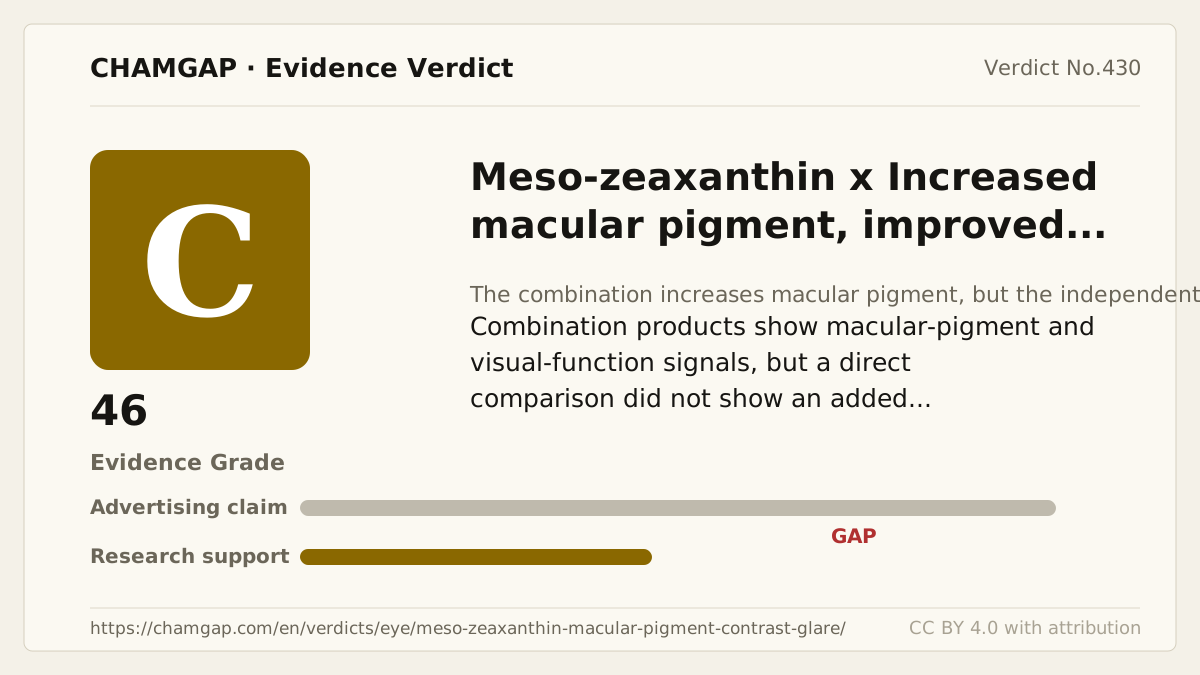
[Chamgap] Meso-zeaxanthin x macular pigment, contrast sensitivity, and glare — Evidence Grade C·46. 3 cited sources checked. Source: https://chamgap.com/en/verdicts/eye/meso-zeaxanthin-macular-pigment-contrast-glare/ · CC BY 4.0CC BY 4.0 — free to use with attribution; do not distort grades, numbers, or verdict meaning.
What this document does and does not do
Chamgap is an information source. It reports what research has and has not confirmed; it does not tell readers what to take or buy. That decision belongs to readers and, when needed, medical or legal professionals. This verdict reflects literature available up to the search date and may change as new research appears. Nothing here is medical advice.