
Riboflavin,
does it really help with Energy production and fatigue improvement?
research showsRiboflavin is an essential component of FAD and FMN in cellular energy metabolism, and prevention or correction of deficiency is established. Severe prolonged deficiency can cause anemia, weakness, and fatigue. Evidence that extra riboflavin improves fatigue or perceived energy in adequately nourished people is weak. Separating deficiency correction from non-deficient experience yields an overall C.
ads claimA nutrient-function statement such as 'necessary for energy production' should not be read as immediate stimulation or fatigue removal. High-dose 400 mg migraine-prevention studies are outside this fatigue verdict.
Useful facts when choosing a product
- Adult recommended intake is generally 1.3 mg/day for men and 1.1 mg/day for women, 1.4 mg in pregnancy, and 1.6 mg in lactation.
- In Korea it is sold in B-complex products, over-the-counter medicines, and imported 100 mg standalone products; 100 mg is dozens of times the recommended intake.
- Absorption becomes limited above roughly 27 mg in a single dose, and excess can make urine bright yellow.
- Safety at ordinary doses is good and no UL has been set, but this does not prove extra benefit from very high doses.
Chamgap Semantic Classification Code
Candidate index · review held
S.riboflavin.UNK.energy-production-and-fatigue-improvement.improve.UNKSupplements and nutraceuticals > Riboflavin > Unknown > Energy production and fatigue improvement > Improvement claim > Unknown
An automated migration candidate, not an issued permanent code; exact claim scope remains under review. This machine-generated migration candidate helps retrieval but is not a permanent assignment. The original verdict ID and URL remain authoritative.
What the research actually shows
NIH ODS and dietary reference standards establish riboflavin's FAD and FMN coenzyme roles in energy production and cellular function. Deficiency can cause oral and skin lesions and, when severe and prolonged, anemia and weakness, and it is correctable. The 2023 crossover trial by Lee MC (Mon-Chien Lee) and colleagues enrolled 32 participants and reported improved exercise exhaustion and metabolites with the branded Ex PLUS® combination containing B1, B2, B6, and B12; the result cannot be attributed to riboflavin alone. No standalone B2 efficacy trial for perceived energy or fatigue in nutrient-replete adults was identified.
Why this is classified as C (52)
Deficiency prevention and correction and the FAD/FMN coenzyme function are A, while perceived-energy and fatigue improvement in nutrient-replete people is unknown because standalone riboflavin trials are absent. Raising the overall verdict to A or B based only on essentiality would falsely imply non-deficient supplementation efficacy, so the separated overall verdict is C with 52 points.
Counterpoint. Persistent fatigue warrants evaluation for anemia, thyroid disease, sleep problems, depression, infection, medications, and other causes; B2 is not a general stimulant.
Rejudgment record. Reassessment (cross-check reflected) — Applied A to deficiency prevention, correction, and FAD/FMN function and unknown to perceived energy and fatigue in nutrient-replete adults, without transferring essentiality to supplementation efficacy
Sub-claim grades by effect
This ingredient is marketed for several effects. A single overall grade blends strong and weak claims together, so each effect is graded separately here. The overall grade reflects the strongest disconfirming or core claim.
| Effect (sub-claim) | Grade | Basis |
|---|---|---|
| Deficiency prevention and correction and energy-metabolism coenzyme function (FAD/FMN) | A | Established essential-nutrient function |
| Improved perceived energy and fatigue in nutrient-replete adults | ? | No standalone human efficacy trial of riboflavin; combination-product results are not attributable to it |
Cross-check — AI research and Codex final gate
Evidence Table
| Study | Design | Sample | Funding | Endpoint | Result | Weight |
|---|---|---|---|---|---|---|
| NIH ODS Riboflavin Fact Sheet | Public-agency nutrition evidence summary | U.S. NIH | Function, deficiency, recommended intake, and safety | Establishes FAD and FMN roles in energy production and deficiency manifestations | Key | |
| Institute of Medicine DRI (1998) | National dietary reference standard | U.S. National Academies | Requirement, recommended intake, and deficiency | Defines riboflavin essentiality and intake standards | Key | |
| Lee MC et al. (2023) | Randomized double-blind crossover trial in 32 adults | 32 | Ex PLUS® branded combination; study product supplied by the company | Exercise exhaustion, lactate, and ammonia | Positive combination containing B1, B2, B6, and B12; standalone B2 cannot be isolated | Low |
Receipt — 3 References
All 3 cited sources were verified for existence at the original page (as of 2026-07-16).
Final verification and publication gate: Codex · Evidence date: 2026-07-16 · Corrections: none
Cite this verdict
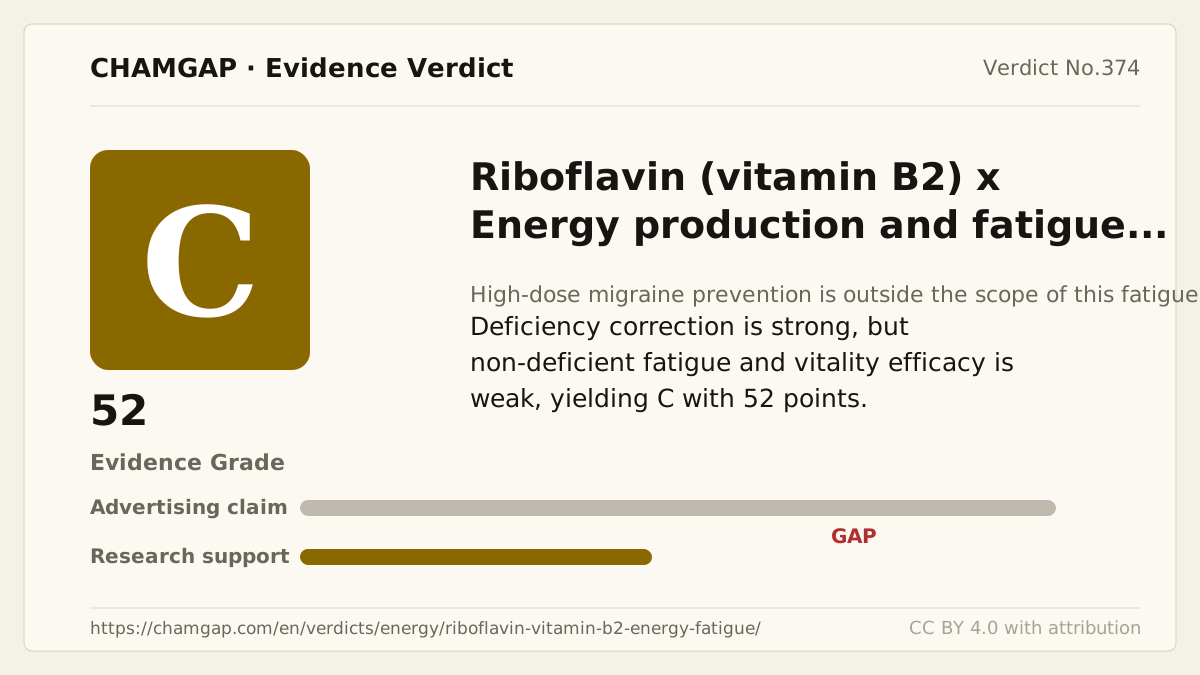
[Chamgap] Riboflavin (vitamin B2) x energy production and fatigue improvement — Evidence Grade C·52. 3 cited sources checked. Source: https://chamgap.com/en/verdicts/energy/riboflavin-vitamin-b2-energy-fatigue/ · CC BY 4.0CC BY 4.0 — free to use with attribution; do not distort grades, numbers, or verdict meaning.
What this document does and does not do
Chamgap is an information source. It reports what research has and has not confirmed; it does not tell readers what to take or buy. That decision belongs to readers and, when needed, medical or legal professionals. This verdict reflects literature available up to the search date and may change as new research appears. Nothing here is medical advice.