
Vortioxetine,
does it really help with Cognitive and processing-speed improvement independent of depression improvement?
research showsVortioxetine is rated B because a meta-analysis of six randomized trials and 1,782 patients repeatedly improved DSST and perceived cognition, while the DSST effect remained an SES of 0.24 after MADRS adjustment. That directly supports a processing-speed claim and is stronger than C. However, most trials lasted eight weeks and were developer-sponsored, while independence from depression is inferred from path analysis and statistical adjustment rather than a separate randomized comparison. Long-term daily functioning remains unknown, yielding a lower-band B score of 66.
ads claimMarketing can turn short-term test-score improvement into claims of eliminating brain fog, restoring job performance, or broadly enhancing cognition. Direct evidence is centered on short-term DSST performance in patients with depression.
Useful facts when choosing a product
- Vortioxetine is a prescription antidepressant for major depressive disorder in adults; it is not a nootropic or cognitive enhancer for healthy people.
- It is generally taken once daily, with the actual dose adjusted for the prescription, tolerability, interacting medicines, and CYP2D6 considerations.
- The United States brand is Trintellix, while Brintellix is used in several other countries. Brand naming does not resolve the evidence gap for long-term cognitive outcomes.
- Nausea is common, and sexual dysfunction, serotonin syndrome, suicidality warnings, and discontinuation symptoms are possible. Tapering from higher doses should be discussed with the prescriber.
Chamgap Semantic Classification Code
Candidate index · review held
M.vortioxetine.UNK.cognitive-and-processing-speed-improvement-independent-of-depression-improvement.improve.placeboMedicinal interventions > Vortioxetine > Unknown > Cognitive and processing-speed improvement independent of depression improvement > Improvement claim > Placebo
An automated migration candidate, not an issued permanent code; exact claim scope remains under review. This machine-generated migration candidate helps retrieval but is not a permanent assignment. The original verdict ID and URL remain authoritative.
What the research actually shows
Huang 2022 pooled six randomized trials and 1,782 participants, finding better DSST, PDQ, and MADRS scores at 10 and 20 mg while calling for longer follow-up. McIntyre 2014 randomized 602 participants for eight weeks and found both doses superior to placebo on a composite cognitive score, with analyses suggesting that most of the effect was independent of depression change. A separate 602-participant CONNECT trial by Mahableshwarkar 2015 also favored vortioxetine on DSST, perceived cognition, and functional capacity, but Takeda and Lundbeck sponsored it. This applies to short-term cognitive symptoms in major depressive disorder, not cognitive enhancement in healthy people or dementia prevention.
Why this is classified as B (66)
Six randomized trials with 1,782 participants repeatedly improved DSST and perceived cognition, and adjusted DSST SES was 0.24, supporting more than C. Evidence is mostly limited to eight weeks and developer-sponsored, while independence from depression rests on statistical adjustment rather than separate randomization and long-term daily function is unknown, giving B with 66 points.
Counterpoint. Short-term DSST improvement is relevant when cognitive symptoms of depression are a treatment target. Medicine selection still needs to integrate mood symptoms, prior response, adverse effects, and cost rather than one cognitive score.
Rejudgment record. New verdict — Accepted repeated DSST and perceived-cognition improvement across six trials and 1,782 participants plus adjusted DSST SES of 0.24 as direct processing-speed evidence, but applied lower B because most trials lasted eight weeks, were developer-sponsored, inferred independence from depression through path analysis and statistical adjustment rather than separate randomization, and lacked long-term daily-function outcomes
Sub-claim grades by effect
This ingredient is marketed for several effects. A single overall grade blends strong and weak claims together, so each effect is graded separately here. The overall grade reflects the strongest disconfirming or core claim.
| Effect (sub-claim) | Grade | Basis |
|---|---|---|
| Improved cognition and processing speed on DSST in depression | B | A six-trial meta-analysis and several large short-term trials improved direct cognitive measures. |
| Daily functioning and long-term cognitive outcomes | ? | Short-term functional-capacity signals exist, but long-term independent clinical outcomes are unavailable. |
| Industry sponsorship and short-duration limitation | ? | This is an evidence limitation rather than an efficacy subclaim and has no separate efficacy finding. |
Cross-check — AI research and Codex final gate
Evidence Table
| Study | Design | Sample | Funding | Endpoint | Result | Weight |
|---|---|---|---|---|---|---|
| Huang IC et al. 2022 | Systematic review and meta-analysis of randomized trials | Six randomized trials and 1,782 participants | Academic Taiwanese review; key included trials were mostly developer-sponsored | DSST, PDQ, and MADRS | DSST, perceived cognition, and depression improved at 10 and 20 mg, but longer follow-up was needed. | Key randomized-trial synthesis |
| McIntyre RS et al. 2014 | Multinational randomized double-blind placebo-controlled trial | 602 adults with major depressive disorder over eight weeks | Sponsored by H. Lundbeck | Composite DSST and RAVLT cognition score with MADRS adjustment | Both 10 and 20 mg improved cognition versus placebo, with analyses attributing most of the effect independently of depression change. | Large direct cognitive trial with industry sponsorship |
| Mahableshwarkar AR et al. 2015 | Randomized double-blind placebo-controlled and duloxetine-referenced trial | 602 patients with major depressive disorder and self-reported cognitive dysfunction over eight weeks | Sponsored by Takeda and H. Lundbeck | DSST, PDQ, UPSA, and MADRS | DSST, perceived cognition, and functional capacity favored vortioxetine, and path analysis suggested a direct effect. | Replicated direct cognitive trial with industry sponsorship |
Receipt — 4 References
All 4 cited sources were verified for existence at the original page (as of 2026-07-19).
Final verification and publication gate: Codex · Evidence date: 2026-07-19 · Corrections: none
Cite this verdict
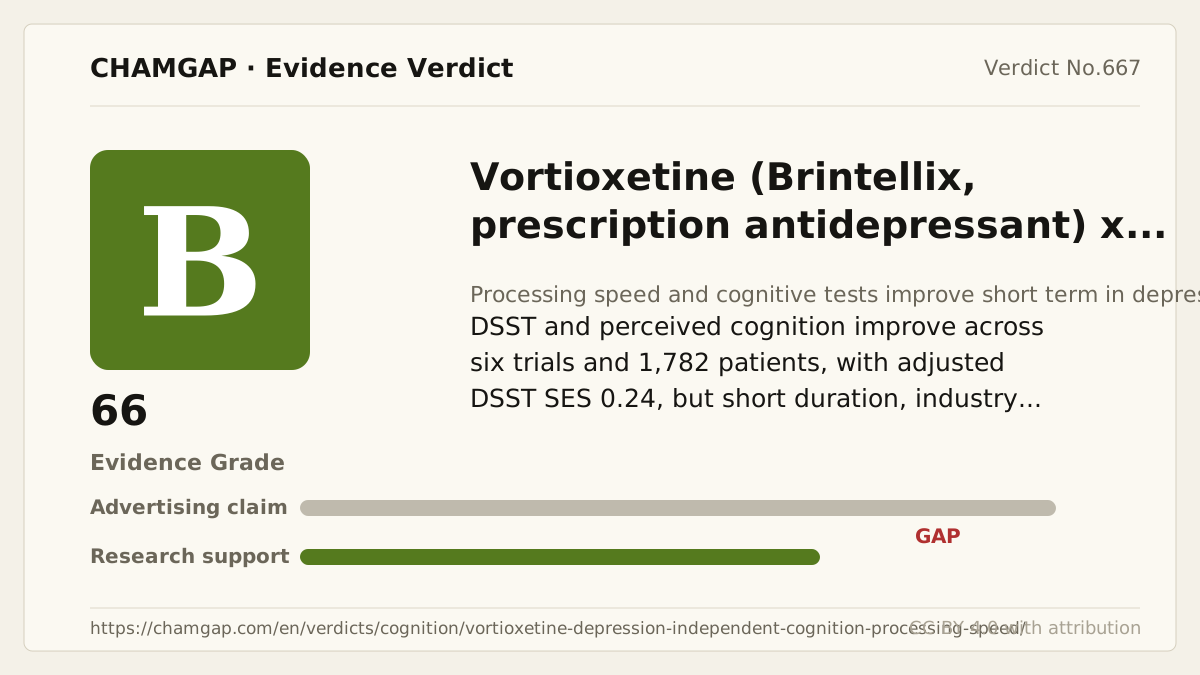
[Chamgap] Vortioxetine x cognitive and processing-speed improvement independent of depression improvement — Evidence Grade B·66. 4 cited sources checked. Source: https://chamgap.com/en/verdicts/cognition/vortioxetine-depression-independent-cognition-processing-speed/ · CC BY 4.0CC BY 4.0 — free to use with attribution; do not distort grades, numbers, or verdict meaning.
What this document does and does not do
Chamgap is an information source. It reports what research has and has not confirmed; it does not tell readers what to take or buy. That decision belongs to readers and, when needed, medical or legal professionals. This verdict reflects literature available up to the search date and may change as new research appears. Nothing here is medical advice.